
How to Use the Free YouTube Video Editor. Filters and Video Enhancements It would be great if everything we shot was perfectly exposed, in focus, and stabilized to give us the perfect footage we wanted.

However, in reality, it doesn't always work like this. So, YouTube includes a number of quick fixes that are designed to help correct problems like this. To find the Quick Fixes, click on any video clip that you want to enhance and look to the right of the preview window to see the options at your disposal, (see image below). SideVibe. Simon's Cat lyhyitä piirrettyjä ilman tekstiä. YouTube. Why Use YouTube In The Classroom. If you like to bring multimedia into your lessons (and who doesn’t?)
Then you probably use YouTube in the classroom from time to time. But there’s a lot to the mega-video site and it’s getting a bazillion hours of video uploaded every minute nowadays. So there’s no shortage of content and the Google folks have done their best to tame the mountain of videos into an easy-to-use resource. YouTube Tools. When most people think about YouTube they think sharing videos and or about all of the videos they can discover.

Most people don't think about the useful editing tools that are built into YouTube. The YouTube video editor has some useful features for teachers and students. 1. Create photo slideshows. The YouTube photo slideshow creation tools allow you to specify the length of time that each image is displayed for. 2. 3. Touchcast. Overstream videotekstitys. Sous-titrez vos vidéos. Voilà trois outils pour appliquer des sous-titres à vos vidéos, dotSUB, Amara et Aegisub, notre préférence Amara car nous venons de découvrir une utilisation collaboratif du CED (Canal éducatif à la demande) avec la Création de sous-titres pour CED & l’Art en Question : tout ce qu’il faut savoir… et aussi Aegisub pour la fonction karaokés.
Utilisation pédagogique : En termes d’utilisation dans le monde, les vidéos en ligne commencent à rivaliser avec la télévision. Au cas où vous réalisez, ou seriez intéressé(e) de réaliser, des vidéos avec vos élèves, il semble logique d’essayer d‘utiliser les outils de sous-titrage disponibles sur Internet pour conférer une toute nouvelle dimension linguistique à vos vidéos. L'article E-Twinning porte sur l'analyse des raisons du sous-titrage, de certains processus associés et vous présente certains outils déjà disponibles sur Internet. Voir le site Voici quelques-uns des avantages liés à l’utilisation de sous-titres dans l’apprentissage des langues : G+ Hangouts. At its core, Google+ Hangouts is simply a souped-up version of video chat.

But when it comes to education, it’s so much more than that. It becomes a vehicle for learning, sharing, collaboration, and ideas. Whether you’re an educator in Alaska, Alabama, Arkansas, Connecticut, Georgia, Iowa, Indiana, discussing learning practices, or a first-grade classroom speaking with an astronaut, Hangouts have seemingly endless possibilities. These are our 50 favorite ways for schools to use Google Plus Hangouts. How do you plan to use this cool tool? Teaching & Administration Professional learning, meetings, even college recruitment are all possible with Hangouts. Campus previews: Using Hangouts, admissions counselors can chat with students and discuss what it’s like to attend their college or university.Professional discussion: Through Google Hangouts, personal learning networks can come together on a regular basis for discussions.Team meetings: Teachers spend enough time at school.
Appear.in. Video conferencing isn’t something most people get excited about.

Until recently, the field has been dominated by the likes of Polycom and Cisco in the enterprise sphere, and Skype and Google Plus picking up the slack in the consumer sphere. Commonly, video conferencing hasn’t been done especially well. For the most part Skype stutters and glitches out more than a Max Headroom marathon, even with a fast internet connection. Meanwhile, users of Google Plus Hangouts are required to sign up for a Google account and install a bulky, bloated plugin before chatting to their mates. Vimeo. TED-Ed.
Creating Video Tutorials. Ever wondered how people show you so clearly what is happening on their computer, like in the Photoshop Video Tutorials we shared with you?
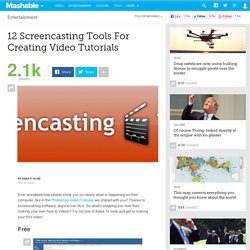
Thanks to screencasting software, anyone can do it. So what's stopping you now from making your own how-to videos? Try out one of these 12 tools and get to making your first video! Free AviScreen - As the name would imply, this capture program records the video into AVI files, but can also do BMP photos. CamStudio.org - An open source program for capturing your on-screen video and audio as AVI files. Copernicus - A free program for Macs that focuses heavily on making quick and speedy films by recording the video to your RAM for quicker access. JingProject.com - Beyond recording video, Jing allows you to take a picture of any portion fo your desktop, draw on it, add a message, and immediately upload your media to a free hosting account.
Wink - Screencasting software that focuses on making tutorials with audio and text annotation abilities. Video Sites. Teleprompter. Twiddla co-op no signing. Creating Videos Without Installing. Over the years I've published some lists and reviews of free tools for creating videos online.

Quite a few of those tools have been for creating simple videos that are really just automated, audio slideshows. See Animoto for an example of this. There's nothing inherently wrong with having your students use those tools, but at some point you will want to take your video projects to the next level. These are the five tools that I recommend for creating and editing videos without installing any special software. Pixorial is the online video creation tool that I hear teachers talking about a lot lately.
WeVideo. What is export time? This is the cumulative length of all your exports.