
Using a Custom White Balance. White balancing means adjusting the color balance in an image to compensate for the color temperature of the illumination source.
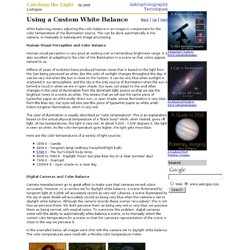
This can be done automatically in the camera, or manually in subsequent image processing. Human visual perception is very good at working over a tremendous brightness range. It is also excellent at adapting to the color of the illumination in a scene so that colors appear natural to us. Millions of years of evolution have produced human vision that is based on the light from the Sun being perceived as white. But the color of sunlight changes throughout the day. The color of illumination is usually described as "color temperature". Digital Cameras and Color Balance Camera manufacturers go to great effort to make sure that cameras record colors accurately. Digital Photography Tutorial: Understanding White Balance. [ Print-friendly ] If you come from the world of films, you may remember using filters to correct for incandescent or fluorescent lighting.
Most people don't bother and their indoors pictures invariably come out with a yellow/orange or bluish cast. In the digital world, these correction filters are no longer necessary, replaced by a feature found in most -- even the entry-level -- digital cameras called, "White Balance. " Light Colour Temperature The reason that pictures turn out with a yellow/orange cast in incandescent (tungsten) lighting and bluish in fluorescent lighting is because light has a colour temperature.
By using an orange or blue filter, we absorb the orange and blue light to correct for the "imbalance" -- the net effect is a shift in the colour temperature. In digital photography, we can simply tell the image sensor to do that colour shift for us.
DIY Grey Card — DiyPhotoBits.com — A few bits and pieces about photography. I was checking out Profotolife’s list of cheapo photo gifts and one of the suggestions was a set of grey cards, and that reminded me I always wanted to do a print my own grey card.
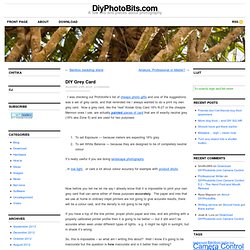
Now a grey card, like the “real” Kodak Gray Card 18% R-27 or the cheapie Mennon ones I use, are actually painted pieces of card that are of exactly neutral grey (18% aka Zone 5) and are used for two purposes: To set Exposure — because meters are expecting 18% greyTo set White Balance — because they are designed to be of completely neutral colour Now before you tell me let me say I already know that it is impossible to print your own grey card that can serve either of these purposes accurately. The paper and inks that we use at home in ordinary inkjet printers are not going to give accurate results, there will be a colour cast, and the density is not going to be right.
So, this is impossible – so what am I writing this about? Discussing Expodisc alternative for Easy White Balance Setting $89.95 vs. $0.05... in DIYPhotography. - Jason W says: If you've done any research on the Expodisc or Expocap products, you may have come across people suggesting the use of a normal disposable coffee filter as an alternative. The results were quite positive. Since I don't own an Expodisc, I can only compare the coffee filter against a white card WB test.
DIY expodisc - Photography Wiki. From Photography Wiki If you have problems to determine the exact white balance in a mixed light environment, there is an easy way to measure white balance.
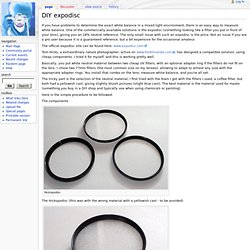
One of the commercially available solutions is the expodisc (something looking like a filter you put in front of your lens), giving you an 18% neutral reference. The only small issue with such an expodisc is the price. Not an issue if you are a pro user because it is a guaranteed reference, but a bit expensive for the occasional amateur. The official expodisc site can be found here: www.expodisc.com Tom Hicks, a extraordinary nature photographer, active on www.fredmiranda.com, has designed a compatible solution, using cheap components. Basically, you put white neutral material between two cheap UV filters, with an optional adapter ring if the filters do not fit on the lens.
Understanding White Balance. White balance (WB) is the process of removing unrealistic color casts, so that objects which appear white in person are rendered white in your photo.

Proper camera white balance has to take into account the "color temperature" of a light source, which refers to the relative warmth or coolness of white light. Our eyes are very good at judging what is white under different light sources, but digital cameras often have great difficulty with auto white balance (AWB) — and can create unsightly blue, orange, or even green color casts. Understanding digital white balance can help you avoid these color casts, thereby improving your photos under a wider range of lighting conditions. Introduction to White Balance.
A Post By: Darren Rowse White Balance is an aspect of photography that many digital camera owners don’t understand or use – but it’s something well worth learning about as it can have a real impact upon the shots you take.

So for those of you who have been avoiding White Balance – let me introduce you to it. I promise to keep it as simple as possible and keep what follows as useable as I can: At its simplest – the reason we adjust white balance is to get the colors in your images as accurate as possible. Why would you need to get the color right in your shots? You might have noticed when examining shots after taking them that at times images can come out with an orange, blue, yellow etc look to them – despite the fact that to the naked eye the scene looked quite normal. White Balance. Article and Photography by Ron Bigelow www.ronbigelow.com Imagine an artist who wants to create an oil painting.
He has the materials, skill, and a beautiful scene before him. There is only one problem. All of his oil paints have a color cast to them. Photography is basically painting with light. To create an image that accurately depicts what the photographer intended, the photographer must be aware of the color of light and must make adjustments when necessary. Color and the Human Brain Unfortunately, the human eye and brain do not always properly interpret light color correctly. When dealing with the color of light, certain matters need to be kept in mind.