
Iceweasel. By Nasca Octavian PAUL Introduction This is a program for stretching the audio.
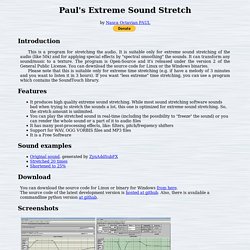
It is suitable only for extreme sound stretching of the audio (like 50x) and for applying special effects by "spectral smoothing" the sounds. It can transform any sound/music to a texture. The program is Open-Source and it's released under the version 2 of the General Public License. Please note that this is suitable only for extreme time stretching (e.g. if have a melody of 3 minutes and you want to listen it in 3 hours). Features It produces high quality extreme sound stretching. Sound examples Download You can download the source code for Linux or binary for Windows from here. Screenshots Usage Before starting, you need to open a WAV, OGG VORBIS or MP3 file. The main window has two main controls: the stretch amount and the audio window. The stretch amount The audio window This program doesn't process the sound as a single piece: it cuts the sound in small pieces and process them.
The playback controls Suggestions. Untitled Document - Iceweasel. Time Frequency Processing (Direct FFT/IFFT Approach) Team Members: 1. Rich McWalter 2. Kai Zhang 1. The approach of the phase vocoder using direct FFT/IFFT is to break down an audio file into user specified blocks and then to process those blocks, add in effects, and then to reconstruct the processed segments to create modified version of the original audio file.
The diagram below is a high level depiction of our understanding and implementation of the above described approach. During the implementation of the code, we found that we had to zero pad the beginning and end of the fft/ifft approach due to a cut off phenomenon at the beginning and end of the samples sound file. Windowing Because by definition of the Fourier Transform, when we take the FFT of something, we assume that it is periodic. Hanning Window A Hanning weighted signal actually is only half there, the other half of it having been removed by the windowing. Blackman Window 2. Robotization Robot.wav Whisperization if r >= maxamp end.
Audio timescale-pitch modification - Wikipedia, the free encyclopedia - Iceweasel. These processes are used, for instance, to match the pitches and tempos of two pre-recorded clips for mixing when the clips cannot be reperformed or resampled. (A drum track containing no pitched instruments could be moderately resampled for tempo without adverse effects, but a pitched track could not).
They are also used to create effects such as increasing the range of an instrument (like pitch shifting a guitar down an octave). Resampling[edit] Phase vocoder[edit] One way of stretching the length of a signal without affecting the pitch is to build a phase vocoder after Flanagan, Golden, and Portnoff. Basic steps: The phase vocoder technique can also be used to perform pitch shifting, chorusing, timbre manipulation, harmonizing, and other unusual modifications, all of which can be changed as a function of time.
Time domain[edit] SOLA[edit] This is much more limited in scope than the phase vocoder based processing, but can be made much less processor intensive, for real-time applications.