
FFTW Home Page. Keep it simple, Stupid! [OMAPL138] Hello DSPLink Program - OMAPL1x Processors Forum - OMAP™ Processors - TI E2E Community - Iceweasel. It's been a few days, no much progress.
![[OMAPL138] Hello DSPLink Program - OMAPL1x Processors Forum - OMAP™ Processors - TI E2E Community - Iceweasel](http://cdn.pearltrees.com/s/pic/th/omapl138-processors-community-5614132)
What I have done is: 1, Re-configured the dsplink using command: perl dsplinkcfg.pl --platform=OMAPL138 --nodsp=1 --dspcfg_0=OMAPL138GEMSHMEM --dspos_0=DSPBIOS5XX --gppos=ARM --comps=ponslrmc --trace=1 --DspTskMode=1 This turns on the trace function. 2, Re-build dsplink following this link: Made some modifications to use 3 script files instead of 2, paths.sh: #! # paths.tcsh # This file simply creates environment variables. . # these variables in build_dsplink.tcsh by passing them on the # command line. export PERL_DIR=/usr/bin export ARM_BASE_BUILDOS=${HOME}/OMAP-L138_arm_1_00_00_11/DaVinci-PSP-SDK-03.20.00.06/src/kernel/linux-03.20.00.06 export ARM_BASE_TOOLCHAIN=${HOME}/CodeSourcery/Sourcery_G++_Lite.
DSPLink POOL FAQs - Texas Instruments Embedded Processors Wiki - Iceweasel. DSP Link is still available for download, but no further releases or updates are planned.
Please see IPC Software Options for details and alternatives. This page contains Frequently Asked Questions for the DSPLink POOL module. The POOL module overview is available here: DSPLink POOL Module Overview Application Programmer Questions I have configured sufficient total pool size of 4Mbytes. OMAP3 DSP MMU Configuration - Texas Instruments Embedded Processors Wiki - Iceweasel. What are TLBs?
The OMAP35xx MMU has Translation Lookaside Buffers (TLB). The TLB is a cache the allows the MMU to accelerate virtual to physical address translation by holding the most recent translations. For example if there is a TLB hit then the translation will be retrieved from the TLB cache. However, with a TLB miss the translation will have to be retrieved from the translation tables which would be a less optimal with regards to performance. For detailed description of the MMU for OMAP35xx see the following manual.
OMAP35x Memory Management Units Reference Guide Who configures TLB entries? DSP MMU Faults - Texas Instruments Embedded Processors Wiki - Iceweasel. Enabling trace in DSPLink - Texas Instruments Embedded Processors Wiki - Iceweasel. DSP Link is still available for download, but no further releases or updates are planned.
Please see IPC Software Options for details and alternatives. Overview In certain kinds of failures seen in applications, sometimes the system just hangs without a kernel crash dump. Or some Operating Systems do not provide such crash dump. In this case, it is useful to enable trace within DSPLink to give information about the APIs and steps that have resulted in the crash/hang. Enabling trace Run the dsplinkcfg.pl static build configuration script to enable trace :::::::::::::::::::::::::::::::::::::::::::::::::::::::::::: DSP/BIOS(TM) LINK Configuration Tool :::::::::::::::::::::::::::::::::::::::::::::::::::::::::::: Enable debug trace?
You can also enable trace when running the dsplinkcfg.pl script from the command line by providing the --trace=1 option. Audio Soc example - Texas Instruments Embedded Processors Wiki - Iceweasel. Introduction The audio Soc example is a demo application that illustrates the use of DSP-side peripheral drivers running in conjunction with a Linux kernel application on a ARM processor for select Texas Instruments Soc (System on a Chip) devices.
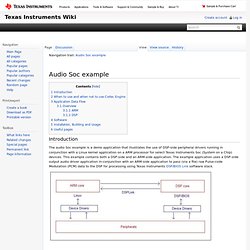
This example contains both a DSP-side and an ARM-side application. The example application uses a DSP-side output audio driver application in-conjunction with an ARM-side application to pass (via a file) raw Pulse-code Modulation (PCM) data to the DSP for processing using Texas Instruments DSP/BIOS Link software stack. Note: This example is not intended to solve system issues when running peripheral drivers on SOC devices (ARM + DSP cores) but as a starting point for developing applications to take advantage of peripheral drivers on both cores.
When to use and when not to use Codec Engine. Example application using DSP Link on OMAPL1x - Texas Instruments eXpressDSP Software Wiki - Iceweasel. DSPLink Memory Map Tutorial [ETH PIXHAWK MAV: Computer Vision on Micro Air Vehicles] - Iceweasel. The memory map is necessary to define the memory areas where Linux and DSP work on.
![DSPLink Memory Map Tutorial [ETH PIXHAWK MAV: Computer Vision on Micro Air Vehicles] - Iceweasel](http://cdn.pearltrees.com/s/pic/th/dsplink-tutorial-computer-5613652)
It can be adjusted to the needs of the application. Instructions how to calculate the size based on the application can be found below. Via the Linux bootloader (u-boot) the Kernel software has to be informed which RAM regions they should use. OMAP3530 Memory sections Note that some of the sections discussed here have a static address range while others can be dynamically assigned (dynamically in the sense of configuration, not during runtime).
Static memory regions The table below gives an overview of the hardwired OMAP3530 memory mapping configuration. Dynamic memory regions The memory sections listed in this section are created during each DSPLink GPP and DSP build depending on the user-specified configuration as discussed further below in this tutorial. CMEM is an API for allocating contiguous memory, hence its name. Computer Vision Software for more details. Using the API. DSPLink API Guide [ETH PIXHAWK MAV: Computer Vision on Micro Air Vehicles] - Iceweasel. Learn here what DSPLink is, what it can be used for and how to use it.
![DSPLink API Guide [ETH PIXHAWK MAV: Computer Vision on Micro Air Vehicles] - Iceweasel](http://cdn.pearltrees.com/s/pic/th/dsplink-pixhawk-computer-5613643)
Category:DSPLink - Texas Instruments Embedded Processors Wiki - Iceweasel. Texas Instruments - Iceweasel. BeagleBoard_DSPLink – OSSIE - Iceweasel. Contents: There are multiple options of how to make use of the onboard TI TMS320C64x+ DSP.
The first step is to install the GPP/DSP interface. Two of the more popular interface options are DSPBridge and DSPLink. Both were developed by TI but DSPLink is still supported, which makes DSPLink a more preferable option. After selecting DSPLink as the GPP/DSP interface, you need to build DSPLink for your specific platform. Building DSPLink inside OpenEmbedded This is generally the preferred method. Although the instructions written at this website were designed around a BeagleBoard which has an OMAP3530 + TMS320C64x+ DSP, the instructions should be compatible across a variety of platforms with only a minimal number of changes.
Introduction to this Guide ¶ This guide will show you how to compile DSPLink from source specifying the target platform as the BeagleBoard. There are two main ways of compiling applications for TI's DSPs. Downloading and Installing Required Files ¶ Linux Kernel ¶ $ . DSPLinkGuide - creation-station - This page is under ongoing construction. I'm hoping it will snowball into an idiot's guide to using the DSPLink on the BeagleBoard. There are a number of resources online for the DSPLink, and this p - Project Hosting on G. After digging around online and chatting it up on the #Beagle IRC channel, it seems like a lot of people are using the BeagleBoard as a tiny ARM/Linux box.
While this is all well and good, the beauty of the OMAP is the DSP sitting next to the ARM. We set out to create our synthesizer using the DSP to generate, filter, and transform audio waveforms; however, much to our dismay, using the DSP is no easy task. Armed (hah, that could be a pun..) with extremely limited Linux skills, this page documents our approach to concurring DSPLink. In the BeagleBoard's OMAP3530 and similar processors, Texas Instruments has included a general purpose processor (ARM) and digital signal processor (DSP).
To speed up development, TI put together an inter-processor communication scheme called DSPLink in an attempt to standardize communication between the GPP and DSP on the OMAP. Cool, so TI did some (read: a bunch) of work for us. It's late, and I'm tired... and I haven't saved this page yet.