
Stuff You Missed in History Class - Download free podcast episodes by HowStuffWorks.com on iTunes. 6 Enlightened Ideas Brought to You by Evil Empires. If history teaches us anything, it's that it's way harder to pick out the good guys from the bad guys than the movies would lead us to believe.

In fact, some of history's most face-blastingly savage regimes came up with some shockingly progressive innovations in health, human rights and, well, everything else. The Nazis Get the Anti-Tobacco Ball Rolling We put this on the list at great risk to our future political careers. You really can't say anything good about the Nazis without it getting taken out of context in a campaign ad, and obviously pointing out that, say, Hitler's soldiers were well-groomed doesn't excuse their many, many, many atrocities. So nothing we're about to say about the Nazis makes us feel even the slightest bit bad about slaughtering them in one video game after another. Your dapper Mechsuit won't save you this time, Hitler. And Yet... They were the first to point out that, hey, tobacco kills people. British occupation of Manila. The resistance from the provisional Spanish colonial government established by members of the Royal Audience of Manila and their Filipino allies prevented British forces from taking control of territory beyond the neighbouring towns of Manila and Cavite.
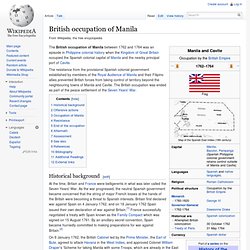
The British occupation was ended as part of the peace settlement of the Seven Years' War. Historical background[edit] At the time, Britain and France were belligerents in what was later called the Seven Years' War. As the war progressed, the neutral Spanish government became concerned that the string of major French losses at the hands of the British were becoming a threat to Spanish interests.
Britain first declared war against Spain on 4 January 1762, and on 18 January 1762 Spain issued their own declaration of war against Britain.[1] France successfully negotiated a treaty with Spain known as the Family Compact which was signed on 15 August 1761. Offensive actions[edit] Occupation of Manila[edit] Resistance[edit] Aftermath[edit] Arnold Toynbee quotes. This Is Civilisation ep.4 (5/6) Pat Robertson: Haiti's Earthquake a Result of Deal with the Devil.
Marshall H.
Cohen Times; color: #000000;">The Haitians I knew at my high school were not exactly the devil-dealing types. Thousands of them had arrived by boat in the early 1990s following Jean-Bertrand Aristide’s (first) ouster. Most knew little English and had not been introduced to such luxuries as deodorant or a high-top fade. Their clothes were out of date. In the American high school social order of things, they raced for the bottom. As a transfer student from the grappling with culture shock of my own, I was mostly confused. Most of all, why the hate? You won’t find satisfying answers in most world history texts. In the wake of the catastrophic earthquake that has claimed thousands of lives, the tenor and emotional response to the people of has returned to a familiar place: Mostly pity, but from the likes of Rush Limbaugh, disdain.
“Something happened a long time ago in , and people might not want to talk about it," he said. “True story. Was clearly his favorite stop. Yamasee War. The Yamasee War (also spelled Yemassee War) (1715–1717) was a conflict between British settlers of colonial South Carolina and various Native American tribes, including the Yamasee, Muscogee, Cherokee, Chickasaw, Catawba, Apalachee, Apalachicola, Yuchi, Savannah River Shawnee, Congaree, Waxhaw, Pee Dee, Cape Fear, Cheraw, and others.
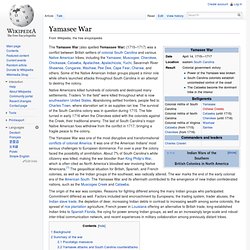
Some of the Native American Indian groups played a minor role while others launched attacks throughout South Carolina in an attempt to destroy the colony. Native Americans killed hundreds of colonists and destroyed many settlements. Traders "in the field" were killed throughout what is now southeastern United States. Abandoning settled frontiers, people fled to Charles Town, where starvation set in as supplies ran low. The survival of the South Carolina colony was in question during 1715. The Yamasee War was one of the most disruptive and transformational conflicts of colonial America.
Background[edit]