
What should be included in my personal statement? Your CV is designed to do one thing and one thing only: to get you an interview.

Yet the average recruiter will only spend between 20 to 30 seconds glancing at your CV which means that you need to make an impression quickly and sell yourself. Your personal statement is your first opportunity to do just that. It is perhaps the single most important part of you CV. Get it wrong and your chances of being invited to interview are drastically reduced. Its aim is to highlight your professional attributes and goals, emphasising why they should continue reading the rest of your CV. Your CV's Personal Statement – Get it Right. CV profiles, personal statements, career aims and objectives. A Career Aim, Personal Statement or Profile can be a useful way of flagging an interest and skills for a particular career on your CV, particularly if you have no relevant degree or work experience to give your CV focus.
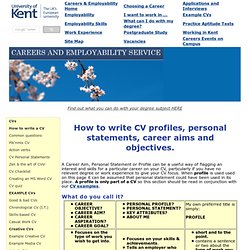
When profile is used used on this page it can be assumed that personal statement could have been used in its place. A profile is only part of a CV so this section should be read in conjunction with our CV examples. What do you call it? Is it necessary? It's not necessary to have a profile but if you do, it must be lively and succinct! What is the difference between a personal statement and a covering letter? A profile is a short introduction to your CV, whereas a covering letter is a one page letter going into much more detail about why you are suitable for a specific job and organisation. Because your profile will be on all your CVs, you normally just mention the particular job sector you are applying for jobs in (e.g. publishing).
Avoid Buzzwords! 13 Most Overused Résumé Phrases. How to turn them into solid examples of talent By Rachel Zupek, CareerBuilder.com writer Throughout your career, you've accomplished many feats, exceeded several goals and mastered countless skills.

Now you're on yet another job hunt and you can't remember a lick of any of it. Such is the importance of keeping your résumé up-to-date, whether you're looking for a job or not. When you don't, not only will you forget the important details that'll help your résumé stand out to employers, but in your rush to submit your application on time you'll end up using the same words and phrases as everyone else - ruining your chances altogether. Career experts always advise job seekers to avoid common résumé mistakes, but one grave error often left out of the mix is the overuse of clichés and vague phrases - and perhaps it's the worst gaffe to commit. Details, details Keywords When employers search for candidates in their databases, it's based on "exclusion" rather than "inclusion," Sweeney says.