
Paul
IDictionary<TKey,TValue>: Iterating over map/value pairs : IDictionary « Data Structure « C# / CSharp Tutorial. Practical_.NET_Unit_Testing.pdf (application/pdf Object) Low Level Bit Hacks You Absolutely Must Know. I decided to write an article about a thing that is second nature to embedded systems programmers - low level bit hacks.
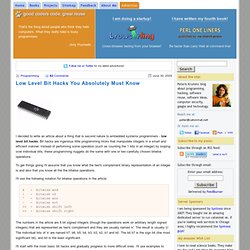
Bit hacks are ingenious little programming tricks that manipulate integers in a smart and efficient manner. Instead of performing some operation (such as counting the 1 bits in an integer) by looping over individual bits, these programming nuggets do the same with one or two carefully chosen bitwise operations. To get things going I'll assume that you know what the two's complement binary representation of an integer is and also that you know all the the bitwise operations. Advanced Unit Testing, Part I - Overview. Oh dear God, anybody who votes [for unit-testing] has major problems.

I hate the @#$% things. And the "Write tests first, code later" paradigm eludes me. I mean, come on, unit testing is not the end-all, be-all people! I don't care how sophisticated your tests are, a "pass/fail" grade is not sufficient to make sure you're ready for production. - David Stone, on the "do you like design or unit testing better" survey. Contents. C# Examples. DateTime.ToString() Patterns.
All the patterns: Design Patterns and Refactoring. Obfuscated code. In software development, obfuscation is the deliberate act of creating obfuscated code, i.e. source or machine code that is difficult for humans to understand.
Programmers may deliberately obfuscate code to conceal its purpose (security through obscurity) or its logic, in order to prevent tampering, deter reverse engineering, or as a puzzle or recreational challenge for someone reading the source code. Programs known as obfuscators transform readable code into obfuscated code using various techniques. Writing and reading obfuscated source code can be a brain teaser for programmers. A number of programming contests reward the most creatively obfuscated code: the International Obfuscated C Code Contest, Obfuscated Perl Contest, and International Obfuscated Ruby Code Contest. Types of obfuscations include simple keyword substitution, use or non-use of whitespace to create artistic effects, and self-generating or heavily compressed programs.
C#, Java, and JavaScript Programming, by Richard G Baldwin. If you find the links to any of my tutorials broken, you might try either: Going to Google or Bing and searching the web for pages having the same title, or Going to More articles by Richard G.

Baldwin at Developer.com and searching that page for the tutorial by title. One of those two options is almost certain to lead you to a copy of the tutorial. The New Face of Computer Science Education - The Scratch Generation Java v.s. Codefetch{ Hidden Features of C# Visual Representation of SQL Joins. Introduction This is just a simple article visually explaining SQL JOINs.
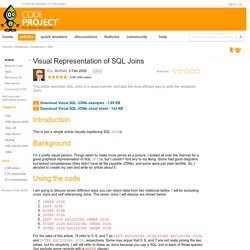
Background I'm a pretty visual person. Things seem to make more sense as a picture. I looked all over the Internet for a good graphical representation of SQL JOINs, but I couldn't find any to my liking. Using the code I am going to discuss seven different ways you can return data from two relational tables. For the sake of this article, I'll refer to 5, 6, and 7 as LEFT EXCLUDING JOIN, RIGHT EXCLUDING JOIN, and OUTER EXCLUDING JOIN, respectively.
Inner JOIN This is the simplest, most understood Join and is the most common. Hide Copy Code SELECT <select_list> FROM Table_A A INNER JOIN Table_B B ON A.Key = B.Key Left JOIN This query will return all of the records in the left table (table A) regardless if any of those records have a match in the right table (table B). Tutorial 2: Creating a Business Logic Layer. Scott Mitchell June 2006 Download the ASPNET_Data_Tutorial_2_CS.exe sample code.

Contents of Tutorial 2 (Visual C#) Introduction Step 1: Creating the BLL Classes Step 2: Accessing the Typed DataSets Through the BLL Classes Step 3: Adding Field-Level Validation to the DataRow Classes Step 4: Adding Custom Business Rules to the BLL's Classes Summary Introduction The Data Access Layer (DAL) created in the first tutorial cleanly separates the data access logic from the presentation logic. Free C# Resources - freeprogrammingresources.com. Fraction class in C# Introduction This article demonstrates how to remove the problem of limited precision when numbers such as 1/10, 1/7, 1/3, etc. are represented in a floating point variable type in C#.

Yes, you guessed it right, this problem can be solved by storing such numbers in a fraction format. As a fraction object stores its numerator and denominator as integer variables, there is no loss of accuracy. For this purpose, I have written a simple C# class representing fractions. It can be used in various applications, e.g., equation solving, matrix transformations, etc. Features of class. C Sharp Tutorial - Meshplex.
Help.