
Metanoia (psychology) Metanoia (from the Greek μετάνοια, metanoia, "changing one's mind") has been used in psychology since at least the time of American thinker William James to describe a process of fundamental change in the human personality.[1] The term derives from the Ancient Greek words μετά (metá) (meaning "beyond" or "after") and νόος (noeō) (meaning "perception" or "understanding" or "mind"), and takes on different meanings in different contexts.

In Transactional analysis, metanoia is used to describe the experience of abandoning an old scripted self or false self for a more open one: a process which may be marked by a mixture of intensity, despair, self-surrender, and an encounter with the inner void.[7] Jump up ^ Petrushka Clarkson, On Psychotherapy (1993) p. 57Jump up ^ Petrushka Clarkson, On Psychotherapy (1993) p. 57Jump up ^ R. Arp. 1001 Ideas That Changed the Way We Think (2013) p. 255Jump up ^ Petrushka Clarkson, On Psychotherapy (1993) p. 56Jump up ^ D. A. R. Ouroboros. Chaos (cosmogony) Discordianism. "Sacred Chao" redirects here.
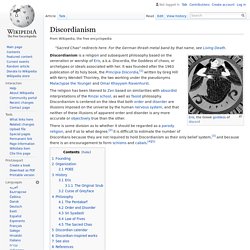
For the German thrash metal band by that name, see Living Death. There is some division as to whether it should be regarded as a parody religion, and if so to what degree.[2] It is difficult to estimate the number of Discordians because they are not required to hold Discordianism as their only belief system,[3] and because there is an encouragement to form schisms and cabals.[4][5] Founding[edit] Enantiodromia. Though "enantiodromia" was coined by Jung, it is implied in the writings of Heraclitus.

In fr. 126, for example, Heraclitus says "cold things warm, warm things cool, wet things dry and parched things get wet. "[1] It also seems implicit in other of his sayings, like "war is father of all, king of all" (fr. 53), "they do not know that the differing/opposed thing agrees with itself; harmony is reflexive (παλίντροπος palintropos, used of a compound bow, or "in reflexive tension"), like the bow and the lyre" (fr. 51).
In these passages and others the idea of the coincidence of opposites is clearly articulated in Heraclitus' characteristic riddling style, as well as the dynamic motion back and forth between the two, generated especially by opposition and conflict. Nigredo. For the character in Xenosaga, see Gaignun Kukai.

Nigredo is also an album by Diary of Dreams. Nigredo, or blackness, in alchemy means putrefaction or decomposition. The alchemists believed that as a first step in the pathway to the philosopher's stone all alchemical ingredients had to be cleansed and cooked extensively to a uniform black matter.[1] Jung[edit] For Carl Jung, 'the rediscovery of the principles of alchemy came to be an important part of my work as a pioneer of psychology'.[3] As a student of alchemy, he (and his followers) 'compared the "black work" of the alchemists (the nigredo) with the often highly critical involvement experienced by the ego, until it accepts the new equilibrium brought about by the creation of the self'.[4] Jungians interpreted nigredo in two main psychological senses.
Dialectical monism. Dialectical Monism Principles[edit] Ideas relating to "teleological evolution" are important in some progressive interpretations of dialectical monism.

However, this element has not always been present historically, and is generally not present in contemporary dialectical monisms such as Taoism. It is important to note that teleological tendencies in dialectical monism can significantly differ from other variants of teleology if dialectical progression is linked to materialism, because such an interpretation is a naturalistic progression rather than a result of design or consciousness.
However, non-materialistic philosophies exist that also are dialectical monisms, such as Actual Idealism. Some variants of dialectical monism adhere to the view that all conditions exist at all times in unity, and our consciousness separates them into dualistic forms. Chaos (cosmogony) Demiurge. In the Platonic, Neopythagorean, Middle Platonic, and Neoplatonic schools of philosophy, the demiurge (/ˈdɛmiˌɜrdʒ/) is an artisan-like figure responsible for the fashioning and maintenance of the physical universe.
The term was subsequently adopted by the Gnostics. Pantheon (gods) A pantheon (from Greek Πάνθεον [1] - pantheon, literally "(a temple) of all gods", "of or common to all gods", from πᾶν pan- "all" + θεῖος theios, "of or for the gods", from θεός theos "god") is a set of all the gods of a particular polytheistic religion or mythology.
Max Weber's 1922 opus, Economy and Society, discusses the link between a pantheon of gods and the development of monotheism. Since the 16th century "pantheon" can also refer in a secular sense to the set of a society's exalted persons.[2] For example "Mick Jagger was exalted into the pantheon of rock megastars". Hermes. Hermes is a god of transitions and boundaries.
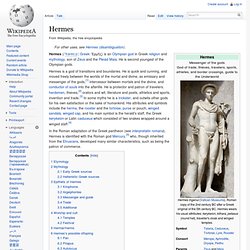
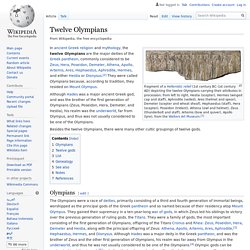
He is quick and cunning, and moved freely between the worlds of the mortal and divine, as emissary and messenger of the gods,[1] intercessor between mortals and the divine, and conductor of souls into the afterlife. He is protector and patron of travelers, herdsmen, thieves,[2] orators and wit, literature and poets, athletics and sports, invention and trade.[3] In some myths he is a trickster, and outwits other gods for his own satisfaction or the sake of humankind. Twelve Olympians. Major deities of the Greek pantheon Fragment of a Hellenisticrelief (1st century BC–1st century AD) depicting the twelve Olympians carrying their attributes in procession; from left to right, Hestia (scepter), Hermes (winged cap and staff), Aphrodite (veiled), Ares (helmet and spear), Demeter (scepter and wheat sheaf), Hephaestus (staff), Hera (scepter), Poseidon (trident), Athena (owl and helmet), Zeus (thunderbolt and staff), Artemis (bow and quiver), Apollo (lyre), from the Walters Art Museum.[1] Although Hades was a major ancient Greek god, and was the brother of the first generation of Olympians (Zeus, Poseidon, Hera, Demeter, and Hestia), his realm was the underworld, far from Olympus, and thus was not usually considered to be one of the Olympians.
Eshu. A mask representing Eshu.
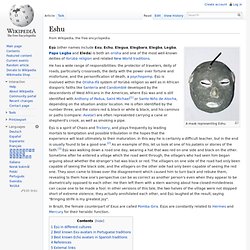
Èṣù (other names include Exu, Echu, Elegua, Elegbara, Elegba, Legba, Papa Legba and Eleda) is both an orisha and one of the most well-known deities of Yorùbá religion and related New World traditions. Chthonic. Some dictionaries, such as the OED, state that the first two letters should be pronounced (as /k/), /ˈkθɒnɪk/, while others, such as the AHD, record these letters as silent, /ˈθɒnɪk/. The modern pronunciation of the Greek word "χθόνιος" is [ˈxθonios],[2] although the Classical Greek pronunciation would have been [ktʰónios].
Chthonic and Olympian[edit] While terms such as "Earth deity" or Earth mother have sweeping implications in English, the words khthonie and khthonios had a more precise and technical meaning in Greek, referring primarily to the manner of offering sacrifices to the deity in question. Some chthonic cults practised ritual sacrifice, which often happened at night time. When the sacrifice was a living creature, the animal was placed in a bothros ("pit") or megaron ("sunken chamber"). Hyoscyamus niger. Hyoscyamus niger (commonly known as henbane),[1] also known as stinking nightshade or black henbane, is a plant of the family Solanaceae[1] that originated in Eurasia,[1] though it is now globally distributed. Toxicity and historical usage[edit] Recently evidence for its earlier use in the Scottish Neolithic has been debated.[6]).
The name henbane dates at least to AD 1265. Golden Dawn (political party) The Popular Association – Golden Dawn[5][6] (Greek: Λαϊκός Σύνδεσμος – Χρυσή Αυγή Laïkós Sýndesmos - Chryssí Avgí), usually known simply as Golden Dawn (Greek: Χρυσή Αυγή, Chryssí Avgí pronounced [xriˈsi avˈʝi]), is a far-right[7] political party in Greece. It is led by Nikolaos Michaloliakos. Scholars and media have described it as neo-Nazi[3][8][9] and fascist,[10] [11][12] though the group rejects these labels.[13] Members have expressed admiration of the former Greek leader Ioannis Metaxas, who ruled Greece from 1936 until 1941.[14] They have also made use of Nazi symbolism, and have praised figures of Nazi Germany in the past.[15][16][17] According to academic sources, the group is racist and xenophobic,[18][19] while the party's leader has openly identified it as nationalist and racist.[20] Michaloliakos began the foundations of what would become Golden Dawn in 1980.
It first received widespread attention in 1991, and in 1993 registered as a political party. Nymphaea caerulea. Nymphaea caerulea, also known as the Blue Egyptian water lily or sacred blue lily, is a water-lily in the genus Nymphaea. Distribution[edit] Its original habitat may have been along the Nile and other locations in East Africa. Datura stramonium. Silene undulata. Silene undulata in a small pot Silene undulata (Xhosa: undlela zimhlophe — “white ways/paths”, also known as African Dream Root) is a plant native to the Eastern Cape of South Africa.[1][2]
Eleusinian Mysteries. Poppy goddess. The poppy goddess in the middle. Heraklion Archaeological Museum. Salema porgy. Diplopterys cabrerana. Diplopterys cabrerana is a vine native to the Amazon Basin, spanning the countries of Brazil, Colombia, Ecuador and Peru.[1] In the Quechua languages it is called chaliponga or chagropanga; in parts of Ecuador it is known as chacruna—a name otherwise reserved for Psychotria viridis. D. cabrerana and P. viridis are both common admixtures for ayahuasca. Both species are rich sources of N,N-DMT, a tryptamine endogenous in humans and other many other species. Entheogenic drugs and the archaeological record. Entheogenic drugs have been used by various groups for thousands of years. There are numerous historical reports as well as modern, contemporary reports of indigenous groups using entheogens. Eight-circuit model of consciousness. Neurotheology. Ichthyoallyeinotoxism.
Psychedelic experience. Entheogen. Bad trip. Chaos magic. Fractal. Economic history of the world. Internet. Margaret Cavendish, Duchess of Newcastle-upon-Tyne. Supernatural. Neurotechnology. Mind uploading. Cultured neuronal network. Brain–computer interface.
List of emerging technologies. Cybernetics. Emergence. Neuroinformatics. Computational neuroscience. Mind uploading in fiction. Artificial neural network. Biological neural network. Ritual. Orthopraxy. Religious views on truth. Meditation. LaVeyan Satanism.
Psychology. Social model. Great Transition. Transactional interpretation. Cliodynamics. Historic recurrence. Self-sufficiency. Subsistence agriculture. Historical demography. Homesteading. Permaculture. Anti-globalization movement. Planetary phase of civilization. Ecovillage. Back-to-the-land movement. Artisan fishing. Bioregionalism. Eco-communalism. Democratic transhumanism. Technological singularity. Cross-cultural. Democratic globalization. Global citizens movement. Institution. Culture of the United States. Social class in the United States. American way. Classical demography. Social structure. Organizational culture. Philosophy. Behaviorism. Philosophy of language.
Philosophy of mind. Post-structuralism. Structural functionalism. Logic. Ontology. Reality. Axiology. Epistemology. Modal realism. Determinism. Connectionism. Moral universalism. Cosmopolitanism.