
This is Water - Part 1. He Is There and He Is Not Silent. He Is There and He Is Not Silent is a philosophical work written by American apologist and Christian theologian Francis A.

Schaeffer, Wheaton, IL:Tyndale House, first published in 1972. It is Book Three in Volume One of The Complete Works of Francis A. Schaeffer A Christian Worldview. Westchester, IL:Crossway Books, 1982. This is the third book of Francis Schaeffer's "Trilogy. " Overview[edit] He Is There and He Is Not Silent is divided into four chapters, followed by two appendices. Table of contents[edit] Introduction Chapter 1. In the opening chapter, Schaeffer, after briefly defining "metaphysics," states two dilemmas concerning humankind.
First, what Schaeffer calls the "Line of Despair" (and associates with existentialism): that there is no logical answer to the dilemmas, and that all is "chaotic, irrational, and absurd. " The second class of answers Schaeffer postulates is that logic exists, and that the subject of metaphysics is open to rational discussion. Peterrollins.net. G. K. Chesterton. Early life[edit] G.K.

Chesterton at the age of 17. Born in Campden Hill in Kensington, London, Chesterton was baptized at the age of one month into the Church of England,[8] though his family themselves were irregularly practising Unitarians.[9] According to his autobiography, as a young man Chesterton became fascinated with the occult and, along with his brother Cecil, experimented with Ouija boards. Family life[edit] Chesterton married Frances Blogg in 1901; the marriage lasted the rest of his life.
Career[edit] Chesterton loved to debate, often engaging in friendly public disputes with such men as George Bernard Shaw,[13] H. Visual wit[edit] Chesterton usually wore a cape and a crumpled hat, with a swordstick in hand, and a cigar hanging out of his mouth. Radio[edit] In 1931, the BBC invited Chesterton to give a series of radio talks. The talks were very popular.
Death and veneration[edit] Writing[edit] Chesterton's writings consistently displayed wit and a sense of humour. C. S. Lewis. Lewis and fellow novelist J.
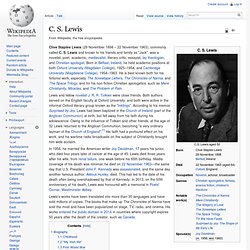
R. R. Tolkien were close friends. Both authors served on the English faculty at Oxford University, and both were active in the informal Oxford literary group known as the "Inklings". According to his memoir Surprised by Joy, Lewis had been baptized in the Church of Ireland (part of the Anglican Communion) at birth, but fell away from his faith during his adolescence. In 1956, he married the American writer Joy Davidman, 17 years his junior, who died four years later of cancer at the age of 45. Lewis's works have been translated into more than 30 languages and have sold millions of copies. Biography Childhood Little Lea, home of the Lewis family from 1905 to 1930 Clive Staples Lewis was born in Belfast, Ireland, on 29 November 1898.[2] His father was Albert James Lewis (1863–1929), a solicitor whose father, Richard, had come to Ireland from Wales during the mid-19th century.
"The New House is almost a major character in my story. "My Irish life" First World War. Christian apologetics. Christian apologetics (Greek: ἀπολογία, "verbal defence, speech in defence")[1] is a field of Christian theology which aims to present a rational basis for the Christian faith, defending the faith against objections.
Apologists have based their defense of Christianity on historical evidence, philosophical arguments, and arguments from other disciplines. Christian polemic is a branch of apologetics aimed at criticizing or attacking other belief systems.[2][3] Terminology and origin[edit] Christian polemics[edit] In its strictest sense, an apologia is a defense against a prior attack, whether actual or merely perceived: Christian apologetics would arise from anti-Christian polemic. In the forced Disputation of Barcelona (1263) at the royal palace of King James I of Aragon, the Dominican friar Pablo Christiani, a convert from Judaism to Christianity, failed to prove the truth of Christianity from the Torah, Talmud and other rabbinical writings.