
Earthlike Planet Found Orbiting at Right Distance for Life. A possible Earth twin has been confirmed orbiting a sunlike star 600 light-years away—and the new planet may be in just the right spot for supporting life, NASA announced Monday. Discovered by the Kepler space mission, the new planet—dubbed Kepler-22b—is the first world smaller than Neptune to be found in middle of its star's habitable zone. Also called the Goldilocks zone, the habitable zone is the region around a star where a planet's surface is not too hot and not too cold for liquid water—and thus life as we know it—to exist. (Also see "New Planet May Be Among Most Earthlike—Weather Permitting. ") Other planets have been spotted in the habitable zones of their stars, but most of those worlds are Jupiter- or Neptune-size bodies that are unlikely to harbor life. (Related: "Six New Planets—Mini-Neptunes Found Around Sunlike Star.
") "What makes this particular discovery so exciting is that this planet is right smack in the middle of the habitable zone," Batalha said. NASA Mars Rover Finds Mineral Vein Deposited by Water. NASA's Mars Exploration Rover Opportunity has found bright veins of a mineral, apparently gypsum, deposited by water.
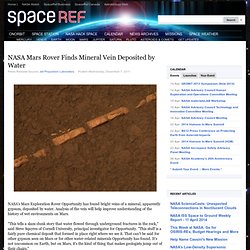
Analysis of the vein will help improve understanding of the history of wet environments on Mars. "This tells a slam-dunk story that water flowed through underground fractures in the rock," said Steve Squyres of Cornell University, principal investigator for Opportunity. "This stuff is a fairly pure chemical deposit that formed in place right where we see it.
That can't be said for other gypsum seen on Mars or for other water-related minerals Opportunity has found. It's not uncommon on Earth, but on Mars, it's the kind of thing that makes geologists jump out of their chairs. " The latest findings by Opportunity were presented Wednesday at the American Geophysical Union's conference in San Francisco. Calcium sulfate can exist in many forms, varying by how much water is bound into the minerals' crystalline structure. For more information about the rovers, visit: NASA Telescope Confirms Alien Planet in Habitable Zone. This story was updated at 12:15 p.m.
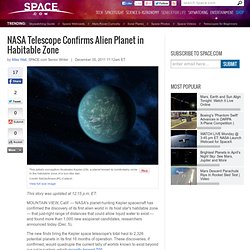
ET. MOUNTAIN VIEW, Calif. — NASA's planet-hunting Kepler spacecraft has confirmed the discovery of its first alien world in its host star's habitable zone — that just-right range of distances that could allow liquid water to exist — and found more than 1,000 new exoplanet candidates, researchers announced today (Dec. 5). The new finds bring the Kepler space telescope's total haul to 2,326 potential planets in its first 16 months of operation. These discoveries, if confirmed, would quadruple the current tally of worlds known to exist beyond our solar system, which recently topped 700. The potentially habitable alien world, a first for Kepler, orbits a star very much like our own sun. "We're getting closer and closer to discovering the so-called 'Goldilocks planet,'" Pete Worden, director of NASA's Ames Research Center in Moffett Field, Calif., said during a press conference today.
The newfound planet in the habitable zone is called Kepler-22b.