
Kunzorrell2004.pdf. Deadly lake turns animals into statues - environment - 01 October 2013. (Images: Nick Brandt) ACCORDING to Dante, the Styx is not just a river but a vast, deathly swamp filling the entire fifth circle of hell.

Perhaps the staff of New Scientist will see it when our time comes but, until then, Lake Natron in northern Tanzania does a pretty good job of illustrating Dante's vision. Unless you are an alkaline tilapia (Alcolapia alcalica) – an extremophile fish adapted to the harsh conditions – it is not the best place to live. Temperatures in the lake can reach 60 °C, and its alkalinity is between pH 9 and pH 10.5. The lake takes its name from natron, a naturally occurring compound made mainly of sodium carbonate, with a bit of baking soda (sodium bicarbonate) thrown in. Photographer Nick Brandt, who has a long association with east Africa – he directed the video for Michael Jackson's Earth Song there in 1995 – took a detour from his usual work when he discovered perfectly preserved birds and bats on the shoreline. More From New Scientist More from the web. Brilliant Bio-Design: 14 Animal-Inspired Inventions. Surveillance cameras flap their wings in the sky just like birds and bats.
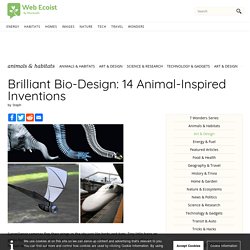
Tiny little hairs on gecko feet help a robot climb a smooth vertical surface. The impact-resistant surface of human teeth inspires light and durable aerospace materials. Just like designs inspired by the sea, insect-mimicking inventions and buildings that look like natural terrain, these 14 examples of biomimicry based on animal and human biology capitalize on the unparalleled efficiency of nature. A Robotic Arm Like an Elephant Trunk (image via: festo.com) Robotics have always been bound by the limitations of the computers of their time, but as computer technology continues to evolve, more complex calculations for a wider range of movements become possible.
Solar-Powered Bat-Inspired Spy Plane (image via: inhabitat) Bats have unwittingly become the inspiration for a government surveillance device. Bird Skulls Inspire Lighter, Stronger Building Materials (image via: andres harris) (images via: yimhafiz, laszlo-photo) The Invention of Velcro - George de Mestral. The Invention of VELCRO ® - George de Mestral Microscopic view of VELCRO By Mary Bellis One lovely summer day in 1948, a Swiss amateur-mountaineer and inventor decided to take his dog for a nature hike.

The man and his faithful companion both returned home covered with burrs, the plant seed-sacs that cling to animal fur in order to travel to fertile new planting grounds. The man neglected his matted dog, and with a burning curiosity ran to his microscope and inspected one of the many burrs stuck to his pants. Mestral's idea met with resistance and even laughter, but the inventor 'stuck' by his invention. Not bad for an invention based on Mother Nature. Velcro and TrademarksToday you cannot buy velcro because VELCRO is the registered trademark for the Velcro Industries' product. Artwork mary bellis. Lessons From the Reverse Engineering of Nature. On the Significance of Species Beginning in the mid-1980s with evolutionary biologist and writer Stephen J.

Gould, the University of Minnesota has invited world-renowned speakers to give public addresses in a lecture series named for the university’s longtime president and Graduate School dean, Guy Stanton Ford. In 1994, I had just started as assistant professor in the department of ecology, evolution and behavior when I was thrilled to discover that the speaker for that year would be Richard Dawkins, another famous evolutionary biologist and writer.
I joined the hundreds in the packed auditorium, and I think all of us were surprised when he began by showing a slide of a familiar religious illustration: a lion and a little girl sitting peacefully beside one another. The illustration portrayed the familiar Christian, Jewish and Islamic construct of Edenic peace, in which all species — including predator and prey — live in harmony. Dawkins found the image preposterous.