
Radioactive Cesium Is Found in Tokyo Tap Water for First Time Since April. Radioactive cesium-137 was found in Tokyo’s tap water for the first time since April as Japan grapples with the worst nuclear disaster in 25 years.
The level was below the safety limit set by the government. Cesium-137 registered at 0.14 becquerel per kilogram in Shinjuku ward on July 2 and none was discovered yesterday, compared with 0.21 becquerel on April 22, according to the Tokyo Metropolitan Institute of Public Health. No cesium-134 or iodine-131 was detected, the agency said on its website. “This is unlikely to be the result of new radioactive materials being introduced” into the water supply, Hironobu Unesaki, a nuclear engineering professor at Kyoto University, said today by telephone.
That’s “because no other elements were detected, especially the more sensitive iodine,” he said. Products including spinach, mushrooms, bamboo shoots, tea, milk, plums and fish have been found to be contaminated with cesium and iodine as far as 360 kilometers (224 miles) from the station. Fukushima effect: Japan schools take health precautions in radiation zone. At first sight, there seems little out of the ordinary on this wet afternoon for the pupils of Oyama primary school.
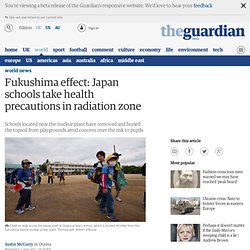
They wave from classroom windows as they rush to finish the day's cleaning chores. Outside, the wind and rain sends the school's pet rabbits into a retreat deep inside their hutches. But buried beneath the surface of the school playing field is evidence that life in this village, about 40 miles from the Fukushima No 1 nuclear power plant, is far from normal: a large quantity of radioactive soil, wrapped in tarpaulin. Fukushima plant owners criticised by nuclear inspectors.
International nuclear inspectors have criticised the operator of the Fukushima Daiichi nuclear plant for failing to prepare for a tsunami of the size that slammed into the facility on 11 March, sparking the world's worst nuclear crisis since Chernobyl. In a preliminary report issued on Wednesday, inspectors from the International Atomic Energy Agency (IAEA) said Tokyo Electric Power (Tepco) had underestimated the risk of a giant tsunami.
Fukushima nuclear plant in Japan 'unready for typhoon' 29 May 2011Last updated at 00:24 The problems with the Fukushima nuclear plant have raised questions over Tepco's future Japan's crippled Fukushima nuclear plant is not fully prepared for heavy rain and winds of a typhoon heading towards the country, officials admit.
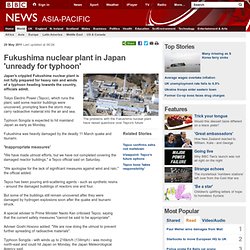
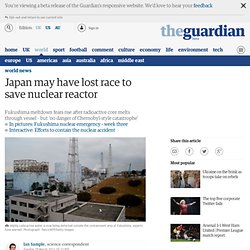
Tokyo Electric Power (Tepco), which runs the plant, said some reactor buildings were uncovered, prompting fears the storm may carry radioactive material into the air and sea. Typhoon Songda is expected to hit mainland Japan as early as Monday. Fukushima was heavily damaged by the deadly 11 March quake and tsunami. 'Inappropriate measures' "We have made utmost efforts, but we have not completed covering the damaged reactor buildings," a Tepco official said on Saturday. "We apologise for the lack of significant measures against wind and rain," the official added. Tepco has been pouring anti-scattering agents - such as synthetic resins - around the damaged buildings of reactors one and four. Japan may have lost race to save nuclear reactor. The radioactive core in a reactor at the crippled Fukushima nuclear power plant appears to have melted through the bottom of its containment vessel and on to a concrete floor, experts say, raising fears of a major release of radiation at the site.
Japan nuclear: PM Naoto Kan signals 'maximum alert' 29 March 2011Last updated at 07:20.
Japan nuclear crisis: Radiation spike report 'mistaken' 27 March 2011Last updated at 16:07 The BBC's Mark Worthington says many people in Japan are becoming increasingly concerned about what is going to happen in the future The operators of a stricken Japanese nuclear plant have apologised for a "mistake" in reporting a radiation spike 10 million times above normal.
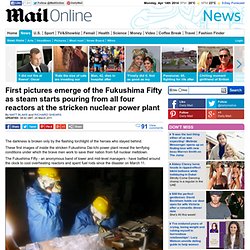
Soaring radioactivity deals blow to Japan's plant. Japan nuclear crisis: Fukushima Fifty pictures from inside nuclear power plant. By Matt Blake and Richard Shears Updated: 08:42 GMT, 24 March 2011.
Japan nuclear plant workers in hospital after radiation exposure. The dangers facing workers battling to avert disaster at the Fukushima Daiichi nuclear power plant were underlined on Thursday when three men were exposed to high levels of radiation after stepping in contaminated water.
The plant's operator, Tokyo Electric Power (Tepco), admitted that the workers had not measured radioactivity levels before beginning work, and that two, who are being treated for radiation burns, were not wearing protective boots. The two more seriously injured men were diagnosed with possible beta ray burns and were due to be taken to a special unit at the National Institute of Radiological Sciences in Chiba, east of Tokyo, Japan's nuclear safety agency said. The injuries are similar to regular burns, but can lead to serious complications over a period of several weeks. Japan's nuclear safety agency said water had probably seeped through their protective clothing, allowing radioactive materials to stick to their skin, as they stood in a 15cm-deep puddle. Japan earthquake: Japan warned over nuclear plants, WikiLeaks cables show.