
Beyond Bitcoin: A Guide to the Most Promising Cryptocurrencies. Just as the success of Facebook helped spawn endless clones, Bitcoin’s arrival on the big stage comes with an assortment of digital currencies, known as “altcoins,” riding on Satoshi’s coattails.
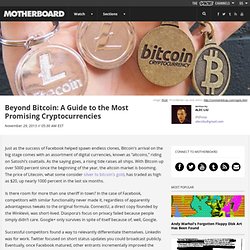
As the saying goes, a rising tide raises all ships. With Bitcoin up over 5000 percent since the beginning of the year, the altcoin market is booming. The price of Litecoin, what some consider silver to bitcoin’s gold, has traded as high as $20, up nearly 1000 percent in the last six months. Is there room for more than one sheriff in town? In the case of Facebook, competitors with similar functionality never made it, regardless of apparently advantageous tweaks to the original formula. Successful competitors found a way to relevantly differentiate themselves. Litecoin: the little brother Price at time of writing: $28.35 Market Cap: $503,102,328 Consistent with its name, Litecoin is essentially Bitcoin-lite and is the second most valuable altcoin. Peercoin: Actually green Price: $3.51 Price: $6.91.
Arguments for Demurrage-Based Post-Growth Currencies. Erik Curren, explaining the proposals of Charles Eisenstein on Demurrage: “Our economy cannot function without growth because most money is not printed by governments, as people usually imagine, but is instead loaned into existence by central banks and commercial lenders, who can loan out ten dollars or more for every dollar they’re required to have in their vaults.
In effect, then, a lender creates new money with every loan. And the whole point of making loans is to earn interest for the lender. But for the borrower, interest obliges her to pay back more than she borrowed. And to earn the money to pay back the principal plus accumulated interest, the borrower will need to create goods and services. “Without growth, debt increases faster than income and wealth and the whole system crashes.
So, since all national currencies, whether the dollar or the Euro or the Yuan, allow lenders to earn interest, the whole economy becomes addicted to economic growth. OPEN SOURCE ECONOMIES. Open source warfare is in the process of revolutionizing war by enabling communities of small autonomous groups to successfully fight much larger foes.
In the initial tests of the method (i.e. the Spanish Civil War of our time: Iraq), open source insurgents were able to fight the most powerful military ever fielded to a standstill for years. It will only get more effective from here on out as the method evolves, technology roars forward, and traditional militaries like the US become husks of their former selves (due to a lack of funding and political divisiveness).
The effectiveness of open source warfare might also apply to another area of intense competition: economics. Simply, would it be possible for a community of small groups and/or a plethora of individuals within an open source economy to decisively outcompete the dominant global system?
Credit / Loans. Open Money. Mobile Banking. Square – Accept credit card payments with your mobile phone. Apple Should Forget The Movie Studios. Go After The Banks Instead. I Want My iMoney. This sign is up for our San Francisco office.
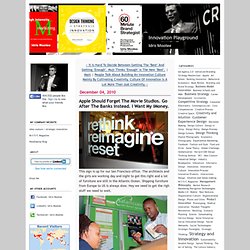
The archtiects and the girls are working day and night to get this right and a lot of furniture are still in the Atlantic Ocean. Shipping furniture from Europe to US is always slow. Hey we need to get the righ stuff we need to wait. Congrats to Nick Hughes (managing director of Signal Point Partners and LBS alum) for picking up the Social and Economic award at the Economist Innovation Awards a few weeks ago held at the Science Museum in London. Nick was recognized for his part in creating the M-Pesa venture in Kenya, a mobile money-transfer initiative – something that is long overdue in the world of banking unmet needs.
M-Pesa was first launched in 2005, allow people to transfer money, pay bills and save using a mobile phone, without NO bank account. Today, it still takes weeks to clear a check, transferring money is still a pain and fees are hefty. Monnaie mobile : des services innovants portés par les usagers « MOBACTU / by @loallard. Certains considèrent le mBanking comme relevant d’une innovation disruptive, au sens où il aura permis un accès à des services bancaires à des populations rejetées par les institutions bancaires dans les pays en développement.
M-PESA, le modèle à suivre Ainsi, depuis l’automne dernier, à Haïti est proposé par la fondation de l’opérateur Digicel, qui touche un quart de la population, un service de dépôt et de transfert d’argent Tcho Tcho Haiti à quelques 20 000 personnes pour l’instant. Un autre opérateur haïtien Voilà en partenariat avec l’agence d’aide internationale Mercy Corps, via un programme du gouvernement américain, a mis au point un compte en banque mobile allouant 40$ de crédit par mois afin d’acheter de la nourriture. Entre philanthropie et capitalisme, le rôle des fondations télécom A noter que ce sont souvent les fondations des opérateurs mobiles qui ouvrent de tels services. Des innovations portées par les usagers.
Flatr.