
Words Over Pixels - Daily Photo Inspiration. Romance languages. The Romance languages—occasionally called the Latin languages or, less often, the Romanic or Neo-Latin languages—are a group of languages descended from Vulgar Latin.
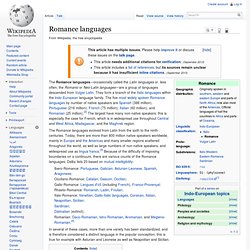
They form a branch of the Italic languages within the Indo-European language family. The five most widely spoken Romance languages by number of native speakers are Spanish (386 million), Portuguese (216 million), French (75 million), Italian (60 million), and Romanian (25 million).[2] The largest have many non-native speakers; this is especially the case for French, which is in widespread use throughout Central and West Africa, Madagascar, and the Maghreb region. The Romance languages evolved from Latin from the sixth to the ninth centuries.
Ibero-Romance: Portuguese, Galician, Asturian-Leonese, Spanish, Aragonese; Transnistria. Political map of Transnistria with the differences between the Autonomous Dniestrian Territory de jure and the Pridnestrovian Moldavian Republic de facto.
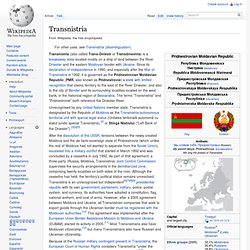
General map of Transnistria. Transnistria (also called Trans-Dniestr or Transdniestria) is a breakaway state located mostly on a strip of land between the River Dniester and the eastern Moldovan border with Ukraine. Since its declaration of independence in 1990, and especially after the War of Transnistria in 1992, it is governed as the Pridnestrovian Moldavian Republic (PMR, also known as Pridnestrovie) a state with limited recognition that claims territory to the east of the River Dniester, and also to the city of Bender and its surrounding localities located on the west bank, in the historical region of Bessarabia.
The terms "Transnistria" and "Pridnestrovie" both reference the Dniester River. What School Lunches Look Like In 20 Countries Around The World: Pics, Videos, Links, News.