
Ragtime. Origem: Wikipédia, a enciclopédia livre.

Contexto histórico[editar | editar código-fonte] Algumas composições antigas para piano nesse estilo são intituladas como marchas, "jig" e "rag" foram usadas variavelmente em meados da década de 1890 [4] e o ragtime foi também precedido por seu correlato cakewalk. Em 1895, o animador Ernest Hogan publicou duas das mais antigas partituras de rag, uma delas ("All Coons Look Alike to Me") consequentemente vendeu milhões de cópias.[5] Como colega músico Tom Fletcher disse, Hogan foi o "primeiro a colocar no papel o tipo de ritmo que estava sendo tocado por músicos que não liam partitura.
"[6] Enquanto o sucesso da canção ajudou à introdução dos ritmos ragtime no país seu uso com insulto racial criou um número de imitações depreciativas das músicas, conhecidas como "coon songs" em razão do seu uso de extremo racismo e imagens com estereótipo de negros. A música ragtime era também distribuída através do rolo de piano para pianolas. Louis Moreau Gottschalk. Origem: Wikipédia, a enciclopédia livre.

Louis Moreau Gottschalk ( New Orleans , 8 de maio de 1829 — Rio de Janeiro , 18 de dezembro de 1869 ) foi um pianista e compositor norte-americano . Compôs, entre outras, a Grande Fantasia Triunfal Sobre o Hino Nacional Brasileiro , que dedicou a Son Altesse Impériale Madame la Comtesse d'Eu . Biografia [ editar ] Filho de um negociante judeu de Londres e de uma haitiana creole , Gottschalk nasceu e foi criado em Nova Orleans onde foi exposto a uma grande variedade de influências musicais .
Aprendeu a tocar piano muito cedo e logo foi reconhecido como um prodígio neste instrumento. Latin jazz. Swing (jazz) Origem: Wikipédia, a enciclopédia livre.

O Swing é um estilo de jazz que foi muito popular na década de 1930, usualmente arranjado para grande orquestra dançante, caracterizado por uma batida menos acentuada que a do estilo tradicional do Sul dos EUA, e menos complexo, rítmica e harmonicamente falando, do que o jazz moderno. Remete também às músicas de Big Bands. Notas Bibliografia. List of jazz clubs. From Wikipedia, the free encyclopedia This is a list of notable venues where jazz music is played.

Bebop. Bebop or bop is a style of jazz characterized by fast tempo, instrumental virtuosity, and improvisation based on the combination of harmonic structure and melody.
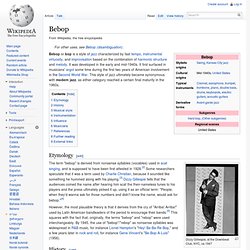
It was developed in the early and mid-1940s. It first surfaced in musicians' argot some time during the first two years of American involvement in the Second World War. This style of jazz ultimately became synonymous with modern jazz, as either category reached a certain final maturity in the 1960s. Etymology[edit] Dizzy Gillespie, at the Downbeat Club, NYC, ca 1947 "In spite of the explanations of the origins of these words, players actually did sing the words "bebop" and "rebop" to an early bop phrase as shown in the following example Play However, the most plausible theory is that it derives from the cry of "Arriba!
History[edit] In the 1940s, the younger generation of jazz musicians created a new style that came out of the 1930s' swing music. Christian's major influence was in the realm of rhythmic phrasing. Musical style[edit] Original dixieland jazz band. Dixieland. Cotton Club. The Cotton Club was a New York City night club located first in the Harlem neighborhood on 142nd St & Lenox Ave from 1923 to 1935[1] and then for a brief period from 1936 to 1940 in the midtown Theater District.

The club operated most notably during America's Prohibition Era. The club was a whites-only establishment even though it featured many of the best black entertainers of the era including: musicians Cab Calloway, Fletcher Henderson, Duke Ellington, Jimmie Lunceford, Louis Armstrong, Count Basie, Fats Waller, vocalists Adelaide Hall,[2][3] Ethel Waters, Avon Long, the Dandridge Sisters, the Will Vodery Choir, Berry Brothers, Nina Mae McKinney, Billie Holiday, Lena Horne, and dancers Bill Robinson, The Nicholas Brothers, Stepin Fetchit, and Earl Snakehips Tucker. The cruise ship MSC Opera has a lounge called "Cotton Club" and bears the same logo as the original New York night club. History[edit] Cotton Club dancer Mildred Dixon - Duke Ellington's second companion The Harlem years[edit] Sunset Cafe. The Sunset Cafe , also known as The Grand Terrace Cafe , was a jazz club in Chicago , Illinois operating during the 1920s, 1930s and 1940s.

It was one of the most important jazz clubs in America, especially during the period between 1917 and 1928 when Chicago became a creative capital of jazz innovation and again during the emergence of bebop in the early 1940s. From its inception, the club was a rarity as a haven from segregation, since the Sunset Cafe was an integrated or "Black and Tan" club where Afro- and Euro- Americans, along with other ethnicities, could mingle freely without much fear of reprisal. Many important musicians developed their careers at the Sunset/Grand Terrace Cafe. [ edit ] Original building The building that housed the Cafe still stands at 315 E 35th St in the Bronzeville neighborhood of Chicago. . [ edit ] Famous performers.