
The Ten Principles. Email Home / About Us / The Ten Principles The Ten Principles The UN Global Compact's ten principles in the areas of human rights, labour, the environment and anti-corruption enjoy universal consensus and are derived from: The UN Global Compact asks companies to embrace, support and enact, within their sphere of influence, a set of core values in the areas of human rights, labour standards, the environment and anti-corruption: Human Rights.
Human variability. Human variability, or human variation, is the range of possible values for any measurable characteristic, physical or mental, of human beings.

Differences can be trivial or important, transient or permanent, voluntary or involuntary, congenital or acquired, genetic or environmental. This article discusses variabilities that characterize a person for all or much of his or her lifetime, and are perceived as not purely learned or readily changed (such as religion, language, customs, or tastes). Each person being different is so essential a part of human experience that it is difficult to even imagine a human existence in which other people are identical. Furthermore, the social value put on these differences by the society in which one lives affects every aspect of a person's life. Sources of human variability[edit] Books - 7 Habits of Highly Effective People. The Seven Habits of Highly Effective People. The 7 Habits of Highly Effective People, first published in 1989, is a business and self-help book written by Stephen R.
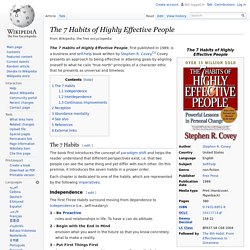
Covey.[1] Covey presents an approach to being effective in attaining goals by aligning oneself to what he calls "true north" principles of a character ethic that he presents as universal and timeless. The 7 Habits[edit]