
What to Do When A Potential Employer Asks for Your Facebook Password. Tony Morrison is the Vice President of Business Development at Cachinko.
Find him on Talent Connection and connect with Cachinko on Facebook or Twitter. Could you imagine a job interview during which your interviewer asks you for your Facebook password? Well folks, it's happening and you should know what to do when it happens to you. The reason why companies are doing this is to get better insight into who you really are. They will strategically ask you to look at Facebook with them — right there, on the spot. With that in mind, what about job applicants in all the other states? Let’s go over some things you can do to protect yourself on a job interview. 1. If you are asked for your password, here are some things you can say, in an eloquent and respectful manner, to show you will stand your ground: "I am very careful with my personal, private online persona and do not feel comfortable giving out any passwords. 2. The answer is probably “no.” 3. Social Media Job Listings.
How to Twitter: the infographic. 11 Twitter Tips for Educators. Twitter for Teachers … a great video introduction. 100 Twitter Tips For Teachers. Twitter may have started off as a fun social media site for keeping up with friends and sharing updates about daily life, but it’s become much more than that for many users over the past few years as the site has evolved and grown.
These days, Twitter is a powerhouse for marketing, communication, business, and even education, letting people from around the world work together, share ideas, and gain exposure. It has become a staple at many online colleges and campuses as well, leaving many academics wondering just how and if they should be using Twitter both in the classroom and in their professional lives. You have to start somewhere and these tips will help ensure that your first foray in Twitter is a great experience. Organize your Twitter. Twitter has made it simple to keep things organized and makes looking through tweets a breeze.
The Internet may be a virtual Wild West but there are some unspoken rules of engagement you should know before adding your two cents into the mix. Twellow. Building a professional learning network on Twitter. January 12, 2013 by tomwhitby For those who do not know, here are two basic Twitter principles: 1.
If you only follow 10 people you will only see the general tweets of those 10 people. 2. If only 10 people follow you, only those 10 people will see your general tweets. Although some might argue that the right ten people might be enough, I would argue that ten educators is a very limited Professional Learning Network. The never-ending task of building a PLN is to continually follow really good educators to get the information they put out.
I often say that the worst advocates for using Twitter as a PLN are power users. Building a professional Learning Network consisting of quality educators, who responsibly share quality information and sources, takes time and requires a plan. Why Restrict Who You Follow? The iPad and Twitter Revisited. It’s a question that I have pondered over recent weeks.
There is a growing trend for people to ‘cull’ the amount of people they follow on twitter. Why do they do it? Context is required here. During my early twitter use, I was the first person to become frustrated by a timeline filled too quickly. The need to see every tweet, in case it was the most important thing in the world, led to me unfollowing anyone who tweeted more than once every couple of hours! After realising I didn’t need to see every tweet, I wrote a piece about how a learning network could be developed with the use of an iPad and twitter: ‘We are all learning together. Learning has always been based on exposure to new stimuli, research and communication. I, like many others, signed up to twitter as it seemed the pertinent thing to do. If I’m honest, I didn’t understand and didn’t make the effort to try. What I wish I Knew Before Using Twitter. I am big on reflection.
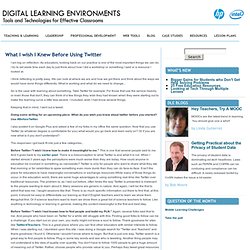
As educators, looking back on our practice is one of the most important things we can do. I try to set aside time each day to just think about how I did a workshop or something I said or a resource I looked at. I think reflecting is pretty easy. We can look at where we are and how we got there and think about the ways we would have done things differently. What is working and what do we need to change... So is the case with learning about something. Keeping that in mind, I sent out a tweet: Doing some writing for an upcoming piece.
I also posted it on Google Plus and asked a few of my folks in my office the same question. 24 Twitter Shortcuts That Will Save You Time. 36 of Our Favorite #Education Hashtags - Getting Smart by Getting Smart Staff - edchat, edreform, EdTech. Terry Heick at TeachThought recently published “The 20 Top #Hashtags in Education.”

We liked it so much that we decided to compile our own list of favorites. (*Includes overlap from Heick’s list.) Priority Hashtags #EdChat*#EdTech*#DigLN#SmartSeries#EdPolicy#BlendedLearning#OnlineLearning#EdLeaders#STEM*#EduVC#HigherEd#EdReform.