
Social Making: Hardware design tools for the web - Upverter.
The Foundation for P2P Alternatives. CircuitLab - online schematic editor & circuit simulator. DIY - Objets Digitaux - Fab Lab. iFixit: The free repair manual. La prochaine révolution ?Faites-la vous même ! « Dans la prochaine révolution industrielle, les atomes seront les nouveaux bits« En janvier 2010, Chris Anderson, rédacteur en chef de Wired et auteur de La longue traîne, tentait ainsi de résumer la révolution en cours du Do It Yourself (DIY, Faites-le vous même, en français).

Après avoir considérablement contribué à développer, et démocratiser, ce que l’on appelait au siècle dernier la « micro-informatique« , puis l’internet, hackers et bidouilleurs s’attèlent aujourd’hui à la fabrication et au développement de nouveaux objets, « libres« . Repenser l?internet des objets (3/3) : Industrialiser l?internet ou internetiser l?industrie ? ? InternetActu.net. Par Daniel Kaplan le 07/05/09 | 8 commentaires | 14,127 lectures | Impression Il n’existe pas aujourd’hui d’”internet des objets”, mais tout au plus une connexion en silos d’objets conçus et régis selon les règles les plus classiques de l’économie industrielle.
La connectivité des objets et des espaces pourrait même signer la fin de la “parenthèse internet”, celle d’un réseau sans tête, sans finalité et totalement ouvert. Ce serait sans compter sur ceux qui, venant du monde numérique ou du design, s’activent dans le sens contraire : celui de doter le monde physique de certaines des propriétés de plasticité et d’ouverture qui caractérisent le monde numérique. D’internetiser l’industrie, alors que celle-ci rêverait d’industrialiser l’internet….Troisième et dernière partie d’une série de trois articles sur la perspective de “l’internet des objets” – lire la 1re partie et la seconde.
Un thème qui sera au cœur de la conférence Lift, qui se tiendra à Marseille les 18, 19 et 20 juin prochains. – The Emergence of Open Design and Open Manufacturing. Les « bidouilleurs » de la société de l’information, par Jean-Ma. En 2005, deux électroniciens découvrirent, stupéfaits, que les données confidentielles contenues dans la carte Vitale n’étaient pas protégées : on pouvait les lire, mais aussi les modifier.
Pour d’obscures raisons, le mécanisme de sécurité n’avait pas été activé. L’affaire aurait pu faire scandale ; elle ne suscita que quelques articles de presse, et fut rapidement oubliée après que les responsables de la carte Vitale, tout en reconnaissant le problème, eurent déclaré qu’il serait corrigé. Quelques mois plus tard, l’un des deux électroniciens remonta au créneau en faisant remarquer que rien n’avait été fait. Aucun journaliste, aucun syndicat, aucune association de patients ne s’en inquiéta. Et ni la Commission nationale de l’informatique et des libertés (CNIL), censée garantir la protection de la vie privée, ni la direction centrale de la sécurité des systèmes d’information (DCSSI), autorité nationale de régulation chargée de la sécurité informatique, ne se saisirent du problème.
Make-offs: DIY indie innovations. DIY, or Do-It-Yourself, is not something that everyone thinks they can do but more people are doing it than you might think.

The DIY movement in science and technology is demonstrating that it can do inexpensively what large companies and even Big Science have spent millions doing. Au "fab lab", fabriquez vous-même votre machine à laver. Vous n’en avez jamais entendu parler, c’est normal.
Le concept de « fab lab » arrive tout juste en France, grâce à une bouillonnante communauté d’enseignants, de hackers et d’artistes. Le principe ? Créer un lieu où les machines industrielles sont mises à la disposition du public. Hackability - What it means, why it’s important. Bienvenue. Taking an Open-Source Approach to Hardware. Online : Open source hardware 2009 - The definitive guide. Welcome to definitive guide to open source hardware projects in 2009.
First up – What is open source hardware? Une imprimante 3D fabrique des objets en verre. Un objet en pâte de verre, d'abord dessiné sur écran et ensuite réalisé par l'ordinateur. © University of Washington Une imprimante 3D fabrique des objets en verre - 2 Photos A l'Université de Washington, Mark Ganter et ses collègues du Solheim Rapid Manufacturing Laboratory travaillent depuis de nombreuses années sur ce que l'on appelle les imprimantes 3D, capables de fabriquer des objets.

A l'origine, cette technique, appelée stéréolithographie, utilisait la polymérisation de résine par un laser piloté par un ordinateur et balayant la surface. Un logiciel peut ainsi, tranche par tranche, solidifier la résine pour matérialiser un modèle numérique. Toujours utilisée dans l'industrie, et même en chirurgie, cette technique reste très coûteuse mais une autre méthode est apparue, reprenant, elle, le principe d'une imprimante à jet d'encre. Grant Marchelli prépare son imprimante 3D en étalant une fine poudre de verre. © University of Washington. 3-D printing hits rock-bottom prices with homemade ceramics mix. This story is, literally, stone age meets digital age: University of Washington researchers are combining the ancient art of ceramics and the new technology of 3-D printing.
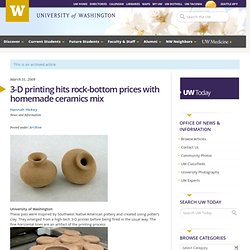
YouTube - Printing Ceramics. DIY Hardware. RepRap: Blog. DLFP: Fabriquer son scanner 3D. La création de modèles en 3D est un travail long et ardu, il nécessite de bonnes compétences ; en d'autres termes, il faut d'excellents artistes/graphistes.
Pour faciliter cette tâche, on peut avoir recours aux scanners 3D, mais c'est onéreux et pas très facile à utiliser. Pourtant, la technologie de la barrière laser n'est pas très compliquée. Techshop. Willkommen beim FoeBuD e.V. — FoeBuD e.V. Vidéoprojecteur DIY. Un livre de Wikilivres.
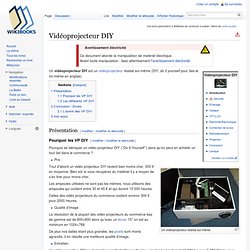
Avertissement électricité Ce document aborde la manipulation de matériel électrique. Le TNWii, un détournement réussi - Éducation. Vous connaissez sans doute le principe du "détournement artistique" qui consiste, en gros, à prendre un objet ou œuvre et à en réaliser une autre à partir de la première. Le plus souvent, il s’agit d’un "détournement de sens" qui vise à parodier ou a critique l’œuvre originale. Ici, il s’agit plutôt d’un "détournement d’usage". Linux - TNWii sous Linux. Pnegre's python-whiteboard at master - GitHub. PRTICE.Info - TNWii. Présentation du TNWii - PRTICE.Info - TNWii. Vous souhaitez avoir un Tableau Numérique Interactif à moindre frais ? Cela est tout à fait possible et le résultat est très satisfaisant.
Vous devez juste disposer des éléments suivants : Steven Johnson: Where good ideas come from. How IBM Uses Social Media to Spur Employee Innovation. “Be yourself.” It’s one of the rules of social media. Robert Accettura’s Fun With Wordage. Building a new product is always fun. Hack a Day. WiNet, wireless Arduino touchscreen. Android hacks. Android app scans barcodes, downloads torrents. Electric VW mobile photobooth. Electric VW Bus Blog. Rapid prototyping with sugar and lasers.
CandyFab relaunched. CandyFabWiki. Table for electronic dreams. Table for Electronic Dreams. Table For Electronic Dreams Electronic objects are not only "smart", they "dream" in the sense that they leak radiation into the space and objects surrounding them, including our bodies. Despite the images of control and efficiency conveyed through a beige visual language of intelligibility and smartness, electronic objects... are irrational - or at least allow their thoughts to wander. Thinking of them in terms of dreaminess rather than smartness opens them to more interesting interpretations.
Lifehacker, tips and downloads for getting things done. Lifehacker - MultiScape Spans a Single Image Across Multiple Des. Machines vivantes ? Maintenant que Wisi 3 est en place et fonctionne comme il faut (les commentaires sont maintenant en rapport avec leur billet), je peux passer à autre chose et vous faire découvrir un personnage absolument extraordinaire. On pourrait le qualifier de poète inventeur, de magicien de notre imagination ou simplement d'illuminé. En tout cas il ne laisse pas indifférent avec ses drôles de bestioles. Arduino - HomePage. Software. Getting started with Arduino. ArduinoNano.
Connecting the Arduino Nano 2.2 to a computer with a Mini-B USB cable. ArduinoBT. This page is temporarily OFFLINE The Arduino BT is an Arduino board with built-in bluetooth module, allowing for wireless communication. Dis-moi si tu préfères bidouiller Arduino ou consommer iPad et j. Parmi la centaine de commentaires provoqués par notre récent article Pourquoi je n’achèterai pas un iPad, on a pu noter une opposition franche entre ceux qui pensaient qu’il était important, voire fondamental, d’avoir la possibilité « d’ouvrir le capot » logiciel et matériel de la bête, et ceux qui n’y voyaient qu’une lubie de geeks passéistes et rétrogrades.
Or aujourd’hui nous allons justement évoquer un drôle d’objet qui accepte d’autant plus volontiers de se mettre à nu qu’il sait que c’est sa principale qualité aux yeux de son enthousiaste et créative communauté. Il s’agit de la carte Arduino qui est un peu à l’électronique ce que le logiciel libre est à l’informatique, puisque le design, les schémas, les circuits et l’environnement de programmation sont disponibles sous licence libre[1]