
Fighting Privatization, Occupy Activists at CUNY and UC Kick Into High Gear. Every afternoon last week, students, teachers, and neighbors gathered to hold classes on UC Berkeley’s Sproul Plaza.
Everyone was welcome. Redefining “public” schools. Student Debt at Colleges and Universities Across the Nation - Interactive Graphic. Chicago Teachers Union Vs. Astroturf Billionaires. Diane Ravitch: First: starve & regulate p... What research exposed about market-based ed reform in 2011 - The Answer Sheet. This was written by Matthew Di Carlo, senior fellow at the non-profit Albert Shanker Institute, located in Washington, D.C.
This post originally appeared on the institute’s blog. By Matthew Di Carlo If 2010 was the year of the bombshell in research in the three “major areas” of market-based education reform – charter schools, performance pay, and value-added in evaluations – then 2011 was the year of the slow, sustained march. Last year, the landmark Race to the Top program was accompanied by a set of extremely consequential research reports, ranging from the policy-related importance of the first experimental study of teacher-level performance pay (the POINT program in Nashville) and the preliminary report of the $45 million Measures of Effective Teaching project, to the political controversy of the Los Angeles Times’ release of teachers’ scores from their commissioned analysis of Los Angeles testing data.
REPORT CARD Here Comes Success. Much of Brooklyn’s school District 15—which includes Park Slope, Carroll Gardens, Cobble Hill, Boerum Hill, and Red Hook—is a comfortable, brownstone-studded idyll, with schools so popular that they drive up real estate values and boast long waiting lists.
What real education reform looks like. As 2011 draws to a close, we can confidently declare that one of the biggest debates over education is — mercifully — resolved.
Student Occupiers: It's the Debt, Stupid. College students have, to some extent, always been poor and hungry.
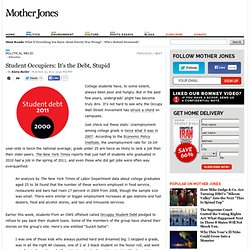
But in the past few years, undergrads' plight has become truly dire. NBC Nightly News Brian Williams: student loans. Casualties of Debt. Dylan Ratigan: Americans Under 35: Going Broke Trying to Become Middle Class? It’s a look at our nation’s future through the eyes of the folks who have to make it work for the next 50 years — Americans under the age of 35.
They’re everywhere across the spectrum, whether it’s stuck in traffic on the way to their job, waiting in the unemployment line, protesting at the Occupy Wall Street demonstrations, or fighting our longest wars in Iraq and Afghanistan. Facing fewer job opportunities and high student loan debt, many 20-somethings now expect that they will do worse in their lifetimes for themselves than their parents generation. Some facts: Average tuition is three times higher today than in 1980.Two out of three students graduate with student loan debt, at an average of over $24,000.African American students are more likely to take out student loans, and to graduate with higher debt levels.The student loan default rate rose 31% over just 2 years.
The full report on The Economic State of Young America is available at Demos’ website. Erica Cadell: I’ll be 20. Student Loans (U.S.) USAToday: Student loans outstanding will exceed $1 trillion this year. Students and workers seeking retraining are borrowing extraordinary amounts of money through federal loan programs, potentially putting a huge burden on the backs of young people looking for jobs and trying to start careers.
The amount of student loans taken out last year crossed the $100 billion mark for the first time and total loans outstanding will exceed $1 trillion for the first time this year. Americans now owe more on student loans than on credit cards, reports the Federal Reserve Bank of New York, the U.S. Department of Education and private sources. Students are borrowing twice what they did a decade ago after adjusting for inflation, the College Board reports. Total outstanding debt has doubled in the past five years — a sharp contrast to consumers reducing what's owed on home loans and credit cards. Taxpayers and other lenders have little risk of losing money on the loans, unlike mortgages made during the real estate bubble. •Defaults. The American Nightmare: Student Debt Will Be A Long-Term Drag On The Economy. Student Loan Debt Leads to Despair, Defaults.
(Corrects Bureau name in sixth paragraph.)
William Prince, of Rosenberg, Texas, knows just how inescapable student loans can be. The 52-year-old father of two started paying off $51,000 in college debt 15 years ago and now owes $57,000. "I don't expect to pay these loans off in my lifetime," he says. Prince, a criminal justice major who works in private security, had to defer payments during three bouts of unemployment, and the accumulated interest left him deeper in debt. Americans now owe about $950 billion in student loans — more than their total credit-card debt. Occupy colleges? How to shut down student debt – Reuters.
One of the more compelling issues to emerge from the Occupy Wall Street movement is subject of crushing student debt.
College financing has gotten to be too onerous and complicated, so it’s difficult for families to negotiate the process and, as a result, it’s hobbling graduates’ attempts to live normal lives. Congress has largely ignored these Americans, though, as it focuses on the national debt and the Tea Party agenda. Proprietary colleges. There are three types of for-profit schools.
One type is known as an educational management organization (EMO), and these are primary and secondary educational institutions. EMOs work with school districts or charter schools, using public funds to finance operations. The majority of for-profit schools in the K–12 sector in America function as EMOs, and have grown in number in the mid-2000s. The other major category of for-profit schools are post-secondary institutions which operate as businesses, receiving fees from each student they enroll.
College Board reveals the real Occupy Wall Street problem - ComPost. “This is the only dollar I have after my student loan payment.” (SHANNON STAPLETON - REUTERS) Thumb through the Tumblr of the 99 percent, and one phrase comes up again and again: Student Loans. Student Loans. Student Loans. WP: A primer on corporate school reform - The Answer Sheet. This is an edited version of a commentary given by Stan Karp, a teacher of English and journalism in Paterson, N.J., for 30 years.
Karp spoke on Oct. 1 at the fourth annual Northwest Teachers for Justice conference in Seattle. He is now the director of the Secondary Reform Project for New Jersey’s Education Law Center and an editor of the 25-year-old Rethinking Schools magazine. A video and fuller version of the commentary can be found here. By Stan Karp “Corporate education reform” refers to a specific set of policy proposals currently driving education policy at the state and federal level.
*increased test-based evaluation of students, teachers, and schools of education. Chris Hedges: Empire of Illusion. USA. New Orleans: Beachhead for Corporate Takeover of Public Schools « Education Talk New Orleans. Lance Hill (@LanceHill2011) sur Twitter. Yes, the marketization of education is still a bad idea « Kritische Studenten Utrecht. Posted by kritischestudentenutrecht under Oktober 2011 | Tags: onderwijsbeleid, zijlstra | [2] Comments by Alexander Beunder This article appears in Krantje Boord #9 Oktober 2011. Future of Journalism -justanotherpicnic- Students / teachers / facilitators protests initiatives. United Kingdom as analogue ? Demise of journalistic independency & access to Uni / HE Media. University Inc. - corporate corruption of Research & Higher Education. Play 'corporate òr state' publishing power. Play corporate edu power.
Bill Gates' Big Play: How Much Can Money Buy in Education? - Living in Dialogue. The Regency -University of California - UC. OWS – Make Sure Education is on the Agenda! On Saturday afternoon, while driving through downtown Spokane – as isolated and homogeneous a city as you can imagine – we drove past a small group of Occupy Wall Street protesters. We rolled down the windows, clapped, honked, and cheered, but couldn’t take time out from our busy consumerist life to participate. I feel that this is the sentiment of most of the "99%," and it is sad because this movement is something I personally have been looking for since 2004.
What I failed to understand until recently, is that the revolution could start right under our noses and many of us wouldn’t even realize it – despite how important it is to our future. The people’s movement currently underway in more than 100 cities across the, U.S. and 1,500+ cities globally, is important in many ways, but none more so than for what it could mean for education. Harvard economics professor Lawrence Lessig explains the larger meaning of the Occupy Wall Street movement: How Online Learning Companies Bought America's Schools. This article was reported in partnership with The Investigative Fund at The Nation Institute. Gothamschools: ‘Occupy the DOE’ Since the first protesters arrived at Zuccotti park nearly five weeks ago, the Occupy Wall Street movement has ignited protests from California to the United Kingdom. The city Department of Education could be next. Leia petty (@cleiapatra) sur Twitter. The Big Picture: undercurrents / influences / inspirations.
Corporate Accountability. If the national movement to "reform" public education through vouchers, charters and privatization has a laboratory, it is Florida. Silent Majority: California's War on its Students. Guardian: Birmingham University gets high court injunction against sit-in protesters. Universities hold students' transcripts hostage over debt.