
Controversial... Rhetoric & Fallacies. Religioskeptic. Hoax & Urban Legends. Responsible thinking web sites. Critical Thinking sites: These sites discuss critical thinking and common errors in reasoning.
The Critical Thinking Community While perhaps the most widely referenced site on critical thinking, the style of the above site is far too dry and academic for my taste. Wikipedia entries for logical fallacies and cognitive biases: Fallacies Biases This is a site that addresses the importance of critical thinking for improving society, a very important but rarely stated motivation for critical thinking. Mindvendor Skepticism Sites: Skeptical writers are usually concerned with making arguments against supernatural and sensational claims, while in this site I try to avoid taking sides on controversial issues such as these. Skeptical Information Information about Urban Legends This is a great site that checks into all kinds of stories, rumors, hoaxes and scams. Avoiding Misleading Political Arguments (Spin) FactCheck.org This site has information about candidates and elected officials Project Vote Smart.
Main Page - FreeThoughtPedia. NoBeliefs.com (Freethinkers) Dalai Lama tells his Facebook friends that religion "is no longer adequate" Well, he'd hardly be the first Buddhist to say something like this.
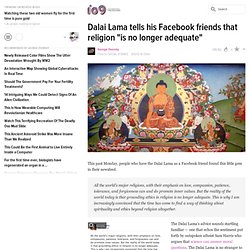
From what I've read, there are already lots of Buddhists, and historical Buddhist movements in various countries, who are atheistic and who prefer to return to Buddhism's roots as a kind of self-help, personal psychological and philosophical system—and yes, I realize I'm hugely oversimplifying that ideological stripe of Buddhism—and that's fine. And if this helps the world be a better place, cool.
I'm all for it. But as an atheist I had already got to this point without making sand paintings, spinning prayer wheels or staring at stupas or rock gardens to shut off all mental processes and get to Satori. On Truth & Reality: Philosophy Physics Metaphysics of Space, Wave Structure of Matter. Famous Science Art Quotes. Bad Science. Nonsense. Cognitive bias. Systematic pattern of deviation from norm or rationality in judgment Although it may seem like such misperceptions would be aberrations, biases can help humans find commonalities and shortcuts to assist in the navigation of common situations in life.[5] Some cognitive biases are presumably adaptive.
Cognitive biases may lead to more effective actions in a given context.[6] Furthermore, allowing cognitive biases enables faster decisions which can be desirable when timeliness is more valuable than accuracy, as illustrated in heuristics.[7] Other cognitive biases are a "by-product" of human processing limitations,[1] resulting from a lack of appropriate mental mechanisms (bounded rationality), impact of individual's constitution and biological state (see embodied cognition), or simply from a limited capacity for information processing.[8][9] Overview[edit] The "Linda Problem" illustrates the representativeness heuristic (Tversky & Kahneman, 1983[14]). Browne,Keeley - Asking the Right Questions, A Guide to Critical Thinking, 8th Ed.pdf. Skeptic » Home » The Skeptics Society & Skeptic magazine.
Skepticality - The Official Podcast of The Skeptics Society & Skeptic Magazine. Michael Shermer: The pattern behind self-deception. Michael Shermer. Home - The Skeptics' Guide to the Universe. The Skeptic's Dictionary. - RichardDawkins.net. James Randi Educational Foundation. Skeptical Software Tools. Freethought Blogs. Optical Illusions and Visual Phenomena. Pharyngula. SourceWatch. Koch Spy Agency Led by Voter Fraud Huckster The Kochs have been complaining about a "lack of civility in politics" as they seek to boost their public image--but one of their top operatives helped propel perhaps the most egregious case of race-baiting voter fraud hucksterism in recent years.

At the same time that the Kochs have been on a PR blitz, publicly spinning an image of themselves as well-intentioned patriots trying to make the world a better place and decrying "character assassination," they've been quietly ramping up a clandestine surveillance and intelligence gathering operation focused on their perceived political enemies, Ken Vogel reports at Politico. At the helm of this "competitive intelligence" operation is a man named Mike Roman, Vice President of Research for Kochs' Freedom Partners and who was paid $265,000 last year, according to Freedom Partners' recent tax filing. Read the rest of this item here. SkeptiCamp. Home. Gibson's law. See also[edit] Clarke's three laws, including Clarke's fourth law: "For every expert there is an equal and opposite expert.
" References[edit] Jump up ^ Proctor, Robert .N. (2004). "Should medical historians be working for the tobacco industry? ". Category:Skeptic organisations. Prix-Défi de 200.000 euros. Afis - Association française pour l'information scientifique. Défi zététique international. Un article de Wikipédia, l'encyclopédie libre.

Le défi zététique international (du grec zêtêin, « chercher ») avait pour objet de mettre en évidence l'existence ou l'inexistence de phénomène(s) paranormal(aux). Lancé en 1987, il promettait un prix « pour la preuve d'un phénomène paranormal, quel qu'il soit, devant Henri Broch, Gérard Majax, Jacques Theodor ». Il s'agissait de la version francophone du One Million Dollar Challenge de James Randi. Initialement de 500 000 francs, le prix a été porté à 1 000 000 francs en 1992, puis à 200 000 euros en 1999. Les Sceptiques du Québec. Science, croyance et idées reçues. Scepticisme et esprit critique en Santé, médecine, paranormal, science, pseudoscience, technologie et impostures en tous genres. Skeptical Investigations - homepage.
Zététique. Un article de Wikipédia, l'encyclopédie libre.
Pour la définition de la zététique comme partie des mathématiques, voir Algèbre nouvelle. La zététique est définie comme « l'art du doute » par Henri Broch[1].