
MIT Department of Earth, Atmospheric and Planetary Sciences (EAPS) The Cause Of Riots And The Price of Food. What causes riots?
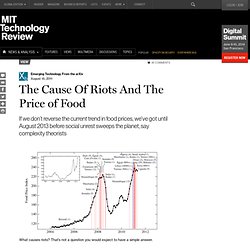
That’s not a question you would expect to have a simple answer. But today, Marco Lagi and buddies at the New England Complex Systems Institute in Cambridge, say they’ve found a single factor that seems to trigger riots around the world. This single factor is the price of food. Lagi and co say that when it rises above a certain threshold, social unrest sweeps the planet. The evidence comes from two sources. This clearly seems to show that when the food price index rises above a certain threshold, the result is trouble around the world. This isn’t rocket science. But what’s interesting about this analysis is that Lagi and co say that high food prices don’t necessarily trigger riots themselves, they simply create the conditions in which social unrest can flourish.
Common Sense Computing Initiative. ConceptNet aims to give computers access to common-sense knowledge , the kind of information that ordinary people know but usually leave unstated. The data in ConceptNet is being collected from ordinary people who contributed it on sites like Open Mind Common Sense . ConceptNet represents this data in the form of a semantic network, and makes it available to be used in natural language processing and intelligent user interfaces. ConceptNet is an open source project, with a Python implementation and a REST API that anyone can use to add computational common sense to their own project.
A great tool to help you use ConceptNet in your software is Divisi . Some of the nodes and links in ConceptNet. Places to go next ConceptNet Development Team Current developers. MIT's artificial leaf is ten times more efficient than the real thing. Speaking at the National Meeting of the American Chemical Society in California, MIT professor Daniel Nocera claims to have created an artificial leaf, made from stable and inexpensive materials, which mimics nature's photosynthesis process.
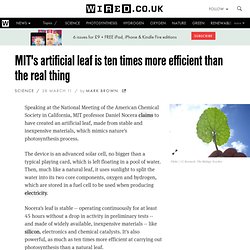
The device is an advanced solar cell, no bigger than a typical playing card, which is left floating in a pool of water. Then, much like a natural leaf, it uses sunlight to split the water into its two core components, oxygen and hydrogen, which are stored in a fuel cell to be used when producing electricity. Nocera's leaf is stable -- operating continuously for at least 45 hours without a drop in activity in preliminary tests -- and made of widely available, inexpensive materials -- like silicon, electronics and chemical catalysts.
Should good leaders embrace uncertainty? "Leaders are overrated. " That's how MIT Media Lab director Joichi Ito started off his presentation at IBM's THINK global leadership summit in New York City, drawing much laughter and perhaps the ire of a few quiet holders of masters of business administration degrees. Ito took to the stage solo to wonder, openly, about the value of the title "leader" in an age where many less hierarchical organizations have proven their worth through connected technology. "Open source is interesting because people decide what they want to do," he said, citing Mozilla, the non-profit organization behind the Firefox browser, and Wikipedia, the free collaborative online encyclopedia.
"With proper incentivation, it's more efficient than [managing by] the Newtonian leadership model. " "We believe enlightened self-interest is what makes the world go round. At Wikipedia, he said, the community pushes members into leadership roles. "You'd never get them to do it, even if you paid," he said with a smile. Office of Digital Learning. Common Sense Computing Initiative.
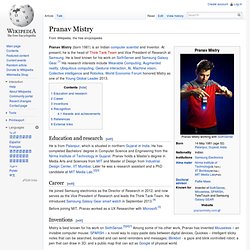
SIMILE Project. The Mind Machine Project. Free Online Course Materials. Global MIT. Lincoln Laboratory. Fluid Interfaces. Pranav Mistry. Pranav Mistry (born 1981) is an Indian computer scientist and Inventor.
MIT App Inventor. MIT Media Lab. Deb Roy - MIT Media Laboratory. Technology Review: The Authority on the Future of Technology. Camera Culture, MIT Media Lab. The Camera Culture Group is looking for outstanding people who can seamlessly work with an energetic team with cross-domain expertise.
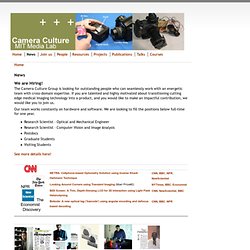
If you are talented and highly motivated about transitioning cutting edge medical imaging technology into a product, and you would like to make an impactful contribution, we would like you to join us. Our team works constantly on hardware and software. We are looking to fill the positions below full-time for one year. Research Scientist – Optical and Mechanical Engineer Research Scientist – Computer Vision and Image Analysis Postdocs Graduate Students Visiting Students See more details here! Deb Roy: The birth of a word. MIT Media Lab: Reality Mining. MIT Media Lab (medialab) MIT Video.
Chaîne de MIT. The open documentary lab. MIT’s Open Documentary Lab brings technologists, storytellers, and scholars together to advance the new arts of documentary. YouTomb. Students for Free Culture. MIT Computer Science and Artificial Intelligence Laboratory. Saxelab Social Cognitive Neuroscience Laboratory at MIT. Welcome to MIT Architecture. Distributed Intelligence. MIT Center for Collective Intelligence.
MIT management professor Tom Malone on collective intelligence and the “genetic” structure of groups. Do groups have genetic structures?
Hacks at the Massachusetts Institute of Technology. A hack in progress in Lobby 7.
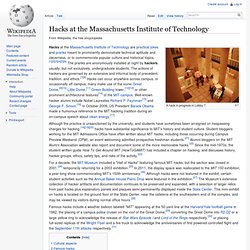
Although the practice is unsanctioned by the university, and students have sometimes been arraigned on trespassing charges for hacking,[18][19][20] hacks have substantial significance to MIT's history and student culture. Student bloggers working for the MIT Admissions Office have often written about MIT hacks, including those occurring during Campus Preview Weekend (CPW), an event welcoming admitted prospective freshman students.[21] Alumni bloggers on the MIT Alumni Association website also report and document some of the more memorable hacks.[22] Since the mid-1970s, the student-written guide How To Get Around MIT (HowToGAMIT) has included a chapter on hacking, and discusses history, hacker groups, ethics, safety tips, and risks of the activity.[23] Cultural aspects[edit] MIT License. The MIT License is a free software license originating at the Massachusetts Institute of Technology (MIT).
It is a permissive free software license, meaning that it permits reuse within proprietary software provided all copies of the licensed software include a copy of the MIT License terms. Such proprietary software retains its proprietary nature even though it incorporates software under the MIT License. The license is also GPL-compatible, meaning that the GPL permits combination and redistribution with software that uses the MIT License.[1] Various versions[edit]
IHTFP Hack Gallery: Welcome to the IHTFP Gallery! MIT. Massachusetts Institute of Technology 150th anniversary. Cameramit. Massachusetts Institute of Technology. MIT is often cited as among the world's top universities.[10][11][12][13] As of 2014[update], 81 Nobel laureates, 52 National Medal of Science recipients, 45 Rhodes Scholars, 38 MacArthur Fellows, and 2 Fields Medalists have been affiliated with MIT.

MIT has a strong entrepreneurial culture and the aggregated revenues of companies founded by MIT alumni would rank as the eleventh-largest economy in the world.[14] History[edit] Foundation and vision[edit] Rogers, a professor from the University of Virginia, wanted to establish an institution to address rapid scientific and technological advances.[19][20] He did not wish to found a professional school, but a combination with elements of both professional and liberal education,[21] proposing that: The Rogers Plan reflected the German research university model, emphasizing an independent faculty engaged in research, as well as instruction oriented around seminars and laboratories.[23][24] Early developments[edit] In Profile: Ramesh Raskar. In 2007, Ramesh Raskar was one of the most promising young researchers at the Mitsubishi Electric Research Labs in Cambridge, Mass.
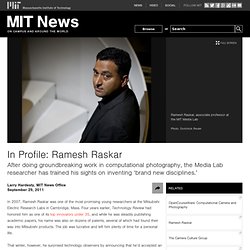
Four years earlier, Technology Review had honored him as one of its top innovators under 35, and while he was steadily publishing academic papers, his name was also on dozens of patents, several of which had found their way into Mitsubishi products. The job was lucrative and left him plenty of time for a personal life. That winter, however, he surprised technology observers by announcing that he’d accepted an appointment to the MIT Media Lab for the following spring. Despite a cut in pay, he’d have to work longer hours, piling administrative and teaching duties on top of his research. But to Raskar, the move made sense. MIT Game Lab.