
Eric Berlow: How complexity leads to simplicity. Complicated VS Complex. What’s the difference between sending a rocket to the moon and getting children to succeed in school?

What’s the difference between a surgeon extracting a brain tumor and judge and jury deciding guilt or innocent for a person accused of murder? Answers: sending a rocket to the moon and surgeons extracting brain tumors are complicated tasks while getting children to succeed in school (or, for that matter, raising a child) and the criminal justice system are complex. According to York University (Ontario, Canada) business professor Brenda Zimmerman, complicated procedures like brain surgery and rocket launchings require engineer-designed blueprints, step-by-step algorithms, well-trained staff, and exquisite combinations of computer software running carefully calibrated equipment.
Simplexity. Simplexity is an emerging theory that proposes a possible complementary relationship between complexity and simplicity.
The term draws from General Systems Theory, Dialectics (philosophy) and Design. Jeffrey Kluger wrote a book about this phenomenon that describes how house plants can be more complicated than industrial plants, how a truck driver's job can be as difficult as a CEO's and why 90% of the money donated to help cure diseases are given only to the research of 10% of them (and vice versa). The term has been adopted in advertising, marketing and the manufacture of left-handed screwdrivers. Design aspects[edit] Complexity tends to rise as system elements specialize and diversify to solve specific challenges.Simple interfaces tend to improve the usability of complex systems. History of the term[edit] Carte conceptuelle : la simplexité.
Alain Berthoz - La Simplexité - 2009 - une vidéo High-tech et Science. "if you can't explain it simply you don't understand it well enough" Simplification Centre. Keep it Simple, Stupid. Un article de Wikipédia, l'encyclopédie libre.
Keep it simple, stupid (en français, mot à mot : « garde ça simple, idiot », dans le sens de « ne complique pas les choses »), ou principe KISS, est une ligne directrice de conception qui préconise la simplicité dans la conception et que toute complexité non indispensable devrait être évitée dans toute la mesure du possible. Ce principe est appliqué dans grand nombre de disciplines telles que le développement logiciel, l'animation, le journalisme, la photographie, l'ingénierie, l'aviation et la planification stratégique. La complexité, souvent utile pour assurer de bonnes performances, est en effet elle-même une source de coûts de conception et de maintenance, ainsi qu'une source potentielle d'erreurs. L'idée est de ne pas optimiser quoi que ce soit avant de maîtriser totalement une version simple de ce que l'on crée.
Variantes en anglais et traductions[modifier | modifier le code] "keep it simple, stupid" - 1,400,000. The Kiss Principle. What does KISS stand for?
The KISS is an abbreviation of Keep It Stupid Simple or Keep It Simple, Stupid What does that mean? This principle has been a key, and a huge success in my years of software engineering. A common problem among software engineers and developers today is that they tend to over complicate problems. George Whitesides: Toward a science of simplicity. Simplicity. Complexity.
Complexity is generally used to characterize something with many parts where those parts interact with each other in multiple ways.
The study of these complex linkages is the main goal of complex systems theory. Embrasser la complexité. Complexe ou compliqué ? Un Airbus serait plutôt compliqué.
Un organisme vivant serait plutôt complexe. Occam's razor. The sun, moon and other solar system planets can be described as revolving around the Earth.
However that explanation's ideological and complex assumptions are completely unfounded compared to the modern consensus that all solar system planets revolve around the Sun. Principle of least astonishment. The principle of least astonishment (POLA) applies to user interface and software design, from the ergonomics standpoint.[1] It is alternatively referred to as the law, principle or rule of least astonishment, or least surprise.[2][3] "If a necessary feature has a high astonishment factor, it may be necessary to redesign the feature.
"[4] Formulation[edit] Examples[edit] The F1 Function key in Windows operating systems is almost always for opening a help program associated with a software, and similarly for some of the Linux desktop environments. Simplicity Theory - Unexpectedness. Chartjunk. An example of a chart containing gratuitous chartjunk.
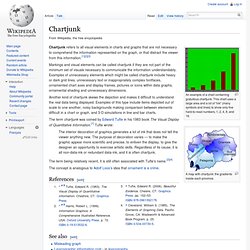
This chart uses a large area and a lot of "ink" (many symbols and lines) to show only five hard-to-read numbers, 1, 2, 4, 8, and 16. Chartjunk refers to all visual elements in charts and graphs that are not necessary to comprehend the information represented on the graph, or that distract the viewer from this information.[1][2][3] Markings and visual elements can be called chartjunk if they are not part of the minimum set of visuals necessary to communicate the information understandably. KISS principle. Design principle preferring simplicity Origin[edit] While popular usage has transcribed it for decades as "Keep it simple, stupid", Johnson transcribed it as "Keep it simple stupid" (no comma), and this reading is still used by many authors.[7] The principle is best exemplified by the story of Johnson handing a team of design engineers a handful of tools, with the challenge that the jet aircraft they were designing must be repairable by an average mechanic in the field under combat conditions with only these tools.
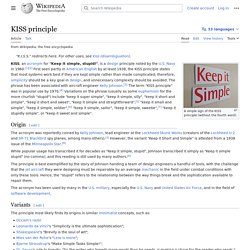
Hence, the "stupid" refers to the relationship between the way things break and the sophistication available to repair them. The Simplex Process - Problem Solving Training from MindTools. A Robust Creative Problem-Solving Process Work through the cycle. © iStockphoto/centyr When you're solving business problems, it's all-too-easy easy to skip over important steps in the problem-solving process, meaning that you can miss good solutions, or, worse still, fail to identify the problem correctly in the first place.
One way to prevent this happening is by using the Simplex Process.