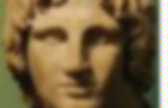
Buo. Bio. Alexander the Great. During his youth, Alexander was tutored by the philosopher Aristotle until the age of 16. When he succeeded his father to the throne in 336 BC, after Philip was assassinated, Alexander inherited a strong kingdom and an experienced army. He had been awarded the generalship of Greece and used this authority to launch his father's military expansion plans. In 334 BC, he invaded the Achaemenid empire, ruled Asia Minor, and began a series of campaigns that lasted ten years.
Alexander broke the power of Persia in a series of decisive battles, most notably the battles of Issus and Gaugamela. He subsequently overthrew the Persian King Darius III and conquered the entirety of the Persian Empire.i[›] At that point, his empire stretched from the Adriatic Sea to the Indus River. Seeking to reach the "ends of the world and the Great Outer Sea", he invaded India in 326 BC, but was eventually forced to turn back at the demand of his troops. Early life Lineage and childhood Adolescence and education. Alexander the Great in Egypt. Alexander in Egypt by Alan M. Fildes & Dr.
Joann Fletcher Alexander III of Macedon (356-323 bc), better known to history as 'Alexander the Great', spent several months in Egypt as part of his on-going campaign against the mighty Persian Empire of Darius III. After conquering Persia's naval bases all along the coastline of Asia Minor and Syria-Palestine, Alexander marched south into Egypt where he remained for some six months. With his reputation going before him, Alexander was met by Egypt's Persian governor Mazaces. Greek travelers had actually been visiting Egypt for centuries, many of them setting up trading colonies or acting as mercenaries. Alexander was therefore hailed as Savior and Liberator, and as the people's choice and legitimate heir he was offered the double crown of the Two Lands.
Always a devout man who began each day with sacrifices to the gods, Alexander had no difficulty worshipping the Egyptian deities. Amun and the chosen one of Ra - meryamun setepenra Aleksandros". Alexander the Great. Alexander III of Macedon, known as Alexander the Great (21 July 356 BCE – 10 or 11 June 323 BCE), was the son of King Philip II of Macedon. He became king upon his father’s death in 336 BCE and went on to conquer most of the known world of his day. He is known as 'the great' both for his military genius and his diplomatic skills in handling the various populaces of the regions he conquered. He is further recognized for spreading Greek culture, language, and thought from Greece throughout Asia Minor, Egypt, and Mesopotamia to India and thus initiating the era of the "Hellenistic World".
Alexander's Youth When Alexander was young, he was taught to fight and ride by Leonidas, a relative of his mother Olympias, as well as to endure hardships such as forced marches. His father, Philip, was interested in cultivating a refined future king so hired Lysimachus of Acarnania to teach the boy reading, writing, and to play the lyre.
Charonea & the Early Campaigns The Persian Campaigns India & Mutiny. Bio of Alexander the Great. Alexander the Great Alexander the Great coin Alexander the Great (352-323 B.C.) came from Macedonia. Alexander had conquered much of Greece and the Levant by the time he was about 20 years old. In 332 B.C. Alexander conquered Egypt. He founded the city of Alexandria on the Mediterranean coast, then left Egypt to continue his battles in the Near East. Close.