
Règles FORWARD et NAT. Education and Services. Interested in Snort education?

Sourcefire, the creators of Snort, offers classroom and virtual instructor-led training as well as on-demand and onsite training for Open Source Snort and Rule Writing Best Practices. As a “Trusted CPE Provider” for (ISC)2, Sourcefire offers students holding certifications as a System Security Certified Practitioner (SSCP) or as a Certified Information Systems Security Professional (CISSP) the ability to earn one Continuing Professional Education (CPE) credit for each hour of education completed. To obtain credit for Instructor-led, virtual and on-demand courses students should provide their SSCP or CISSP number on the registration form, and Sourcefire takes care of the rest. Comment bien choisir son mot de passe.
Je vous ai déjà parlé du bon choix d’un mot de passe mais je pense qu’il est nécessaire de revenir sur quelques principes de base en cassant un peu quelques idées reçues.

Après la lecture de un ou deux articles sur le sujet, j’étais bien tenté de moi aussi vous faire passer le message. Mais ce qui m’a vraiment décidé, c’est ça: xkcd En gros, aujourd’hui, nous sommes beaucoup à utiliser les mêmes techniques mnémotechniques pour nos mots de passe. Nagios - The Industry Standard in IT Infrastructure Monitoring. Nagios made easy. In depth: What's the best way to monitor multiple Linux servers for configuration errors, high load or other problems? The answer is Nagios, which is a fantastic (and free!) Networking monitoring system that lets you track multiple servers (HTTP, SMTP, SSH and more) across multiple machines, all backed by a neat user interface. Nagios gives you an unbeatable overview of all your machines, meaning that you can fix upcoming problems before they turn critical and be certain that you're not missing anything about your network. The basic structure of Nagios is pretty simple: you set up one machine as your Nagios server, and it gathers information on the client machines you point it at, then displays it in a neat web page format.
Read on to learn how to get started with Nagios on your own network! It's incredibly versatile, configurable, and powerful. Initial server setup First of all we'll tackle getting the central Nagios server set up, and enable reporting via the web front-end. 4 Steps to Define Nagios Contacts With Email and Pager Notification. Nagios is one of the best open source server and network monitoring solutions available.

Using the flexible nagios framework, you can monitor pretty much anything (including database and custom application). This article, using 4 simple steps, explains how to setup contact definitions who will get notification when a host or service has any issues. Earlier we also discussed about how to setup Nagios and monitor Windows server, monitor Linux Server, monitor VPN sessions and monitor network switch. 1. Define Generic Contact Template in templates.cfg Nagios installation gives a default generic contact template that can be used as a reference to build your contacts. Network Management with Nagios. When I started with the John Deere Agricultural Marketing Center, we had 12 sites around the US and Canada.
These locations had a mixture of equipment, older servers and desktops providing all functions from domain services to printing. That presented a problem to us functioning as a centralized IT organization. How could we manage and monitor the servers and WAN lines in these diverse sites? About two years ago, we decided to move the user data from the center of our network out to the edges. But how could we monitor all the equipment from multiple manufacturers across all the sites? Because of this diverse setup, no manufacturer's management toolset served our needs, and the idea of using multiple tools to monitor everything was not something I wanted to do. As we started to lose faith that anything existed to fit our situation, I ran across a project called NetSaint. Everything went along fine, with NetSaint performing its job reliably in one of the smaller units of John Deere.
How to Build a Distributed Monitoring Solution with Nagios. How to Build a Distributed Monitoring Solution with Nagios With Nagios, the leading open source infrastructure monitoring application, you can monitor your whole enterprise by using a distributed monitoring scheme in which local slave instances of Nagios perform monitoring tasks and report the results back to a single master. You manage all configuration, notification, and reporting from the master, while the slaves do all the work. This design takes advantage of Nagios's ability to utilize passive checks – that is, external applications or processes that send results back to Nagios. In a distributed configuration, these external applications are other instances of Nagios. Nagios is currently not checking for external commands. Free software downloads. Mertech Solutions - Home. The OpenVPN User Manager is designed to make viewing and managing your OpenVPN server painless.

This is the successor to the OpenVPN Status Viewer. This new version uses the management console of OpenVPN as opposed to reading the status file. If you have any problems with this program please send us an email. Features: General information about users Instant search of users, servers, logs and time blocks Tracking of users, collects connection/disconnection times and bytes sent/received. How to setup You must set the management option in your OpenVPN configuration file. An example: management 192.168.0.10 5555 pass.txt This will start the management console on interface 192.168.0.10 with port 5555 and will search the first line of pass.txt for a password. OpenVPN Web GUI. Créer une autorité de certification et des certificats SSL auto-signés.
Bonjour à tous !

Sécuriser votre serveur SSH. Si vous gérez votre propre serveur, vous possédez forcement une connexion SSH pour y accéder à distance.
SSH est indispensable car en plus de fournir un accès en ligne de commande à votre serveur, il permet de se passer complètement de serveur FTP et de déposer vos fichiers en SFTP (SSH File Transfer Protocol). Je ne suis pas un grand guru de l'admin linux mais je me débrouille, donc si ça vous intéresse, voici un petit tuto ssh pour paramétrer convenablement votre serveur SSH et le sécuriser un minimum. Vous allez voir, ça peut aller assez vite et vous éviter bien des emmerdements. Tous mes tests ont été fait sur une Ubuntu. Configurer et utiliser SSH. Nous allons faire nos premières expérences avec ssh.
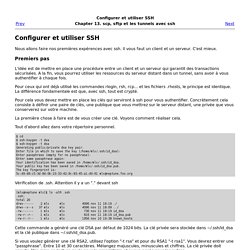
Il vous faut un client et un serveur. C'est mieux. Un lecteur réseau pour votre serveur (SFTP) Un lecteur réseau pour votre serveur (SFTP) SFTP Net Drive est une application gratuite pour Windows qui va vous permettre de connecter comme lecteur réseau, un serveur en SFTP (via SSH donc).

Ainsi vous pourrez manipuler des fichiers se trouvant sur votre serveur, y copier des trucs ou pourquoi pas récupérer les films qui se trouvent sur votre seedbox... On peut tout imaginer. Seule déception, SFTP Drive n'autorise qu'une connexion à la fois.