Principal Component Analysis step by step. In this article I want to explain how a Principal Component Analysis (PCA) works by implementing it in Python step by step.
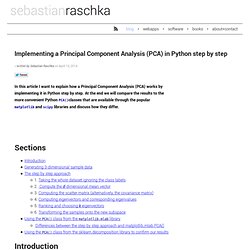
At the end we will compare the results to the more convenient Python PCA()classes that are available through the popular matplotlib and scipy libraries and discuss how they differ. The main purposes of a principal component analysis are the analysis of data to identify patterns and finding patterns to reduce the dimensions of the dataset with minimal loss of information. Here, our desired outcome of the principal component analysis is to project a feature space (our dataset consisting of n x d-dimensional samples) onto a smaller subspace that represents our data "well".
A possible application would be a pattern classification task, where we want to reduce the computational costs and the error of parameter estimation by reducing the number of dimensions of our feature space by extracting a subspace that describes our data "best". What is a "good" subspace? PyMC User’s Guide — PyMC 2.3 documentation.
Python Data Analysis Library — pandas: Python Data Analysis Library. Machine learning in Python. PyPI - the Python Package Index. Welcome to PyBrain’s documentation! — PyBrain v0.3 documentation. The documentation is build up in the following parts: first, there is the quickstart tutorial which aims at getting you started with PyBrain as quickly as possible.
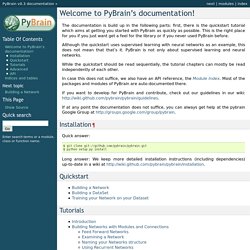
This is the right place for you if you just want get a feel for the library or if you never used PyBrain before. Although the quickstart uses supervised learning with neural networks as an example, this does not mean that that’s it. PyBrain is not only about supervised learning and neural networks. While the quickstart should be read sequentially, the tutorial chapters can mostly be read independently of each other.
In case this does not suffice, we also have an API reference, the Module Index. If you want to develop for PyBrain and contribute, check out our guidelines in our wiki: If at any point the documentation does not suffice, you can always get help at the pybrain Google Group at Installation Quick answer: $ git clone $ python setup.py install. IntegratingPythonWithOtherLanguages. [Hint: The idea is to create pages for the stuff, not just link it.]

There a various tools which make it easier to bridge the gap between Python and C/C++: Pyrex - write your extension module on Python Cython -- Cython -- an improved version of Pyrex CXX - PyCXX - helper lib for writing Python extensions in C++ SCXX ctypes is a Python module allowing to create and manipulate C data types in Python. Templating.
Templating, and in particular web templating is a way to represent data in different forms.
These forms often (but not always) intended to be readable, even attractive, to a human audience. Frequently, templating solutions involve a document (the template) and data. Template usually looks much like the final output, with placeholders instead of actual data (or example data in simplified form), bears common style and visual elements. Data which is presented using that template may be also separated in two parts - data required to be rendered, and data required for template itself (navigation elements if it is a site, button names if it is some UI). Combining template+data produces the final output which is usually (but not always) a web page of some kind.
Templating Engines There are many, many different HTML/XML templating packages and modules for Python that provide different feature sets and syntaxes. Engines using Value Substitution Engines Mixing Logic into Templates CategoryTemplate. CodeSkulptor. The Python Tutorial. Python is an easy to learn, powerful programming language.
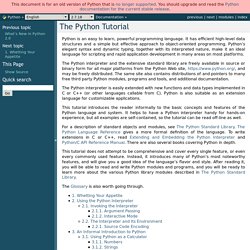
It has efficient high-level data structures and a simple but effective approach to object-oriented programming. Python’s elegant syntax and dynamic typing, together with its interpreted nature, make it an ideal language for scripting and rapid application development in many areas on most platforms. The Python interpreter and the extensive standard library are freely available in source or binary form for all major platforms from the Python Web site, and may be freely distributed. The same site also contains distributions of and pointers to many free third party Python modules, programs and tools, and additional documentation.
The Python interpreter is easily extended with new functions and data types implemented in C or C++ (or other languages callable from C). This tutorial introduces the reader informally to the basic concepts and features of the Python language and system. The Glossary is also worth going through. Hands-On Python A Tutorial Introduction for Beginners. Hands-On Python A Tutorial Introduction for Beginners Contents Chapter 1.