
Saas maths. VC industry dynamics. Web Marketing. Web Industry Topics. Identité2.0. Liste de start-up. Online ad. Education online. Demat facture. Lead Business. Localbiz. Business Model Web. Content / media. Web 2.0 monetization. Ecommerce. Innover les business models par la monétisation. Je participe depuis quelques mois à un travail collectif avec le réseau Entrepreneurs d’Avenir, sur une réflexion sur l’innovation des business models.
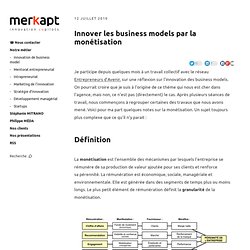
On pourrait croire que je suis à l’origine de ce thème qui nous est cher dans l’agence, mais non, ce n’est pas (directement) le cas. Après plusieurs séances de travail, nous commençons à regrouper certaines des travaux que nous avons mené. Voici pour ma part quelques notes sur la monétisation. Un sujet toujours plus complexe que ce qu’il n’y parait : Définition La monétisation est l’ensemble des mécanismes par lesquels l’entreprise se rémunère de sa production de valeur ajoutée pour ses clients et renforce sa pérennité.
Business Model Selon la nature de l’entreprise, elle privilégiera naturellement une forme ou une autre de rémunération : Innovations Une première forme d’innovation est la capacité pour une entreprise de toute nature, de générer équitablement les quatre formes de rémunération, afin de maximiser sa pérennité. "Nous assistons à un retour des mega-deals" Spécialiste des levées de fonds, Pascal Mercier estime que le marché est en train de rentrer dans un cercle vertueux semblable à celui de 2004.

Il anticipe en particulier des investissements dans le secteur de la data. Chris dixon's blog / The segmentation of the venture industry. Ford Motors dominated the auto market in the early 20th century with a single car model, the Model T.
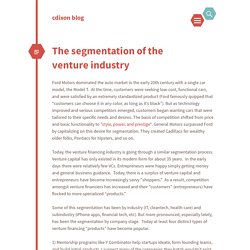
At the time, customers were seeking low-cost, functional cars, and were satisfied by an extremely standardized product (Ford famously quipped that “customers can choose it in any color, as long as it’s black”). But as technology improved and serious competitors emerged, customers began wanting cars that were tailored to their specific needs and desires. The basis of competition shifted from price and basic functionality to ”style, power, and prestige“. 2010_10_28_CdP_InternetMobile.pdf (Objet application/pdf)
Accelerate Your Startup: Develop a Repeatable Sales Model: Tech News « Different phases of a startup’s lifecycle require different approaches to spending.

In my previous post, I talked about the first phase: finding product/market fit. I described how entrepreneurs should have a laser-like focus on finding it, and why they should conserve cash to get there. In this post, I’ll talk about the search for a scalable and repeatable sales model. The Economics Of Facebook Games. Last week at SXSW, John Pleasants, CEO of Playdom, spoke about “The Future Of Social Gaming”, but the greatest takeaway was the current economics of Facebook Games.
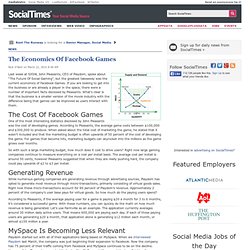
If you are looking to get into the business or are already a player in the space, there were a number of important facts disclosed by Pleasants. What’s clear is that the business is a smaller version of the movie industry with the difference being that games can be improved as users interact with them. One of the most interesting statistics disclosed by John Pleasants was the cost of developing games. According to Pleasants, the average game costs between $100,000 and $300,000 to produce. When asked about the total cost of marketing the game, he stated that it wasn’t included and that the marketing budget is often upwards of 50 percent of the cost of developing the game.
VC. The Web’s €100 billion surplus - McKinsey Quarterly - Media & Entertainment - Publishing. Consumers derive significant value from all they do on the Web, and since advertising pays for much of this, it involves no immediate out-of-pocket cost.

We all experience these benefits each time we log onto a social network or watch a free Web video. But how much is all of this Web use worth? About €150 billion a year, according to new McKinsey research involving a survey of 4,500 Web users across Europe and the United States, as well as conjoint analysis of their willingness to pay for various online activities. HN How Do I Pull a Google? Problem: How does Google, Microsoft, Facebook and friends pay an effective tax rate of 2.4%?

More importantly, can I do the same? Analysis: Saas maths.
365 Days, $10 Million, 3 Rounds, 2 Companies, All With 5 Magic Slides. Welcome to the new reputation economy. This article was taken from the September 2012 issue of Wired magazine.

Be the first to read Wired's articles in print before they're posted online, and get your hands on loads of additional content by subscribing online. Imagine a world where banks take into account your online reputation alongside traditional credit ratings to determine your loan; where headhunters hire you based on the expertise you've demonstrated on online forums such as Quora; where your status from renting a house through Airbnb helps you become a trusted car renter on WhipCar; where your feedback on eBay can be used to get a head-start selling on Etsy; where traditional business cards are replaced by profiles of your digital trustworthiness, updated in real-time. Where reputation data becomes the window into how we behave, what motivates us, how our peers view us and ultimately whether we can or can't be trusted.
In September 2008, Atwood and Spolsky launched Stack Overflow. The Evolving Tag Management Marketplace. Today started with a flurry of communication about Adobe’s intent to start giving their Tagmanager product away to all SiteCatalyst customers at no charge.
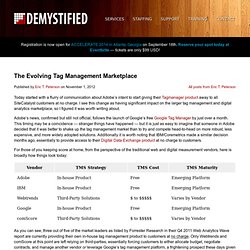
I see this change as having significant impact on the larger tag management and digital analytics marketplace, so I figured it was worth writing about. Adobe’s news, confirmed but still not official, follows the launch of Google’s free Google Tag Manager by just over a month. This timing may be a coincidence — stranger things have happened — but it is just as easy to imagine that someone in Adobe decided that it was better to shake up the tag management market than to try and compete head-to-head on more robust, less expensive, and more widely adopted solutions.
Additionally it is worth noting that IBM/Coremetrics made a similar decision months ago, essentially to provide access to their Digital Data Exchange product at no charge to customers. The “Mature” platforms, at least in my mind, are BrightTag, Ensighten, Tealium, and TagMan. The Shifting Sands Of Tag Management. I published Understanding Tag Management Tools And Technology about six weeks ago.
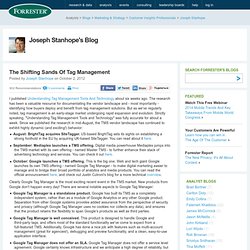
The research has been a valuable resource for documentating the vendor landscape and - most importantly - identifying how buyers deploy and benefit from tag management solutions. But as we've regularly noted, tag management is an early-stage market undergoing rapid expansion and evolution. Strictly speaking, "Understanding Tag Management Tools and Technology" was fully accurate for about a week. Since we published the research in mid-August, the TMS vendor landscape has continued to exhibit highly dynamic (and exciting!)
Behavior: Will Google Tag Manager shake up the industry? On Monday Google announced the launch of its new free tag management system, simultaneously raising the profile of analytics tags and putting the wind up suppliers who currently charge for the service. As Google explained in a blog post, the new tool “consolidates your website tags with a single snippet of code and lets you manage everything from a web interface,” which should mean you can add new tags without bothering the IT team. This sort of technology is nothing new, and it’s something we investigated in more detail in our report The ROI of Tag Management. Google Tag Manager: A Disruptive Opportunity. Here comes Google again. In 2006, Google disrupted the Web analytics industry with its free product, Google Analytics. Here Comes Google Tag Manager.
On November 14, 2005, Google announced Google Analytics – a revolutionary product that changed the web analytics software landscape. It was free, delivered as a service, was integrated with Google AdWords, had a solid (if basic) feature set and did I mention it was free? GA didn’t take over the enterprise web analytics space – sophisticated websites still needed the advanced features and scalability of Omniture SiteCatalyst, CoreMetrics and WebTrends. The GA feature set has improved immensely over the years and today GA is the leading web analytics application with 55.8% of websites worldwide using it. Check out this infographic for more impressive stats on GA usage. Now there is even a paid version of the product, aimed at the needs of larger websites. In 2009, Adobe bought Omniture for $1.8 billion and IBM bought CoreMetrics in 2010. Google Tag Manager compared to Ensighten - Tag Management - ClickInsight Blog. It is openly accessible just as Google Analytics (GA) is (I prefer to avoid the word “free”, I don’t think GA or GTM are free if you really want to make good use of them).It can make your wildest tag management dreams come true (depending on what exactly you dream about, of course).It is a very comparable solution to Ensighten in many key areas.However, depending on what you need, it may just be not enough.
Sounds Interesting? Publications Google Tag Management System Links Channels 10/02. Google introduced a tag container and management platform Monday to support companies using multiple tracking tags. The bits of code set in a container embedded in Web pages measure site traffic and visitor behavior. The goal is to understand the impact of online advertising and social channels and improve Web site performance. Nearly 70% of marketers using a tag management system to create and modify tags in less than a workday, and nearly half report that the process takes less than one hour, according to The ROI of Tag Management Survey from Econsultancy and Tealium.
The survey also found that 64% had an increase in Web site speed load times, with 34% describing the increase as significant. Google's container will hold hundreds of tags from a variety of companies, such as Google, Microsoft, Facebook and others. Some see benefits and opportunities to create industry standards, while others see challenges. Industry skepticism abounds. The Evolving Tag Management Marketplace.
(6) How Tracking Management systems like TagMan work technically? Do they have tieups with existing players like GA. Tag Management Continues To Accelerate Into The Mainstream. The market for tag management systems is gaining momentum at an impressive rate. On the surface, tag management is a rather pedestrian topic, focusing on the occasionally arcane and frequently ugly mechanics underlying our websites. Indeed, tag management seems to be worlds apart from the current marketing zeitgeist, which often directs our attention to sexy topics such as social media, tablet computers, and gamification.
But if we take a deeper view of current marketing trends, it is clear that the two are actually very closely connected. Digital marketing execution and analysis are heavily dependent on website instrumentation, which by extension benefits from enabling technologies such as tag management. Ultimately, I think the enthusiasm for tag management systems stems from the simple fact that these solutions address very real and tangible pain points felt by nearly all companies doing business on the Web. Established vendors enter the market. Tag management assumes strategic importance: new report. Scribd. Five things to look for when selecting a Tag Management System. The Tag Management System (or TMS for short) landscape is evolving quickly and it’s becoming harder to make sense out of the technical jargon and vendor claims.
As a member of the TagMan’s Advisory Board, an early player in the field, I had to wrap my head around this market. Www.webanalyticsdemystified.com/downloads/Demystified_The-Myth-of-the-Universal-Tag_SponsoredBy_Ensighten.pdf. 5 Tools to Manage Code Tags in Websites. The real-time attribution and Tag Management System. Universal container tag for smart tag management. UberTags - Tag Management System For Websites. Tag Commander. QuBit OpenTag.