
Brain surgery removal of metastatic tumor high power surgical microscope. CNS Case Studies. Neuroscience and Zombies Autopsies Unit. The Mind Project: Curriculum. AI, Robotics & Computational Models This module provides an introduction to artificial neural nets with a working network that can solve X-OR problem.

Chain codes are a kind of computer program that can be used to represent the shape of objects. Seven hands-on activities show how to write simple chain codes and explain their application to computer vision. The physics-based simulator, Breve, is used to introduce complex adaptive systems with a special focus on the optimization strategy known as simulated annealing .
Computers play a central role in artificial intelligence, robotics, and in modeling various capabilities of minds/brains. Neurons form elaborate information processing networks. Larry Learner is an artificial intelligence program that plays the game "Last One Loses. " McCulloch and Pitts developed a mathematical model of a biological neuron. Iris 1.2 robotic arm, software, and curriculum. The computer processing in virtually all robots is digital. Anthropology Foundational Issues. Top 10 Brain Myths" At one time in history, decapitation was one of the preferred methods of execution, in part thanks to the guillotine.
Although many countries that execute criminals have dispatched with the method, it's still performed by certain governments, terrorists and others. There's nothing more final than the severing of one's head. The guillotine came about because of the desire for a quick, relatively humane death. But how quick is it? If your head were cut off, would you still be able to see or otherwise move it, even for just a few seconds? This concept perhaps first appeared during the French Revolution, the very time period in which the guillotine was created. Another often-told tale of demonstrated consciousness following beheading dates to 1905. These stories seem to give credence to the idea that it's possible for someone to remain conscious, even for just a few seconds, after being beheaded.
If your head stays on your shoulders, though, it can still be damaged beyond repair. Project NEURON Novel Education for Understanding Research on Neuroscience. Animation brain anatomy. 12 talks on understanding the brain. Read Montague is interested in the human dopamine system — or, as he puts it in this illuminating talk from TEDGlobal 2012, that which makes us “chase sex, food and salt” and therefore survive.
Specifically, Montague and his team at the Roanoke Brain Study are interested in how dopamine and valuation systems work when two human beings interact with each other. Twenty years ago, studying a topic like this was all but impossible because scientists relied on worms and rodents for insight into the brain. But today, in addition to animal research, neurobiologists have at their disposal functional MRI (fMRI), which allows them to make “microscopic blood flow movies” and map the activity of human brains in action.
Scanning the Brain. Diagnosing a zombie: Brain and body - Tim Verstynen & Bradley Voytek. DISCLAIMER: Although we sometimes compare certain symptoms in zombies to real neurological patient populations, we are in no way implying that patients with these other disorders are in some way “part zombie”.
Neurological disorders have provided critical insights into how the brain gives rise to behavior and we bring them up for the sake of illustration only. Their reference in this context is in no way meant to diminish the devastating impact that neurological diseases can have on patients and their caregivers. In order to understand how studies on patients, brain regions, and behavior all link together, check out BrainScanr ( a meta-analytic program designed to show relationships between brain systems and behavior.
For more information on the syndromes described in the video, including how to help, please check out the following support societies: Parkinson’s Disease Foundation: The National Ataxia Foundation: The National Aphasia Foundation: Animation brain anatomy. Diagnosing a zombie: Brain and behavior - Tim Verstynen & Bradley Voytek. DISCLAIMER: Although we sometimes compare certain symptoms in zombies to real neurological patient populations, we are in no way implying that patients with these other disorders are in some way “part zombie”.
Neurological disorders have provided critical insights into how the brain gives rise to behavior and we bring them up for the sake of illustration only. Their reference in this context is in no way meant to diminish the devastating impact that neurological diseases can have on patients and their caregivers. To see what brain areas are associated with different behaviors and cognitive states from functional MRI (fMRI) studies, check out the NeuroSynth website created by Tal Yarkoni ( and the Cognitive Atlas by Russ Poldrack ( Anatomy of the brain. How do pain relievers work? - George Zaidan. All those different brands, varieties, and strengths filling the shelves at the drugstore can give anyone a headache!
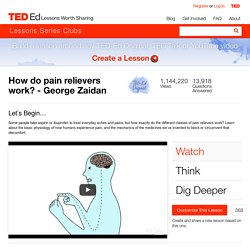
While there may be a hundred different colored boxes and bottles on the shelf, Alice (of Go Ask Alice fame) explains the four basic types of non-prescription pain-relievers. One of the most strangest types of pain comes from hitting your “funny bone.” Mentalfloss writes that the "funny bone" is neither funny (when you whack it on the edge of a piece of furniture), nor a bone (whether you whack it or not). Where'd the name come from, and why is it so painful? Click here. The Secret Life of the Brain. How do nerves work? - Elliot Krane.
What if we could look inside human brains? - Moran Cerf. The Facts About Concussions.