
NP-hard. As consequences of the definition, the following claims can be made: Examples[edit] An example of an NP-hard problem is the decision subset sum problem, which is this: given a set of integers, does any non-empty subset of them add up to zero?
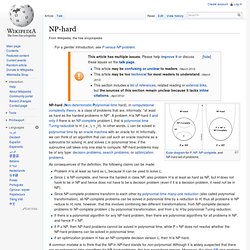
That is a decision problem, and happens to be NP-complete. Another example of an NP-hard problem is the optimization problem of finding the least-cost cyclic route through all nodes of a weighted graph. Elementary cellular automaton. The numbering system[edit] There are 8 = 23 possible configurations for a cell and its two immediate neighbors.

The rule defining the cellular automaton must specify the resulting state for each of these possibilities so there are 256 = 223 possible elementary cellular automata. Stephen Wolfram proposed a scheme, known as the Wolfram code, to assign each rule a number from 0 to 255 which has become standard. Each possible current configuration is written in order, 111, 110, ..., 001, 000, and the resulting state for each of these configurations is written in the same order and interpreted as the binary representation of an integer. This number is taken to be the rule number of the automaton. 18.01SC Single Variable Calculus, Fall 2010. Logarithmic Scale.