
dtf
Place Network. Where the world begins. Jesper Taekke. Cybercities1_text. Boyer, M. Christine (Princeton Architectural Press, 1996) Developing an image of the city in an age of visual saturation appears to be a problem, precisely because awareness of the physical space of the city is disappearing or dematerializing-the result, we are told, of new digital information and communication technologies. Paul Virilio says that every city is over-exposed and its physical sense of space decomposed as our eyes are constantly bombarded with ephemeral and interchangeable images, visions that move along the constant space of flows called the informational city. It is then no accident that William Gibson's account of cyberspace in Neuromancer is conflated with an account of a city that no longer has any imageable form or definable boundary.
He says this metroscape called "BAMA" (Boston-Atlanta Metropolitan Area) reaches from Boston to Atlanta along the eastern seaboard. Yates also describes another, lesser-known art of memory. Gibson's Invisible City. Laura Lee In William Gibson's Neuromancer, the city is an indiscriminate sprawl of virtual projections and imaginary boundaries.

In comparison with Italo Calvino's work "Invisible Cities," Gibson's book presents the urban environment as a topology of signal s and nodes, a design t hat is structured from these nodes internally and then crystallizes as a matrix. We see how the "city" becomes a mental projection of those within it through the creation of virtual worlds, where cyberspace becomes a house of sorts, a house of the mind - -- In its etymological roots, "building" means "to be, to exist, to grow.
" The Virtual Space Theory. Journal of the Imaginary and Fantastic : Vol.2 No.4 : Deep Maps : liminal histories and the located imagination. Mapping Cyberspace. The Library of Babel. The Library of Babel by Jorge Luis Borges By this art you may contemplate the variations of the 23 letters...The Anatomy of Melancholy, part 2, sect.
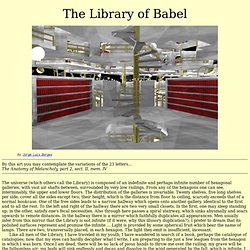
II, mem. IV. Jorge Luis Borges: The Aleph. Maria Beatrice Bittarello-Short Bio. RCCS: View Book Info. The Internet Imaginaire Author: Patrice Flichy Publisher: Cambridge, MA & London: MIT Press, 2007 Review Published: February 2008.

Re-crafting%20the%20past. Cosmic Order Home Page. Mythos. Mythos - The Image of Spirit Harrison Own This material originally appeared in Spirit: Transformation and Development in Organizations, which was published by Abbott Publishing in 1987.

Myth is neither true nor false, but rather behind truth -- as that body of material through which a culture's values, purpose and direction come to expression. Myth is not just "any old story," it is the story, which gives shape and focus to Spirit, and makes everything make sense.(1) Myth, in short is the "eyeglasses" through which a given people perceive and interpret their world. A Taste of Systemics. A Special Integration Group (SIG) of the International Society for the Systems Sciences (ISSS) originally SGSR, Society for General Systems Research. and IISII INTERNATIONAL INSTITUTE for SYSTEMIC INQUIRY AND INTEGRATION Presents.

Cosmic Play Frames. A meeting place for myth, imagination, and mystery in pop culture. A meeting place for myth, imagination, and mystery in pop culture. Mapping the Human Condition. By Maria Popova What the empire of love has to do with the intellect forest and the bay of agoraphobia.
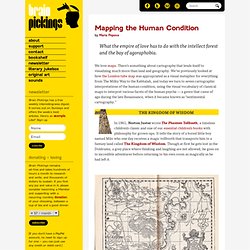
We love maps. There’s something about cartography that lends itself to visualizing much more than land and geography. About Worldviews. Will McWhinney The Navajo Pollen Path “Oh, beauty before me, beauty behind me, beauty to the right of me, beauty to the left of me, beauty above me, beauty below me, I’m on the pollen path.”

About ten years ago I met Will McWhinney. 3506_1Jted03. Will mcwhinney. You don’t need to be a scientist to understand that hostile behavior always attracts hostile behavior.

So if you want to Enforce Peace with Violence you will always attract Violence. Perhaps if you could eliminate the Cause of Violence it would be possible to stop the Violence. If you could eliminate Saddam Hussein or Adolph Hitler you end it all. TDmythmaking. The idea is to analyze metaphors and icons that story and center collective dynamics.

Several consultants use mythmaking and storytelling as a tool for changing large systems and organizations. Most widely know is Harrison Owens. Some Background on Mythmaking Meyer and Rowan (1977) were among the first to argue that interorganizational relations (and networks) transfer institutional myths and rituals between complex organizations through imitation. See "Institutional organizations: Formal structure as myth and ceremony. " Mythmaking. Harrison Owens. The Institute for Intercultural Studies: Gregory Bateson.
"What pattern connects the crab to the lobster and the orchid to the primrose and all the four of them to me?

And me to you? " - Gregory Bateson from Mind and Nature A quarter century after the death of eminent anthropologist and systems theorist Gregory Bateson, much of his work is just beginning to be fully appreciated. During his centennial year 2004 and beyond, a series of discussions, events and publications took a closer look at how Bateson challenged people to think in new ways and how his ideas continue to impact how we think in the 21st century. Our Own Metaphor by Mary Catherine Bateson, An Evolution of Consciousness Review from A Reader's Treasury by Bobby Matherne. Impacts and differences - ecosophe.
James P. Carse. The Play Ethic. The Play Ethic: Little black books for black times. Almost forgotten I'd written this, as part of the new paperback version of the PE's promotion - a long over-due (and far too short) appreciation of James Carse's Finite and Infinite Games as my 'Book of a Lifetime' (it has supplanted yet another small black book, Adorno's Minima Moralia, as my primary life-saving carry-around). The piece doesn't seem to be available online, so it's on extended post below. I must admit, after our recent London Tube bombings, and particularly the mistaken assasination of Mr. Menezes, this quote from Minima on the bourgeois nature of walking (how Adornian) is all too relevant: Running in the street conveys an impression of terror. The victim's fall is already mimed in his attempt to escape it.
Lewis Hyde - Home. Transformations of the Trickster. By Helen Lock Trickster tales have existed globally since the earliest times, and nearly everyone recognizes a trickster when one is encountered in a story, whether it be the Monkey King stealing the Peaches of Immortality, Hermes making Apollo’s cattle walk backwards, or B’rer Rabbit pulling the stunt with the tar baby. It is not hard to account for their appeal—they are fun, for one important thing, in their anarchic assault on the status quo, although their trickery also strikes a deeper human chord.
Transmediastorytellingresearch. Marie-Laure Ryan. A Companion to Digital Humanities. A Companion to Digital Humanities. A Companion to Digital Literary Studies. Possible-Worlds Theory, by Marie-Laure Ryan. Game Studies 0101: Ryan: Beyond Myth and Metaphor: The Case of Narrative in Digital Media.