
Companion_Planting. Companion Planting Guide Anise - Plant anise and coriander seeds together.
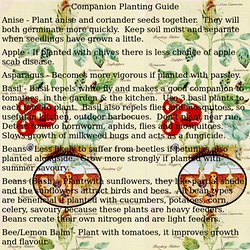
They will both germinate more quickly. Keep soil moist and separate when seedlings have grown a little. Apple - If planted with chives there is less chance of apple scab disease. Asparagus - Becomes more vigorous if planted with parsley. Basil - Basil repels white fly and makes a good companion to tomatoes, in the garden & the kitchen. Beans - Less likely to suffer from beetles if petunias also planted alongside.
Beans (Bush) - Plant with sunflowers, they like partial shade and the sunflowers attract birds and bees. Bee/Lemon Balm - Plant with tomatoes, it improves growth and flavour. Beetroot - Grow better if planted with onions, kohl rabi, basil, beans, lettuce, cabbage and tomatoes. Bergamot - Attracts beneficial honey bees. Borage - Plant with strawberries to increase crop. Broccoli - Planted with dill or mint grows better. Cabbage family - Cabbage butterfly is repelled by planting rosemary or sage with cabbages. Build a vertical aquaponic veggie & fish farm for small yards & houses.
This low-cost vertical aquaponic system can grow leafy greens, herbs and raise fish for a small family year round, and it fits in a 5' by 3' space.
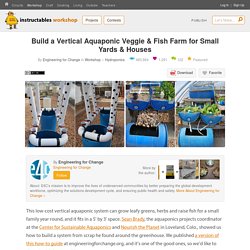
Sean Brady, the aquaponics projects coordinator at the Center for Sustainable Aquaponics and Nourish the Planet in Loveland, Colo., showed us how to build a system from scrap he found around the greenhouse. We published a version of this how-to guide at engineeringforchange.org, and it's one of the good ones, so we'd like to share it with Instructables, too. What it is A vertical aquaponic system grows vegetables without soil in columns above a fish tank. By growing vertically, you can produce about twice the amount of plants as you can with a hydroponic system of the same area.
One five-foot tower can produce more than 200 heads of lettuce per year. The system puts fish waste to work as fertilizer for crops. You do have to replace lost water as needed, power the pump and feed the fish. Build time About two hours. Seed_starting_light_system.pdf (application/pdf Object) Tulip Care – How to Prune Tulips. Tulips, like virtually all flowering plants, will at some point lose their blooms.

The petals (called perianths) become brown as they decay. Unlike some flowering plants, however, caring for tulips is simplicity itself. Often treated like an annual, it’s possible to do nothing at all and simply let nature takes its course. First the flowers will wilt and die, then a few weeks to a couple of months later the leaves will become yellow or brown and also fade. If the gardener has no intention of helping the plant regenerate the following spring no action is needed. In that case, most tulips will not come back after winter. Some tulip types are more like perennials and will produce blooms year after year for several growing seasons. But most tulips have developed after at least some human intervention and have been engineered specifically to emulate the growth patterns of these wild flowers. A day to a few days at most after the flower has wilted, it’s helpful to deadhead them.
Fruit Trees. Compost.