
The Interview Question That's Always Asked (and How to Nail It) 50 Places You Can Learn to Code (for Free) Online. If you’re curious about learning a programming language then you’re in luck: there’s no shortage of resources for learning how to code online.
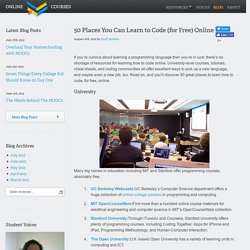
University-level courses, tutorials, cheat sheets, and coding communities all offer excellent ways to pick up a new language, and maybe even a new job, too. Read on, and you’ll discover 50 great places to learn how to code, for free, online. University Many big names in education including MIT and Stanford offer programming courses, absolutely free.
General. Why You Didn’t Get the Interview. After reading the tremendous response to Why You Didn’t Get the Job (a sincere thanks to those that read and shared the post) I realized that many of the reasons referenced were specific to mistakes candidates make during interviews.
At least a handful of readers told me that they didn’t get the job because they didn’t even get the interview. With a down economy, most of us have heard accounts of a job seeker sending out 100, 200, perhaps 300 résumés without getting even one response. How to Create an Awesome Infographic [INFOGRAPHIC] There's no better way to show companies how to create an engaging infographic than through outlined steps in the form of an infographic.
![How to Create an Awesome Infographic [INFOGRAPHIC]](http://cdn.pearltrees.com/s/pic/th/how-create-awesome-infographic-33935855)
A new infographic by Infographic Labs — first published by Performancing.com — highlights the best practices of developing a creative way to get the word out about new data. As the amount of information we consume on the Internet grows and attention spans decrease thanks to a bevvy of distractions from email to Facebook, market research firms and other companies are packaging new data in visual ways. In some cases, infographics even go viral. The Buffer blog: productivity, life hacks, writing, user experience, customer happiness and business. 5.8K Flares Filament.io 5.8K Flares × We all know this and have heard it hundreds of times.
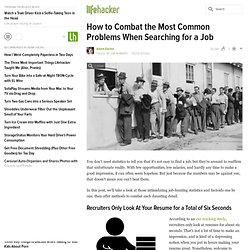
To work efficiently we have to single task. No multitasking. How to Combat the Most Common Problems When Searching for a Job. SExpand You don't need statistics to tell you that it's not easy to find a job, but they're around to reaffirm that unfortunate reality.
With few opportunities, low salaries, and hardly any time to make a good impression, it can often seem hopeless. On Making the Right Choice: The Deliberation-Without-Attention Effect. Showing Up Is Not Enough - dan shipper. This post was republished on LifeHacker.
You can read it here. There’s a Woody Allen quote that goes: “ninety percent of success is just showing up.” Despite the title of this blog post my experience learning about and talking to successful people leads me to agree with him. But it does raise the question: what about the other 10%? I think that the other 10% of success largely depends on what you’re showing up for. Think of it this way: millions of people will get up tomorrow morning and show up for work. TEDXYale- Vikram Mansharamani-The Power of Foxy Thinking. All Hail the Generalist - Vikram Mansharamani. We have become a society of specialists.
Business thinkers point to “domain expertise” as an enduring source of advantage in today’s competitive environment. The logic is straightforward: learn more about your function, acquire “expert” status, and you’ll go further in your career. But what if this approach is no longer valid? Corporations around the world have come to value expertise, and in so doing, have created a collection of individuals studying bark.
There are many who have deeply studied its nooks, grooves, coloration, and texture. Approximately 2,700 years ago, the Greek poet Archilochus wrote that “The fox knows many things, but the hedgehog knows one big thing.” In the six decades since Berlin’s essay was published, hedgehogs have come to dominate academia, medicine, finance, law, and many other professional domains. Get Hired. I was recently asked for interview advice. 1. These are guidelines and examples. Don't repeat them verbatim. Smart Resume Risks. Work Less and Do More by Applying the Pareto Principle to Your Task List.
How to Choose the Best Chart for Your Data. What You Really Need to Apply for a Job—and What You Don't. “An ideal candidate should have a strong marketing background, five years of experience in the consumer goods industry, a track record of designing and running complex marketing campaigns for new consumer products, proficiency with Adobe Creative Suite, and a graduate-level degree with a focus on marketing or public relations.
" How to Manage a Micromanager. When Bad Things Happen To Productive People. You relish being seen as the go-to person when it comes to getting things done.

You take pride in your ability to deal with a hefty workload and numerous deadlines without getting tripped up along the way. Yet, no matter how accomplished and efficient you are, there will be times when you get overwhelmed by negative or upsetting events. Times when you are left wondering how you could possibly accomplish almost anything in the near term – be it the client work that still needs to be completed on time, or the myriad of other commitments and responsibilities crying out for your attention. How to Follow Up on a Job Interview (Without Being Annoying) How to Write an Email That Will Get a Response. How to write an email?

Why “We Need to Work Longer” Is Almost Always a Bad Idea. Go the F**k Home. 6 questions to ask a job interviewer - Ask Annie. To stand out from your competition, says an executive coach, you need to start a real, memorable conversation. Here's how to do it. Dear Annie: I've only been out of college a few years, and I was hired into my first real job (which I still have) by an on-campus recruiter at a career fair, so I don't have much experience with interviews. Now, I'm looking around for something a bit more challenging. I have some tech skills that happen to be in demand right now, so I'm getting interviews, and they've mostly gone pretty well so far. 10 Things To Never Say To Your Boss. The Magic of Doing One Thing at a Time - Tony Schwartz. By Tony Schwartz | 8:53 AM March 14, 2012 Why is it that between 25% and 50% of people report feeling overwhelmed or burned out at work?
It’s not just the number of hours we’re working, but also the fact that we spend too many continuous hours juggling too many things at the same time. What we’ve lost, above all, are stopping points, finish lines and boundaries. Technology has blurred them beyond recognition. Know When to Back Out of a Project. When I fail at a project, it's often because I'm following someone else's instructions and those instructions have a subtle error or three. Carefully searching the web for similar experiences is the obvious potential solution, which I would try before abandoning any project. Be sure to compare several ideas if possible, to help filter out the rampant misinformation.
Having the right tools is important, but a reasonable understanding of the mechanics of a project is crucial. Doing stuff by rote is a very-commonly-used recipe for failure. How to Attend a Conference as Yourself - Peter Bregman. Excel Six Sigma Metrics Balanced Scorecard. Process Capability Analysis in Excel. Home » Quality Tools » Process Capability Process Capability Indices Cp Cpk A capable process meets customer requirements 100% of the time. Customer requirements are defined using an upper specification limit (USL) and a lower specification limit (LSL). Think of these specification limits as goal posts. Process capability analysis determines how well the output of a stable process meets these specifications.
DMAIC Tools: Six Sigma Toolkit and Excel Templates. Excel Dashboards, Templates and Business Software. Jonah Lehrer on How to Be Creative. Five Leadership Lessons From Jean-Luc Picard. Proact - Faq. What are the benefits of adopting Proact? Enterprise Agility. In today's dynamic business environment, it is impossible to plan and predict the future. How, then, does an enterprise prepare to react to changing and unpredictable market and economic conditions, new product opportunities, systems and technology opportunities, etc.? By using the Proact Toolkit to identify and define the complete set of enterprise capabilities as modular service components of the business that can be developed, reconfigured, scaled up (or down) as required. These enterprise capabilities are independent of organizational silos and politics, providing strategists, architects, and planners the means to drive for high performance across the enterprise, regardless of the shifting set of strategic business drivers.
What results can the IT organization expect to see? The results will become apparent at the outset and over time. How to Write a Cover Letter That Employers Will Actually Read. Make Better Quality Decisions with the Help of This Spreadsheet. How to Ask for Help via Email (and Actually Get It) Ok so I met this girl about a year and a half ago and when we met we just had this connection and became friends instantly. Over the summer we got really close and became best friends, we talked/texted 24/7 and we hung out all the time. How To Take Control of Your Next Job Interview. Winston Joseph.