
0801_education_graduation_age_whitehurst_whitfield.pdf (application/pdf Object) Without (or Beyond) College: 22 Tools For Success. Free to explore options.

Image: iateyourbubbles.deviantart.com What doesn’t add up It’s easier to teach an old dog new tricks than it is to change old mindsets. Like the one that insists that all the years up to 18 are preparation for college. After that a bachelor’s degree or higher must be obtained because college is THE ONLY route to success. This dusty way of thinking relies on old figures showing that college leads to high-earning careers. Equating college with success doesn’t take today’s realities into account. So students go into debt. Except the job market sucks. What does add up In the real world, grades and tests actually don’t correlate with adult accomplishments. The college highway is actually one of many roads to the future. Learning Empowerment Tools 1. , a manual with thought-provoking and empowering information on each page. 2. 3. And a free e-book The Edupunks’ Guide to a DIY Credential. Top 5 Ways Educators Can Stop Bullies. A new documentary film, “BULLY,” follows several students to show how bullying happens in schools—and how educators often struggle to put a stop to it.
A safe and supportive school climate can be one of the best tools in preventing bullying. Whether it’s the classroom, the cafeteria, the library, the restrooms, on the bus, or on the playground, children need to feel safe—or they can’t focus on learning. Working together, everyone at school can help create a climate where bullying is not acceptable. Below are five tips to help teachers, administrators and other school personnel prevent bullying from occurring in school, as well as how to respond when it happens.
The information comes from the recently re-launched federal website www.StopBullying.gov. 1. Establish a culture of inclusion and respect that welcomes all students Monitor bullying “hot spots” in and around the building. 2. 3. Intervene immediately. 4. 5. Cameron Brenchley is Director of Digital Engagement at the U.S. Education Department changing graduation rate measurements. WASHINGTON -- A long-held wish of many community colleges is on the verge of becoming reality: the Education Department has announced its plans to change how student success is measured in higher education, taking into account students who transfer, part-time students and students who are not attending college for the first time.
The department outlined its plans Wednesday to carry out the recommendations of the Committee on Measures of Student Success, a federal panel that called for changing how data on completion rates and other measures at community colleges is reported in the Integrated Postsecondary Educational Data System, or IPEDS. The changes will apply to all postsecondary institutions, including four-year colleges. The department indicated that could soon change: it will take steps to enhance graduation and transfer rate reporting, and is examining the feasibility of including part-time degree-seeking students as well as other adult and nontraditional students. TakePart - News, Culture, Videos and Photos That Make the World Better. According to FBI Special Agent Patrick Bohrer, uncovering public corruption is the FBI’s top criminal investigative priority.
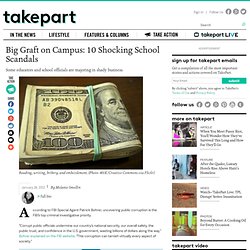
“Corrupt public officials undermine our country’s national security, our overall safety, the public trust, and confidence in the U.S. government, wasting billions of dollars along the way,” Bohrer explained on the FBI website. “This corruption can tarnish virtually every aspect of society.” Our nation’s public schools are not impervious to scandalous crimes of fraud, bribery, and embezzlement.
In response to recent corruption cases involving education employees, U.S. Attorney David J. Just how prevalent is corruption in public education?
Success. School legal. Local and NC education issues. Education Policy. Websites. Article ideas. Budget.