
Scriptwriting: A New Literacy. Washington Post. A new debate about whether computers can really edit essay tests is really about how writing can best be graded.
Here to delve into that issue is Doug Hesse, professor and executive director of writing at The University of Denver. He is co-author (with Lynn Troyka) of “The Simon and Schuster Handbook for Writers” and of “Creating Nonfiction” (with Becky Bradway). He is also a past chair of the Conference on College Composition and Communication and a past president of the Council of Writing Program Administrators. Nazi Concentration Camps (1945) WARNING : Very graphic. Brochure Common Core State Standards. The Official Site of Coach John Wooden.
Should We Teach the Five-Paragraph Essay? - Teacher in a Strange Land. Headline: As Children's Freedom Has Declined, So Has Their Creativity.
Biggest decline? Creative elaboration--expanding on ideas in novel and creative ways. Have we done this to children, with "eminently gradable" assignments? Josh Boldt, who teaches writing at the University of Georgia in Athens, shares his thoughts: College writing teachers hate the five-paragraph essay. The writing guide takes a sharp stance against the five-paragraph essay, claiming that its "rigid, arbitrary, and mechanical organizational scheme values structure over just about everything else, especially in-depth thinking" (7). Uncertainty, and the willingness to test and complicate rather than just assert ideas" (8). My practical observations of freshman comp pedagogy confirm the assertions of Rosenwasser and Stephens. Personally, I don't consider my role to be quite so extreme. Encourage Authentic Writing With #WhatIWrite and #NaNoWriMo. Jennifer AnsbachFinished novels written by students in Jennifer Ansbach’s class during National Novel Writing Month.

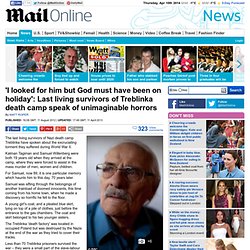
Updated | Oct. 18, 2012 #WhatIWrite If you’ve been reading this blog for a while now, you may remember that last year at this time we were enthusiastic participants in a collaborative push to get as many people as possible to take to Twitter on Oct. 20, the annual National Day on Writing, and post messages with the hashtag #WhyIWrite. Thousands did, and it was a thrilling and memorable day for us, as students, teachers, novelists, poets, historians, journalists, comedians and ordinary citizens of all kinds posted thoughts to a vigorous stream. Stories from Treblinka: Last two living survivors speak of horrors and haunting memories from Nazi death camp. By Matt Roper Published: 16:08 GMT, 11 August 2012 | Updated: 17:48 GMT, 11 April 2013.
30 Ideas for Teaching Writing. Summary: Few sources available today offer writing teachers such succinct, practice-based help—which is one reason why 30 Ideas for Teaching Writing was the winner of the Association of Education Publishers 2005 Distinguished Achievement Award for Instructional Materials.
The National Writing Project's 30 Ideas for Teaching Writing offers successful strategies contributed by experienced Writing Project teachers. Since NWP does not promote a single approach to teaching writing, readers will benefit from a variety of eclectic, classroom-tested techniques. These ideas originated as full-length articles in NWP publications (a link to the full article accompanies each idea below). Table of Contents: 30 Ideas for Teaching Writing. Teaching Grammar. Choosing a Topic for our Ted.com Speeches. I’m currently prepping my classes for another research unit, this one a blend of Memoir, Advocacy, and Speech Writing.

After all, never in real life are genres categorized. They blend together; and the Common Core assessments to come recognize the desegregation of writing genres and the need for performance based assessments. Mentor Texts in the Digital Writing Workshop: Writer as Decision-Maker. "This is no recipe book: I have tried not to be formulaic.
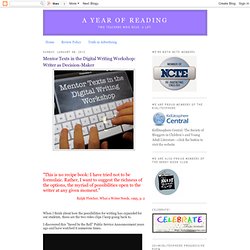
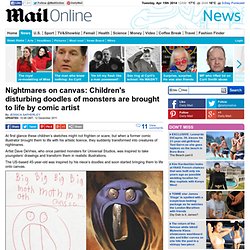
Rather, I want to suggest the richness of the options, the myriad of possibilities open to the writer at any given moment. " Ralph Fletcher, What a Writer Needs, 1995, p. 2 When I think about how the possibilities for writing has expanded for our students, these are the two video clips I keep going back to. Voices from the Middle - Individual Issues. Nightmares on canvas: Children's disturbing doodles of monsters are brought to life by comic artist. By Jessica Satherley Updated: 10:46 GMT, 12 December 2011.
The MY HERO Project.
Robot hysteria in the 1930s (slide show) In the autumn of 1932, a British inventor named Harry May invited some friends over to see a demonstration of his latest invention, a robot called Alpha that could fire a gun at a target.

Operated by wireless control, the robot sat lifeless in a chair on one side of the room. May placed a firearm in the robot’s hand and made his way to the other side of the room to set up a target. With the inventor’s back turned, the two-ton Alpha slowly rose to his feet and pointed the gun with his metallic arm. The men shouted warnings while the women screamed in terror. The inventor turned and was startled to see that his robot had come to life—and was now pointing a gun directly at him. At the last possible moment, the inventor put his hand in front of his face to defend himself. Putting the 'Prod' in Productivity. New Write or Die iOS App!
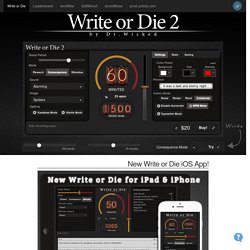
Now you can Write or Die wherever you are! Works for both iPad and iPhone. Android version coming soon. New online Leaderboard for Write or Die! Over 1.5 million words written so far! VLC Control, custom playlist that works.