The Visual Memory of Grammar. This study represents an interdisciplinary attempt to trace the origins of metaphorical expressions as they are found in English grammatical terminology.

The perspective chosen combines cognitive and art-historical approaches to the meaning of abstract concepts: cognitive semantics and iconography. It takes into account the historical dimension of the media which have served, over the course of centuries, to render abstract concepts graspable: figurative language, visual images, and the printed page. By taking a close look at examples from an iconography of grammar created for the purpose of this study (which includes personifications, allegories and memory buildings from the early Modern period), I shall discuss the visual traditions and patterns in the representation of abstract concepts and structures. Dieser Beitrag ist ein interdisziplinärer Versuch, die medienhistorische Dimension von metaphorischen Ausdrücken in der englischen Grammatikterminologie aufzuzeigen.
Method of loci. The method of loci (loci being Latin for "places") is a method of memory enhancement which uses visualizations with the use of spatial memory, familiar information about one's environment, to quickly and efficiently recall information.
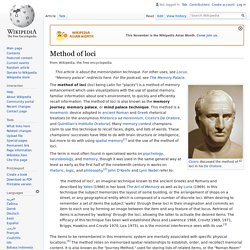
The method of loci is also known as the memory journey, memory palace, or mind palace technique. This method is a mnemonic device adopted in ancient Roman and Greek rhetorical treatises (in the anonymous Rhetorica ad Herennium, Cicero's De Oratore, and Quintilian's Institutio Oratoria). Many memory contest champions claim to use this technique to recall faces, digits, and lists of words. These champions' successes have little to do with brain structure or intelligence, but more to do with using spatial memory[1] and the use of the method of loci. 'the method of loci', an imaginal technique known to the ancient Greeks and Romans and described by Yates (1966) in her book The Art of Memory as well as by Luria (1969).
Contemporary usage[edit] Literature[edit] Dual N-Back. Statistical background: Against null-hypothesis significance testing Mainstream science is flawed: seriously mistaken statistics combined with poor incentives has led to masses of misleading research.

Not that this problem is exclusive to psychology. Medical science in general is often on very shaky ground. The basic nature of significance being usually defined as p<0.05 means we should expect something like >5% of studies or experiments to be bogus (optimistically), but that only considers false positives; reducing false negatives requires statistical power (weakened by small samples), and the two combine with the base rate of true underlying effects into a total error rate. Ioannidis 2005 points out that considering the usual p values, the underpowered nature of many studies, the rarity of underlying effects, and a little bias, even large randomized trials may wind up with only an 85% chance of having yielded the truth.
And only then can we get into replicating at all. Cosma Shalizi: The Pomodoro Technique® What is The Pomodoro Technique?

EASY for anyone to use! Improves productivity IMMEDIATELY! FUN to do! Why Pomodoro? The Pomodoro Technique isn’t like any other time-management method on the market today. For many people, time is an enemy. Essential to the Pomodoro Technique is the notion that taking short, scheduled breaks while working eliminates the “running on fumes” feeling you get when you’ve pushed yourself too hard. Whether it’s a call, a Facebook message, or suddenly realizing you need to change the oil in your car, many distracting thoughts and events come up when you’re at work. Most of us are intimately acquainted with the guilt that comes from procrastinating. Who does the technique work for? These are all ways real folks use the Pomodoro Technique: Motivate yourself to write.Limit distractions.Keep track of how long you’re spending brainstorming / writing / revising.Reduce back and neck pain by walking around during Pomodoro breaks.Draft a book in three weeks.
How It works.