
Chapters in the EET. Ten Recent Advances in Evolution. By Carl Zimmer Posted 10.26.09 NOVA To celebrate the 150th anniversary of the Origin of Species, here's a list—by no means exhaustive—of some of the biggest advances in evolutionary biology over the past decade.
These advances include not just a better understanding of how this or that group of species first evolved, but insights into the evolutionary process itself. In some cases those insights would have given Darwin himself a pleasant jolt of surprise. Ten significant leaps forward in evolution research in the past decade, as chosen and described by noted science writer Carl Zimmer Enlarge Photo credit: (Earth) © NASA; (text) © WGBH Educational Foundation Darwin envisioned natural selection acting so slowly that its effects would be imperceptible in a human lifetime. If he were alive today, Darwin would be astonished at the pace and nature of discoveries being made in evolutionary biology, including the witnessing of evolution in action. Exploring Life's Origins: A Virtual Exhibit. Tree of Life Web Project. The Tree of Life Web Project (ToL) is a collaborative effort of biologists and nature enthusiasts from around the world.
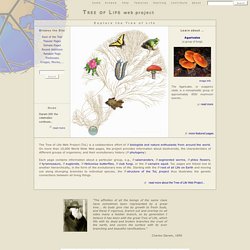
On more than 10,000 World Wide Web pages, the project provides information about biodiversity, the characteristics of different groups of organisms, and their evolutionary history (phylogeny). Each page contains information about a particular group, e.g., salamanders, segmented worms, phlox flowers, tyrannosaurs, euglenids, Heliconius butterflies, club fungi, or the vampire squid. ToL pages are linked one to another hierarchically, in the form of the evolutionary tree of life. Starting with the root of all Life on Earth and moving out along diverging branches to individual species, the structure of the ToL project thus illustrates the genetic connections between all living things. Evolution. What Darwin Never Knew. Skip to Main Content Use one of the services below to sign in to PBS: You've just tried to add this video to My List.

But first, we need you to sign in to PBS using one of the services below. You've just tried to add this show to My List. But first, we need you to sign in to PBS using one of the services below. By creating an account, you acknowledge that PBS may share your information with our member stations and our respective service providers, and that you have read and understand the Privacy Policy(opens in new window) and Terms of Use(opens in new window). You have the maximum of 100 videos in My List. We can remove the first video in the list to add this one. Edit My List You have the maximum of 100 shows in My List. We can remove the first show in the list to add this one. Edit My List. Tracing Ancestry with MtDNA. By Rick Groleau In 1987, three scientists announced in the journal Nature that they had found a common ancestor to us all, a woman who lived in Africa 200,000 years ago.
She was given the name "Eve," which was great for capturing attention, though somewhat misleading, as the name at once brought to mind the biblical Eve, and with it the mistaken notion that the ancestor was the first of our species—the woman from whom all humankind descended. The "Eve" in question was actually the most recent common ancestor through matrilineal descent of all humans living today. That is, all people alive today can trace some of their genetic heritage through their mothers back to this one woman. The scientists hypothesized this ancient woman's existence by looking within the cells of living people and analyzing short loops of genetic code known as mitochondrial DNA, or mtDNA for short.
Nuclear DNA vs mitochondrial DNA When someone mentions human DNA, what do you think of? Inheriting mtDNA.