Translating Key Words Poster - Gina Wilson. Foldables/Study Guides. Lose a foldable?
All foldables & study guides that we have made in class are available below. If you need help filling in the blanks, please see the completed foldable or study guide in the classroom. Remember, many of these files were copied back-to-back, so a two-page file is the front and back of the foldable. 6th Grade Adding and Subtracting Fractions and Mixed Numbers (PDF 11 KB)Four-door foldable for operations with fractions. 6th Grade Multiplying and Dividing Fractions and Mixed Numbers (PDF 12 KB)Four-door foldable for operations with fractions. 6th Grade Decimals Foldable (PDF 43 KB)Four-door foldable for decimal operations 6th Grade Ratio, Rates, and Proportions (PDF 46 KB)This foldable gives definitions and examples of ratios, rates, and proportions. 6th Grade Proportions (PDF 32 KB)This foldable shows the steps needed to solve a proportion. 6th Grade Percents (PDF 70 KB)This tabbed-book is a great overview of percents.
Mrs. Pictures of Platonic Solids. A Platonic solid is a polyhedron all of whose faces are congruent regular convex polygons*, and where the same number of faces meet at every vertex.
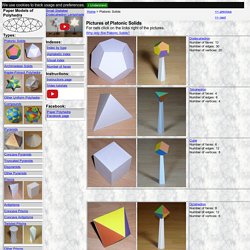
The Greeks recognized that there are only five platonic solids. But why is this so? The key observation is that the interior angles of the polygons meeting at a vertex of a polyhedron add to less than 360 degrees. Tetrahedron: Three triangels at a vertex: 3*60 = 180 degrees Octahedron: Four triangles at a vertex: 4*60 = 240 degrees Icosahedron: Five triangles at a vertex: 5*60 = 300 degrees Cube: Three squares at a vertex: 3*90 = 270 degrees Dodecahedron: Three pentagons at a vertex: 3*108 = 324 degrees Note: Six triangles: 6*60 = 360 degrees Four squares: 4*90 = 360 degrees Four pentagons: 4*108 = 432 degrees Three hexagons: 3*120 = 360 degrees So there are only five Platonic Solids! *) Regular means that the sides of the polygon are all the same length. Gazette August 2003 - MATH & LITERACY LEARNING CENTERS FOR UPPER GRADES - Teachers.Net Gazette - MENTORING, STRESS RELIEF, STUDENT MOTIVATION, ORGANIZATION IDEAS, CLASSROOM MANAGEMENT, LESSON PLANS, DISCIPLINE, AND MORE - featuring columns and articles by.
Teacher Feature...

Math & Literacy Learning Centers for Upper Grades from the Teachers.Net Learning Centers Chatboardteachers.net/projects/centers We stay away from one-shot centers that are high-maintenance for teachers. Here's one kids love and it can last from today till the last day of school. Using old encyclopedias: Go through Volume I and write 5 questions on a card for which the answers can be found in that volume. For kids who had less time due to pull-out programs, they had to do fewer volumes--this was a private arrangement between me and those students. In addition to encyclopedia you can also use a kid's question and answer book about the world. I use centers during novel study time. I have found that there are three real tricks to making centers work: You have to train your kids. Learning centers are for remediation, practice and enrichment. Vocabulary/spelling centers are easy to set up as well.
Browse the latest posts from the Classroom Centers Chatboard: Free Nets of 3D Shapes - Nyla's Crafty Teaching. Pictures - Short division in action - Mankato Homeschooling.