
Elephants worth much, much more alive than dead, says new report. A living African elephant has 76 times the value of one poached for ivory, according to report Elephants are worth 76 times more when they’re alive than dead, according to a new analysis released this past weekend.

The report follows on the heels of findings by WWF that the world has lost 50 percent of its wildlife over the past 40 years, with more than half of African elephants killed for ivory in just one decade. The analysis, conducted through the David Sheldrick Wildlife Trust’s iworry campaign, compared the value of elephants to local economies to profits netted through the illegal ivory trade. Between January and August 2014, researchers tallied approximately 17.8 metric tons of ivory seized worldwide, harvested from 1,940 poached elephants. Most of these seizures occurred in Kenya, Gabon, China, and Vietnam, countries identified by CITES as doing relatively little to stem the tide of black-market ivory. Anti-Poaching Teams with seized ivory. Blog comments powered by. Mānoa: New study reveals whales as marine ecosystem engineers. University of Hawaiʻi at Mānoa Contact: Whales transfer nutrients from deep to surface water via plumes of fecal matter.

Credit:Roman et al. Fallen whale carcasses are home to species that rely on the unique habitat. Credit: C.Smith Baleen and sperm whales, known collectively as the great whales, include the largest animals in the history of life on Earth. A recent synthesis, published in Frontiers in Ecology and the Environment, evaluates decades of research on the ecological role of great whales. Commercial whaling dramatically reduced the abundance of great whales – by at least 66% and perhaps as high as 90%, according to some estimates – but recovery is possible, and potentially critical for ocean resiliency.
Among their many ecological functions, whales recycle nutrients and enhance primary productivity, locally and on a regional scale. Sometimes, commercial fishermen have seen whales as competition. Salamander’s Hefty Role in the Forest. Fungi sequester more carbon than leaf litter. We all know that boreal forests sequester an incredible amount of carbon.
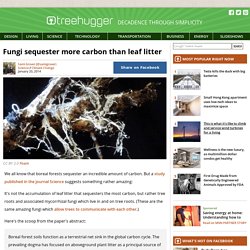
But a study published in the journal Science suggests something rather amazing: It's not the accumulation of leaf litter that sequesters the most carbon, but rather tree roots and associated mycorrhizal fungi which live in and on tree roots. (These are the same amazing fungi which allow trees to communicate with each other.) Here's the scoop from the paper's abstract: Boreal forest soils function as a terrestrial net sink in the global carbon cycle. Researchers found that anywhere between 47% and 70% of soil carbon found in their samples was the result of fungi.What this means for long term forest and carbon management remains to be seen, except to say we have yet another reason to better understand the amazing world of mushrooms—and to protect the ecosystems that they call home.
But that's just a layman's hope, and not something covered in this particular research. When Trees Die, People Die - Lindsay Abrams. ~maja*majika~/Flickr The blight was first detected in June 2002, when the trees in Canton, Michigan, got sick.

The Social Responsibility of Business is Natural Resource Protection. Over the next couple of weeks, we’ve asked our writers (and guests) to respond to the question” What is the Social Responsibility of Business?” Please comment away or contact us if you’d like to offer an opinion. Improvements in Air Quality add Years to Life Expectancy in US. Are all the environmental laws and regulations accomplishing anything?

Sometimes progress is not apparent, so it is good news that a new study led by researchers at Harvard School of Public Health (HSPH) has found an association between reductions in fine particulate matter and improved life expectancy in 545 counties in the U.S. from 2000 to 2007. It is the largest study to date to find beneficial effects to public health of continuing to reduce air pollution levels in the U.S.
The study appears in the December 3, 2012 online edition of the journal Epidemiology. "Despite the fact that the U.S. population as a whole is exposed to much lower levels of air pollution than 30 years ago—because of great strides made to reduce people’s exposure—it appears that further reductions in air pollution levels would continue to benefit public health," said lead author Andrew Correia, a PhD candidate in the Department of Biostatistics at HSPH". Los Angeles from the air via Shutterstock. Tree intercropping could save Africa's soils.
How Much Is Clean Water Worth? A lot, say researchers who are putting dollar values on wildlife and ecosystems—and proving that conservation pays 02-01-2005 // Jim Morrison.
Napa River restoration project serves as model. The U.S.

Environmental Protection Agency's top man in the region shook his head after tromping through a restored Napa River floodplain and then motoring on a boat through one of the nation's premier riparian revitalization projects. "Why," asked Jared Blumenfeld, the EPA's regional administrator, "do we not hear more about this? " The grapevine is getting louder, with community planners and environmentalists taking note, as Napa County moves forward with a project that, when completed, will have restored 15 miles of the Napa River and added 135 acres of floodplains. It is already California's largest floodplain and wildlife habitat restoration project.