
Introduction to Bird Species and Ornithology. Falcon Species Index. World Bird Guide. BIRD. [site/link_exchange.htm] On this website, you can find the bird checklists of all countries of the world: Just go to In many of them you can find the bird names in its native language as well.
But there is much more. There are pictures of nature, great tools for conservation, information on national parks and other nature reserves, an on-line book on ecology and nature conservation, free software for downloading, technical reports for those who want it. In order to find your way through the 2000 interlinked web pages on nature and conservation, please go to the site map. On this page we help you find the way to the worldwide list of birds and the bird names in other languages.
We have composed a list of bird species originally based on the bird list of Sibley and Monroe of 9702, 1993. However, what matters to you, the birdwatcher is what you find in the field at the place where you are birding. Another discussion is at: We are providing non-English bird names for 20 languages. Avibase - The World Bird Database. Bird Species Index. Naturesongs Nature Recordings and Photos. Bird Songs & Calls. Arie Ouwerkerk's Photo Galleries at pbase.com.
Migration10. As of 1 September 2013 these pages will remain on this server as an archive, but they will not be updated.

Please visit my new site at www.ospreytrax.com Home Page - Osprey Main Page - Migration Page - Birds of Prey Migration 2010 Use these links to go straight to a bird's maps or bios. (More details on the project below). Overview of our Osprey research This is the 11th year of our satellite tracking and the 13th year that we have been following the Osprey population on Martha's Vineyard. UNC Charlotte Biology. Welcome to my cyber-résumé.

Browse around to find out about my research and publications on birds of prey, birds of the New World Tropics, habitat fragmentation in the Amazon, ecology, and conservation, as well as my graduate students, courses taught (ornithology and sometimes field ecology), and links to interesting pages on the Web, including a number of local conservation organizations with which I'm involved. Ospreys: I've been studying the Osprey population on Martha's Vineyard, MA, since 1969. Beginning in 2000, in collaboration with Dr. Mark Martell of The Raptor Center at the University of Minnesota, I put satellite transmitters on a total of seven adult birds, six on Martha's Vineyard and one in Charlotte. Beginning in 2004 I began tagging juvenile Ospreys. Read about the Osprey research in more detail. Bird identification guide. News and Features — eBird.
Sam Murray, June eBirder of the Month Please join us in congratulating Sam Murray of Augusta, GA, winner of the June 2017 eBird Challenge, sponsored by Carl Zeiss Sports Optics.
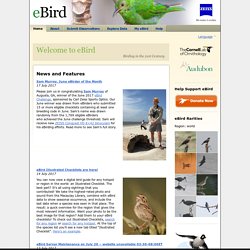
Our June winner was drawn from eBirders who submitted 15 or more eligible checklists containing at least one breeding code in June. Sam’s name was drawn randomly from the 1,769 eligible eBirders who achieved the June challenge threshold. Sam will receive new ZEISS Conquest HD 8×42 binoculars for his eBirding efforts. Read more to see Sam’s full story. eBird Illustrated Checklists are here! You can now view a digital bird guide for any hotspot or region in the world: an Illustrated Checklist.
Birds With Child-care Assistance Invest Less In Eggs. An Australian bird has been found to produce smaller, less nourishing eggs when it breeds in the presence of other 'helper' birds that provide child-care assistance.

This unique adaptation enables the birds to live longer and breed more often than females without helpers. The research, led by a University of Cambridge academic, was published in Science. In many animal species, parents caring for their offspring are assisted by so-called 'helpers', adults that forego reproduction to help others raise young.
Although parents decrease the amount of food they provide to offspring when helpers are present, the additional supply provided by the helpers more than compensates for this reduction. As a result, chicks fed by parents and helpers tend to receive more than those raised without helpers. However, research has shown that these offspring who receive additional food do not appear to gain any advantage as a result. Australian birds attract mates with 'scary movie effect' Using a horror film to bring your date closer is a classic move in the teenage playbook.
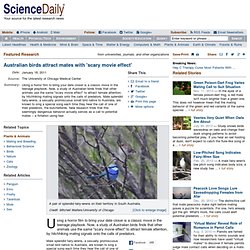
Now, a study of Australian birds finds that other animals use the same "scary movie effect" to attract female attention, by hitchhiking mating signals onto the calls of predators. Male splendid fairy-wrens, a sexually promiscuous small bird native to Australia, are known to sing a special song each time they hear the call of one of their predators, the butcherbirds. New research from scientists at the University of Chicago finds that this seemingly dangerous behavior actually serves as a call to potential mates -- a flirtation using fear. Published in the journal Behavioral Ecology, the study involved painstaking field research playing sound clips to splendid fairy wrens at a conservation center in Southern Australia. Experiments determined that the "vocal hitchhiking" of male birds is a courtship behavior that uses predator calls to grab the attention of female birds.