Will The New York Times Redesign Lead To A New Web Standard? The latest conversation in web design has been, how do we reimagine the web for a mobile device?

Do you design your mobile site first, then supersize it for PCs? Or do you wrap all that content in an app and bring special functionality to tablets? For most websites, it’s an ongoing debate between aesthetics and user experience. But for the New York Times, the stakes are much higher. The way a story is consumed is intrinsic to its meaning--even its perceived veracity. “We want to make sure we’re shaping our journalism in a way that does not reflect a bias to a particular medium or format,” Ian Adelman tells Co.Design. Mobile Devices and News Consumption: Some Good Signs for Journalism. By Amy Mitchell & Tom Rosenstiel of PEJ, and Leah Christian of the Pew Research Center Each of these technologies offers a separate set of features, conveniences and potential uses.
But less is known to date about how people use these devices — whether they behave differently on different platforms and what the move to mobile might mean for news and journalism and the notion of a common experience or public square. New York Times Unveils iPad Web App. Internet : ces journaux américains qui ne croient plus au modèle gratuit fondé sur la publicité. Le site du New York Times amorce son changement de look. Après USA Today, c’est un autre des grands journaux américains qui tente de faire peau neuve sur le web.

Le prototype lancé par le New York Times veut s’adapter aux évolutions du journalisme numérique et aux nouvelles habitudes des lecteurs. Ravalement de façade au NYTtimes.com ! Le quotidien américain a dévoilé le 13 mars dernier les visuels d’un prototype de la nouvelle version de son site web. C’est la première refonte majeure du design du site depuis 2006. Et surprise, le changement ne commence pas sur la page d’accueil, mais sur celles des articles. Un nouveau design épuré qui met en avant les visuels Pour ce faire, le journal a choisi de donner à son prototype une apparence plus propre et aérée que celle du site actuel.
À gauche, un article visible sur le prototype. La forme des papiers est d’ailleurs flexible en fonction des sujets. Le iPad, sauveur de la presse écrite ? Le jour du lancement du iPad, plusieurs éditeurs de quotidiens et de magazines étaient présents sur la boutique en ligne AppStore.

En effet, le iPad permet aux éditeurs de commercialiser leurs contenus en passant outre le Web. Contre espèces sonnantes et trébuchantes, l’utilisateur du iPad peut dorénavant télécharger une application qui lui ouvrira les portes de l’information numérique. La reproduction à l’écran de la mise en pages papier, entre autres des magazines Time et Paris Match ou du quotidien USA Today, est somptueuse.
D’ailleurs, des magazines comme Wired entendent repousser les limites du graphisme en exploitant les possibilités offertes par cette mise en pages déstructurée combinant texte et contenus multimédias. A Better Letter To New York Times Readers About Digital Subscriptions. Today, the New York Times is taking a major step forward as we introduce digital subscriptions in the United States and the rest of the world.

Since we first announced the plan 11 days ago, we’ve heard from so many of you, our readers. We’ve also heard from a bunch of noisy bloggers, but they just rip us off anyway, so we’re ignoring them. We’re grateful for the feedback from our loyal readers (not those blogger brats) and, most of all, for your commitment to the The Times.
The Tablet Revolution. Eighteen months after the introduction of the iPad, 11% of U.S. adults now own a tablet computer of some kind.
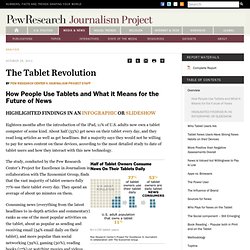
About half (53%) get news on their tablet every day, and they read long articles as well as get headlines. But a majority says they would not be willing to pay for news content on these devices, according to the most detailed study to date of tablet users and how they interact with this new technology. The study, conducted by the Pew Research Center’s Project for Excellence in Journalism in collaboration with The Economist Group, finds that the vast majority of tablet owners-fully 77%-use their tablet every day.
They spend an average of about 90 minutes on them. The Transition to Digital Journalism. While cellphones have become ubiquitous as mobile devices, it's been a much longer road to popularity for tablet computers - portable electronic devices that try to fill a void between tiny screen cellphones and more cumbersome laptops.

Roger Fidler was one of the original proponents of these portable "electronic tablets" when he ran the Knight Ridder Information Design Lab in the early 1990s. See this story and this 1994 video showing Fidler's vision (Fidler is now at the Reynolds Journalism Institute as Program Director for Digital Publishing). Many companies subsequently produced various forms of tablet computers as reading devices, such as the SoftBook and the Rocket eBook in the late 1990s and Sony's e-book readers in the mid to late 2000s. But most of the devices failed to gain much traction with consumers. Then with Amazon's release of the popular Kindle e-book reader in late 2007, buzz about portable tablet computers heated up again. Apple's iPad announced in January 2010. Information behaviour of New York City subway commuters. Irene Lopatovska with Alexandra S.

Basen, Anshuman M. Duneja, Helen Kwong, Denise L. Pasquinelli, Sarah Sopab, Brian J. Stokes and Christopher Weller School of Library and Information Science, Pratt Institute, 144 w. 14th street, 6th floor New York, NY 10011-730ress Introduction. NYTimes for Android. NewsHunt, India's #1 mobile newspaper app brings together the News from 80+ regional newspapers in 11 languages, and the largest collection of regional language ebooks from the world.

*Large Collection of Indian language eBooks on ‘NewsHunt: India News | eBooks*Now, ‘NewsHunt : News | eBooks’ lets you browse, download and read the largest collection of regional language eBooks. Read authors including Surendra Mohan Pathak, Chetan Bhagat, Rajesh Kumar, Sudha Murthy, Kannadhasan, and Deepak Chopra as well as international best selling authors. Features:• Read Free Books—Choose from thousands of free ebooks such as The Adventures of Sherlock Holmes to Alice in Wonderland* Shop for Books—Easily shop for ebooks, including new releases* Pay using your mobile phone in addition to your credit/debit cards - Buy eBook using your mobile operator. NYTimes for iPad. New York Times Mobile - Mobile Apps.