
Full wrap aluminum fins for solar collector absorbers. Search The Renewable Energy site for Do-It-Yourselfers These pictures and description below from Henry show the relatively simple tools used to make a fin that wraps the full diameter of the tube.

Thanks to Henry for sending in these pictures. General After reading many diy solar water heating articles on the net I attempted to built my first panel. Step 1 -- Photos 1,2,3 More fin area is required to accomplish a full wrap and in order achieve this I secured a 6 mm square steel spacer underneath a ½”stainless steel rod. Photo 1 Photo 2 Photo 3 Step 2 -- Photo 4 Next the ½” copper tube is dropped into the “U” shaped curvature of the fin and placed into the jig and squeezed until the wrap is completed. Photo 4 Step 3 -- Photo 5 The two ends are now dressed back, and if need be, the jig may be turned up finally to secure a near perfect wrap.
Photo 5 The final result is a neat fit around the copper pipe. Solar Water Heating Projects and Plans. Solar water heating systems have a good economic payoff, and are manageable systems to install or build as a DIY project.
Some of the solar water heating designs are very simple and low cost. You can save as much as $7000 by building your own system. There are just over one hundred projects with full construction details listed below -- all free. The projects range from simple batch heaters for warm climates through closed loop and drain back systems that will work in any climate. One of the systems is our own $1,000 solar water heating system that has provided a solar fraction in excess of 90% through our cold Montana winter. My thanks to the people who have built systems, and then taken the time to send in pictures and descriptions for others to use. Directory for this page: Information on pumps, heat exchangers, heat storage tanks Controllers, pipe insulation, backdraft dampers and other components for solar space heating systems here...
Blog/pluggingintothesun/ DIY Solar panela made of pop cans for home solar heating. At the end, the solar absorber is painted black and placed in the diy solar panels casing.
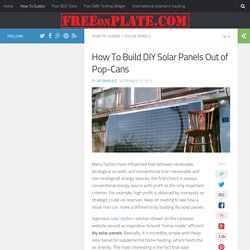
The casing is covered with plexiglass that we attach to the frame and thoroughly corked with silicone. Polycarbonate / plexiglass is slightly convex in order to gain greater strength. You can see installed solar absorber without plexiglass in picture 18. Complete solar collector is shown on Picture 19, and finally, installed solar system can be seen in Picture 20. The following page shows complete specification of parts and material needed for building diy solar panels. On YouTube you can see how our diy pop-can solar panels work.
Important note: Our solar system is not able to accumulate thermal energy after producing it. Differential thermostat (snap disc) controls the fan. If on/off temperatures are set carefully, diy solar panels are able to produce an average 2 kW of energy for home heating.