
Cynthia Lanius' Fractals Unit: The Koch Snowflake. Fractals. SCIENCE. Life Sciences. Science News & Organizations.
New Research Info. Scientific Representation. Other Sciences. 13 things that do not make sense - space - 19 March 2005. Read full article.
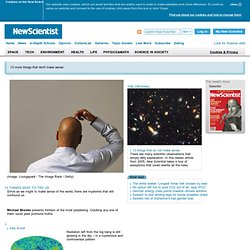
13 more things that don't make sense. Cookies on the New Scientist website close Our website uses cookies, which are small text files that are widely used in order to make websites work more effectively.
To continue using our website and consent to the use of cookies, click away from this box or click 'Close' NASA video crushes 2012 Mayan apocalypse myth. Scientists at NASA's Jet Propulsion Laboratory have put out a new video to address false claims about the "Mayan apocalypse," a non-event that some people believe will bring the world to an end on Dec. 21.
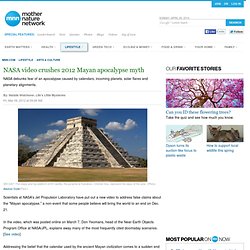
In the video, which was posted online on March 7, Don Yeomans, head of the Near-Earth Objects Program Office at NASA/JPL, explains away many of the most frequently cited doomsday scenarios. [See video] Addressing the belief that the calendar used by the ancient Mayan civilization comes to a sudden end in December 2012, and that this will coincide with a cataclysmic, world-ending event, Yeomans said: "Their calendar does not end on December 21, 2012; it's just the end of the cycle and the beginning of a new one. It's just like on December 31, our calendar comes to an end, but a new calendar begins on January 1.
" 6 Insane Discoveries That Science Can't Explain. We like to feel superior to the people who lived centuries ago, what with their shitty mud huts and curing colds by drilling a hole in their skulls.
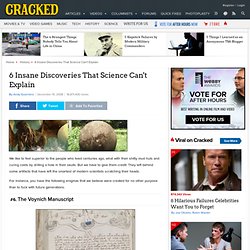
But we have to give them credit: They left behind some artifacts that have left the smartest of modern scientists scratching their heads. [1208.2686] Exploring scientists' working timetable: Do scientists often work overtime? The earliest split in modern humanity was 100,000 years ago. What's interesting is that as a result of this split, populations within the Khoisan group should about as much genetic diversity as the rest of humanity does combined.
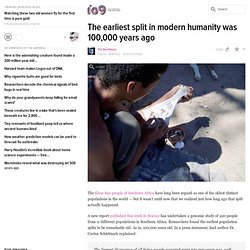
And that's including every other genotype within Africa. Did fist fighting change the course of human evolution? Protective buttressing of the human fist and the evolution of hominin hands. + Author Affiliations ↵* Author for correspondence (carrier@biology.utah.edu) Received June 6, 2012.
Accepted September 24, 2012. The derived proportions of the human hand may provide supportive buttressing that protects the hand from injury when striking with a fist. The Loom. Your hands are, roughly speaking, 360 million years old.
Before then, they were fins, which your fishy ancestors used to swim through oceans and rivers. Once those fins sprouted digits, they could propel your salamander-like ancestors across dry land. Rediscovering Life. Notes and Commentaries Toward a Biology Worthy of Life Stephen L.
Talbott RSS Feed for this page: This page serves as a portal introducing all new content for the “Biology Worthy of Life” project: BiologyWorthyofLife.org. Copyright 2014 The Nature Institute. Scientific Ideas for the Garbage Dump - On Science Blogs. Hello there!
If you enjoy the content on On Science Blogs, consider subscribing for future posts via email or RSS feed. These scientific ideas will drive you crazy. The 100 Top Science Stories of 2010. Ernest Rutherford’s Nucleated Century. The critical discovery in this atomic model emerged a century ago in a talk before the Manchester Literary and Philosophical Society in March 1911 and a paper published soon after in the Philosophical Magazine.

Child creates molecule that could be used for energy storage or explosives. On Truth & Reality: Philosophy Physics Metaphysics of Space, Wave Structure of Matter. Famous Science Art Quotes. Science. The more we understand about science and its complexities, the more important it is for scientific data to be shared openly. It’s not useful to have ten different labs doing the same research and not sharing their results; likewise, we’re much more likely to be able to pinpoint diseases if we have genomic data from a large pool of individuals.
Since 2004, we’ve been focusing our efforts to expand the use of Creative Commons licenses to scientific and technical research. Science Advisory Board Open Access The Scholars’ Copyright Project Creative Commons plays an instrumental role in the Open Access movement, which is making scholarly research and journals more widely available on the Web. Physics and biology sites. Otherwise, there are a quite a lot of sites out there covering physics and biology at this level, but my impression of them is that they would be good for revision, but not so good if you were struggling to understand something in the first place.
If you want to find what is available a Google search on "a level" physics or "a level" biology should throw up a good selection. Specials archive : Nature. Prokaryotes, Eukaryotes, & Viruses Tutorial. Interactive Concepts in Biochemistry - Interactive Animations. Organic Chemistry Animations ChemTube3D. CHEM 1211 COURSE CONTENTS. Virtual Laboratory: Thermodynamic Equilibrium. Click chemistry. Understanding Chemistry - interesting links. Chemistry - few periodic rules to rule them all :) CHEMISTRY & PHYSICS. REALLY GOOD STUFF. Autopoiesis. ORGANICA. Ethnobotany. Health ReferencEd.