
Frozen Homemade Baby Food Cubes that Freeze Well, Which baby foods freeze best or good for homemade baby food. Mini Shepherd's Pie Recipe. Lemon Chicken for Babies. Meat for Baby Food recipes, Puree Homemade Meats Baby Food, Puree Chicken, Pork, Beef Meats, Meat Recipe Purees. Homemade Meat Baby Food Recipes – Nutritious Homemade Meat Baby Foods Are Better than Jarred.
Please note: Meats may be introduced anytime between 7-8 months of age with the advice of your pediatrician. Many pediatric authorities, specifically in Canada, the EU and the U.K. recommend meat as one of baby’s first solid foods but not as THE first food. In the U.S. the recommendation to start meats earlier than 8 months is also becoming more common. Easy, Fresh & Nutritious Meat Baby Food Recipes that your baby will Love. Try the Beef, Chicken & Vegetable Stock/ Broth recipes too. You may add veggies or fruits to any of the meat baby food puree recipes as you like. Beef, Pork or Veal Purée (Basic) Ingredients: 1 cup cold and cooked boneless beef, pork or veal – chopped into chunks no bigger than 1 inch1/4 c cooking juice (save the juices that you cooked the meat in) or plain water Directions: Step 1: Place meat chunks in blender or food processor and puree until a powdery mix is formed.
Egg Yolks. Baby Feeding Tips: 9- to 11-months. Mealtime with your older baby is becoming a freewheeling affair.

Your youngster is growing more independent by the day, learning to crawl and stand. She is trying her hand at wielding a spoon, testing the laws of physics by dropping food onto the floor, and testing your patience as she smears it in her hair. How to Start If your baby has not tried finger foods already, she'll be ready to start now. At every meal, offer a variety of tiny pieces of "real" food. . • Your baby has choppers. Sneak in Vegetables into Food - Puree Recipes.
Baby-Friendly Chicken. Here are two basic methods of cooking chicken that can be used to create a variety of textures and meals for your baby.
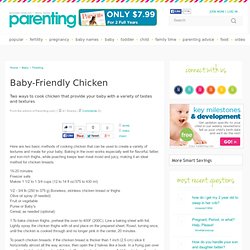
Baking in the oven works especially well for flavorful, fattier, and iron-rich thighs, while poaching keeps lean meat moist and juicy, making it an ideal method for chicken breasts. 15-20 minutesFreezer safeMakes 1 1/2 to 1 3/4 cups (12 to 14 fl oz/375 to 430 ml) 1/2 - 3/4 lb (250 to 375 g) Boneless, skinless chicken breast or thighsOlive oil spray (if needed)Fruit or vegetablePuree or Baby'sCereal, as needed (optional) 1 To bake chicken thighs, preheat the oven to 400F (200C). Line a baking sheet with foil. To poach chicken breasts: if the chicken breast is thicker than 1 inch (2.5 cm) slice it horizontally almost all the way across, then open the 2 halves like a book. Baby-Friendly Beef. 10 minutesFreezer safeMakes 1/2 cup (4 fl oz/125 ml) Beef is a good source of protein, B vitamins, and iron for babies.

To keep it digestible for tiny stomachs, choose a lean cut. Top sirloin steak is a good choice in this respect. Choose organic beef if you can, or grass-fed if available: this type is higher in healthful omega-3 fats than corn-fed beef. 1 1/4-lb (125-g) small top sirloin steak, ¾ to 1 inch (2 to 2.5 cm) thickpepper1/4 tsp minced fresh rosemaryvegetable oil sprayfruit or vegetable puree, such as applesauce or Sweet Potato Puree 1 Sprinkle the steak lightly with salt and pepper and the minced rosemary. 2 Preheat the broiler and line a rimmed baking sheet with foil. 3 Broil the steak on the first side for 4 minutes, then turn and cook on the other side for 4 minutes more. 4 For pureed beef, coarsely chop the steak.
Sneak in Vegetables into Food - Puree Recipes.
Bottle-feeding basics for formula-fed babies. Reviewed by the BabyCenter Medical Advisory Board En español How often should I feed my baby?

As with breastfeeding, most experts agree that you shouldn't follow a rigid schedule in the early weeks, though you may be able to work out an approximate pattern for feeding within a month or so. Offer the bottle every two to three hours at first, or as your baby seems hungry. When your baby is about a month old, she'll be ready to eat on a schedule. Formula-fed infants tend to be heavier than breastfed babies, so following a feeding schedule can help prevent them from overeating.
Feed your baby once every three to four hours. Do I need to sterilize the bottles? Before you first use new bottles, nipples, and rings, sterilize them by submerging them in a pot of boiling water for at least five minutes. Two exceptions: One, if you have well water, it may be best to continue sterilizing the bottles. Do I need to sterilize my drinking water for making formula? What's the best way to warm a bottle?
Tips for Pumping Breast Milk.