
Verfahrenstechnische Prozesse und Systeme. Neben der Analyse von Verfahren, ihrer Zerlegung in Grundverfahren und deren Strukturierung entsprechend den Wirkprinzipien ist die Synthese von Verfahren, also das Zusammensetzen der Grundverfahren zu verfahrenstechnischen Systemen, in denen gewünschte neue Produkte hergestellt werden können, eine der Hauptaufgaben des Verfahrensingenieurs.

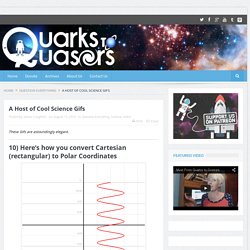
Die Entwicklung eines neuen Verfahrens ist für ihn eine "Pioniersituation", da er einer Problemstellung gegenübersteht, die bisher nicht gelöst wurde. Neu sind nicht die zur Verfügung stehenden Grundverfahren und dafür bewährte konstruktive Lösungen, sondern das Neue besteht darin, daß die Grundverfahren aus einem alternativen Angebot auszuwählen und auf geeignete Weise zu verknüpfen sind. Unabhängig vom aufzubauenden System ist folgende Vorgehensweise kennzeichnend für die Verfahrensentwicklung: 1. Festlegung der Funktion: 2. 3. 4. 20 Gifs That Teach You Science Concepts Better Than Your Teacher Probably Can - StumbleUpon. These Gifs are astoundingly elegant. 10) Here’s how you convert Cartesian (rectangular) to Polar Coordinates 9) This is how Exterior Angles of Polygons work (they add up to 360 degrees)
Hochpunkte, Tiefpunkte - Vorzeichenvergleich, 2. Ableitung - Vorzeichenwechselkriterium. Wenn wir Extremstellen berechnet haben und auch schon ihre zugehörigen Extremwerte, so kann es immer noch sein, dass es sich gar nicht um Extrempunkte handelt.

Denn eine Nullstelle der Ableitung kann auch nur Berührpunkt mit der x-Achse sein, in diesem Fall bliebe die Ableitung positiv (bzw. negativ) und die Steigung der Funktion bliebe positiv (bzw. negativ). Zur Überprüfung auf Hochpunkt bzw. Tiefpunkt gibt es zwei Methoden. 1. Methode: Vorzeichenvergleich (auch: Vorzeichenwechselkriterium) 2. Vorzeichenvergleich Wir untersuchen die 1. Wenn der Vorzeichenvergleich um die Nullstelle ein Wechsel von positiv zu negativ zeigt, so handelt es sich bei dieser Nullstelle um eine Hochstelle der Funktion.
Zweite Ableitung überprüfen Die Methode der zweiten Ableitung baut auf die des Vorzeichenvergleichs auf. Das Gleiche für einen Tiefpunkt. Und weiterhin ist klar, dass die zweite Ableitung in der hinreichenden Bedingung nicht Null sein darf. TED Science.
Scripts. Frequently asked questions. What is fracking?

Fracking or hydraulic fracturing is a method utilized by oil and gas companies to increase production of oil or gas from a well that would otherwise exhibit a low flow rate usually due to the geologic rock formation being too dense to allow for the economic recovery of hydrocarbons. These low permeability formations generally include tight sands, shales and coal bed methane deposits. Fracking consists of pumping millions of gallons of water, sand and various toxic chemicals (known as fracking fluids) thousands of feet down a well and out into the oil or gas bearing geologic rock formation at high enough pressure sufficient to cause that formation to fracture or crack.
These fractures can extend hundreds of feet from the wellbore. After the desired fracking has occurred, the pumping of fracking fluids ceases and the internal pressure of the rock formation (the formation pressure) causes the injected fracking fluids to return to the surface (this is known as flowback).
Science sites. Interactive. The World of Seven Billion The map shows population density; the brightest points are the highest densities.

Each country is colored according to its average annual gross national income per capita, using categories established by the World Bank (see key below). Some nations— like economic powerhouses China and India—have an especially wide range of incomes. But as the two most populous countries, both are lower middle class when income is averaged per capita. Science Sites.
Free Science Learning Materials. Biggest Scientific Breakthroughs of 2011. Biology. Physics. The Invisible Universe. Professor Ian Morison 1) Evidence of Dark Matter in Galaxy Clusters The first evidence of a large amount of unseen matter came from observations made by Fritz Zwicky in the 1930's.
He studied the Coma cluster of galaxies, 321 million light years distant, and observed that the outer members of the cluster were moving at far higher speeds than were expected. He was able to measure the velocities away from us by using the shift in the spectral lines of the galaxy: When the spectra of galaxies were first observed in the early 1900's it was found that their observed spectral lines, such as those of hydrogen and calcium, were shifted from the positions of the lines when observed in the laboratory.
Δf/f = Δλ/λ = v/c may be used. The redshift in the spectral lines from a distant galaxy (below) relative to those observed in our Sun (above). Suppose a cluster of galaxies were created which were not in motion. 2) Evidence for an unseen component - Dark Matter - in Spiral Galaxies = ~ 2.4 x 10²⁰ m. Wait but why: Putting Time In Perspective. Humans are good at a lot of things, but putting time in perspective is not one of them.

It’s not our fault—the spans of time in human history, and even more so in natural history, are so vast compared to the span of our life and recent history that it’s almost impossible to get a handle on it. If the Earth formed at midnight and the present moment is the next midnight, 24 hours later, modern humans have been around since 11:59:59pm—1 second. And if human history itself spans 24 hours from one midnight to the next, 14 minutes represents the time since Christ.
Maths.