
Mathematics. For more than a decade, research studies of mathematics education in high-performing countries have concluded that mathematics education in the United States must become substantially more focused and coherent in order to improve mathematics achievement in this country.
To deliver on this promise, the mathematics standards are designed to address the problem of a curriculum that is “a mile wide and an inch deep.” These new standards build on the best of high-quality math standards from states across the country. They also draw on the most important international models for mathematical practice, as well as research and input from numerous sources, including state departments of education, scholars, assessment developers, professional organizations, educators, parents and students, and members of the public. The math standards provide clarity and specificity rather than broad general statements. Exploring Coherence in the New Math Standards - Activity Recording Sheet.
Illustrativemathematics. The University of Arizona - Institute for Mathematics & Education. The Common Core State Standards in mathematics were built on progressions: narrative documents describing the progression of a topic across a number of grade levels, informed both by research on children's cognitive development and by the logical structure of mathematics.
These documents were spliced together and then sliced into grade level standards. From that point on the work focused on refining and revising the grade level standards. The early drafts of the progressions documents no longer correspond to the current state of the standards. It is important to produce up-to-date versions of the progressions documents. They can explain why standards are sequenced the way they are, point out cognitive difficulties and pedagogical solutions, and give more detail on particularly knotty areas of the mathematics. This project is organizing the writing of final versions of the progressions documents for the K–12 Common Core State Standards. Untitled. Resources for Implementation.
Sample curriculum framework documents District curriculum framework documents need to address the curriculum at different grain sizes to be effective, and the Charles A. Dana Center supports districts in creating such framework documents. Sampled below are three of the four types of curriculum framework documents on which we work. These documents represent our thinking about how the concepts and skills described in the Common Core State Standards for Mathematics might be developed across the course of a school year. PARCC Online. Item and Task Prototypes. PARCC Task Prototypes and Sample Items Samples can be found by clicking on each grade level on the left menu.
There are two types of samples found on these pages: • Task Prototypes, which were released in August 2012; and, • Sample Items, which were released beginning on August 15, 2013 The task prototypes were created to provide viable early models to guide item development. The new sample items are first presented in PDF format to emphasize a focus on the content of the items. PARCC Releases Assessment Blueprints and Test Specifications Documents. PARCC Releases Assessment Blueprints and Test Specifications Documents WASHINGTON, D.C. - April 30, 2013 - The Partnership for Assessment of Readiness for College and Careers (PARCC) today released assessment blueprints and test specifications for both the English language arts/literacy and mathematics assessments set to debut in 2014-15.

These blueprints and test specifications will help educators better prepare students for the new online assessments that are aligned to the more rigorous Common Core State Standards (CCSS) and designed to measure college and career readiness. Smarter Balanced Assessment Consortium. PARCC Model Content Frameworks. 01_a_graph_of_the_content_standards. PARCCMCFMathematics_August 2012rev2_FINAL. Interest-Inventories.
Response to Intervention. Research_brief_02_-_Effective_Strategies. Learning from the news. Skip to main content GOV.UK uses cookies to make the site simpler.
Find out more about cookies Is this page useful? Yes this page is useful No this page is not useful Is there anything wrong with this page? Newspaper generator. RTI Kindergarten - 5th Grade Resources. RTI and Math Instruction. By Amanda VanDerHeyden, Ph.D., Education Research and Consulting, Inc., Fairhope, AL Using RTI to Improve Learning in Mathematics Response to Intervention (RTI) has become a vehicle for system reform because it provides a framework in which data can be relied on as the basis for making relative judgments (e.g., determining who needs help the most and how much they need) and for distributing instructional resources to promote the greatest good for the greatest number of students.

Much of the writing and research on RTI has occurred in the area of reading, but RTI is not limited to reading. Rather, it is a science of decision making that can be applied to a variety of “problem” behaviors. RTI, properly understood and used, is focused on improving student learning. In mathematics, a reform process similar to what occurred in reading in the 1990s appears to be underway. K-12 News. Instructure Launches Open Resource LTI App Catalog LMS provider Instructure has launched EduAppCenter.com, an open resource Learning Tools Interoperability (LTI) catalog that lets users incorporate more than 130 education apps into their own LMS or education environment. Beginners Guide for Seasonal/Temporary Pools. The Pool Calculator. Infographs. Mind mapping. An App for Teachers to Create Educational Portfolios of Student Work with an iPhone, iPad, or Android Smartphone.
Apps and Ideas for Literature Circles on iPads. Mobile Learning | Feature Apps and Ideas for Literature Circles on iPads By Margo Pierce05/08/12 Technology is sliding a power cord, app, or some other innovation into every aspect of education, even elementary reading classes.
Today, the use of e-books and iPads in the classroom are taking reading to a “whole new level,” according to Diane Darrow, library information media specialist at Bel Aire Elementary in Tiburon, Calif and an Apple Distinguished Educator. Darrow says that traditional methods for teaching reading have centered on a verbal-only methodology, which she describes as using one track in the brain. Letters to Lions. Find, build and share lessons. Audience Response Systems.
Welcome to Google Docs. Mr. Leander23. Kathy Schrock's Guide to Everything - Bloomin' Apps. This page gathers all of the Bloomin' Apps projects in one place.Each image has clickable hotspots and includes suggestions for iPad, Android, Google and online tools and applications to support each of the levels of Bloom's Revised Taxonomy.I have created a page to allow you to share your favorite online tool, iOS, or Android app with others.
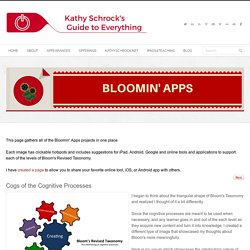
Cogs of the Cognitive Processes I began to think about the triangular shape of Bloom's Taxonomy and realized I thought of it a bit differently.Since the cognitive processes are meant to be used when necessary, and any learner goes in and out of the each level as they acquire new content and turn it into knowledge, I created a different type of image that showcased my thoughts about Bloom's more meaningfully.Here is my visual which showcases the interlocking nature of the cognitive processes or, simply, the "Cogs of the Cognitive Processes".
Readwritethink. Microsoft PowerPoint - Sprague_and_Sadler_OPBS_Final.ppt. Integrate iPads Into Bloom's Digital Taxonomy With This 'Padagogy Wheel' You’re going to want to turn on your printer and fire up a PDF viewer.
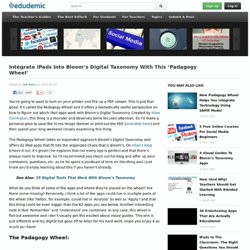
This is just that good. It’s called the Padagogy Wheel and it offers a fantastically useful perspecitve on how to figure out which iPad apps work with Bloom’s Digital Taxonomy. Created by Allan Carrington , this thing is a monster and deserves some focused attention. So I’d make a personal plea to save the hi-res image (below) or print out the PDF ( available here ) and then spend your long weekend closely examining this thing. The Padagogy Wheel takes an expanded approach Bloom’s Digital Taxonomy and offers 62 iPad apps that fit into the organized chaos that is Bloom’s.
Educational Technology and Mobile Learning: A Great Resource Sheet on How to Grow Your PLN on Twitter. Educational Technology and Mobile Learning: Everything Teachers Need to Know about Google Plus. Google Plus is turning two and it seems like we have been using it forever.

Blooming Orange: Bloom's Taxonomy Helpful Verbs Poster. Here’s another poster to help get you thinking about how you can apply Bloom’s higher-order thinking skills with your children. This poster shows the segments of an orange with each segment relating to a thinking skill and some helpful verbs to serve as prompts. While there are many more verbs that we could have added, we felt that including just seven in each segment would make them easier to remember (For more information, see Miller’s paper “The Magical Number Seven, Plus or Minus Two: Some Limits on Our Capacity for Processing Information.” We thought it would be interesting to depict the verbs in a circular form as opposed to a hierarchical list, given that these skills don’t often occur in isolation and are interconnected.
We went through several concepts including a wheel, a pie, and an apple, but somehow the orange seemed to work best when we put everything together. For those of you who prefer it, we’ve also created a grayscale version of the poster. Download the pdf’s here: Webb's Depth of Knowledge - QCSD Elementary Special Interest. Bloom+wheel.png 550×548 pixels. To Get Students Invested, Involve Them in Decisions Big and Small. By Matt Levinson When asked why he became a scientist, Nobel Laureate Isidor Rabi attributed his success to his mother.
Every day, she would ask him the same question about his school day: “Did you ask a good question today?” “Asking good questions – made me become a scientist!” Rabi said. Questions are critical, and how to manage and navigate a good question requires practice. The hardest part about using design thinking in class is getting the question right and staying in the question. For teachers, in designing learning experiences for students that are embedded with technology, the wording and focus of the question are paramount. [RELATED: For Students, Why the Question is More Important Than The Answer] “I’ve seen students with iPads and the novelty is there and the engagement is there, but it’s not clear that novelty and engagement will lead to increased academic achievement,” writes Stanford Education professor Larry Cuban In The LA Times. Online Reproducibles. Google Drive for Teachers with ‘How-to’ video links.
Edutopia: Teaching Critical Thinking and the CC. Reading%20Level%20Conversion%20chart. Events in Instruction- Event #8. CCSS. CCSS Videos - The Reading. Pathways to the Common Core: Videos from Inside Classrooms features almost 40 clips of Common-Core aligned teaching and learning. We captured these scenes of classroom teaching in an effort to help you imagine methods of teaching that can support students in moving towards the ambitious standards set by the Common Core. Watch videos of teaching aimed to help move students toward major aspects of the standards: Reading Literature Reading Informational Texts Opinion/Argument Writing Information Writing Narrative Writing Each clip includes critical commentary by a member of the Project staff and explains connections we see to the Common Core.
Our Students. Their Moment. CC Assessment: Formative, Summative, and Standardized. The Standards. Teacher Toolkit. Common Core: What Does My Child Need To Know? (Common Core Part 3) Common Core is the new national education objectives that are currently in 45 states*. Common Core: What Does My Child Need To Know? (Common Core Part 3) COMMON CORE STANDARDS ELA FIFTH GRADE CHECKLIST. Common Core State Standards Initiative. Appendix A.indd. Appendix_C. Sample Items and Performance Tasks. Common Core Toolkits for Principals. Developing a Collaborative Culture: From Command and Control to Collaborative Responsibility. Good people work in all these schools, as do people who want students to be successful, but some are more effective than others.
The difference is culture (see Figure 10.1). Teachers who work in strong, collaborative cultures behave differently from those who depend on administrators to create the conditions of their work. Dbrady3702. Jwilliams43. Flipped Learning. The Flipped Class for Administrators. John Mellencamp - Live By Request 2004. More teachers use blended learning to engage students. My First Week as a Principal. 10 Silent Disruptors Of Student Academic Performance - Louisville, KY. Welcome to edcampCapeCod! - Home. Sharing. Learning. Leading. What Does It Mean to be the Lead Learner? Tips for First Year Principals: Eight Ways to Make Your Mark. Teaching Channel: Videos, Lesson Plans and Other Resources for Teachers.
Parent-Teacher Conference Resources (Printables & Articles. Back to School- 2nd & 3rd Day. Launching-ww-shubitz-pd-on-090106-11-am. TOP TEN WAYS TO TURN YOUR CLASSROOM INTO A HOTBED OF ENTHUSIASTIC READERS by Megan Ginther and Holly Mueller. Home. Aimee buckner « TWO WRITING TEACHERS. What are Ralph Fletcher and Aimee Buckner Reading? Writer's Workshop Resources and Ideas. Anchor Charts. Middle School (5-8) Writer's Workshop / Peer Editing Lessonplans, homework, quizzes. Reading Workshop. Reader's Workshop.org. Authors Live. Famous People.