
How to Focus Attention in Adult Learning and E-learning. Studies show that focus is a key attribute for performance improvement and success in life.
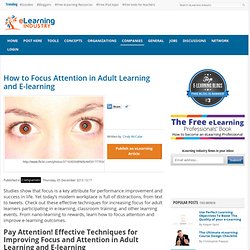
Yet today’s modern workplace is full of distractions, from text to tweets. Check out these effective techniques for increasing focus for adult learners participating in e-learning, classroom training, and other learning events. From nano-learning to rewards, learn how to focus attention and improve e-learning outcomes. Daniel Goleman, psychologist and author of the bestseller Emotional Intelligence, has just written a book called Focus: The Hidden Driver of Excellence. Goleman calls “attention” a “little-noticed and underrated mental asset,” which is essential to success in work, play, relationships, and self-awareness. How to Structure an eLearning Interaction. Whether you are designing an eLearning course or an instructor-led session, your solution will likely include a series of carefully-planned learning interactions.
These interactions should be closely tied to one of your instructional objectives: what learners should know, do, or believe after completing the activity. Jennifer Bertram I interviewed our Manager of Instructional Design, Jennifer Bertram, to learn more about what goes in to creating learning interactions. Our discussion focused almost exclusively on eLearning, as developing varied and effective interactions that work within a course can be quite the elusive task for would-be designers.
Jennifer had some great thoughts on how to get started with designing learning interactions, as well as suggestions on types of learning activities to consider. The Challenge: When designing interactions for eLearning, you are already at a bit of a disadvantage. 4 Steps to Creating a Portfolio of your eLearning Projects. This post provides four quick steps on how to create a winning eLearning portfolio.

If you already have a portfolio, use these steps to update it. Your next eLearning opportunity may hinge on an updated winning portfolio! 1. Locate all your eLearning samples Review your resume to recall all your eLearning projects. 2. While a good-looking sample is important, the story behind the sample seals the deal when you’re looking for work. Who was the client? What was the problem you solved? 3. Review your project samples and spreadsheet and then choose the best pieces for your portfolio. 4. Do a search on eLearning portfolios and choose the ones you like. If you don’t have a website, you could build a portfolio using an authoring tool. ¿Cómo integrar Tin Can API con Moodle? En el post anterior explicamos que es Tin Can API , como esta estructurado y cuales pueden ser sus usos. A continuación explicaremos como podemos integrar este estándar en una plataforma Moodle . Gracias a Tin Can API , todos podemos aprender en cualquier momento, medio o lugar, ya que nos permite crear una actividad , grabarla y registrarla cuando y donde se produzca el aprendizaje , por medio de los LRS (Learning Record Store).
Esta información es almacenada en la nube, pero ¿Como podemos gestionarla y generar informes desde nuestra plataforma Moodle ? La solución que nos propone Rustici Software para integrar Tin Can API con Moodle es SCORM Cloud . Tin Can Api ¿El futuro sustituto del SCORM? Tin Can Api ¿El futuro sustituto del SCORM?

Hace más de 10 años que el estandard SCORM, especialmente el SCORM 1.2, se ha tomado como estandard de elearning que se utiliza en las principales Plataformas de formación y cursos. La forma en que los alumnos aprenden en la red ha cambiado radicalmente, existen nuevos dispositivos (SmartPhones, tablets, etc..), nuevas formas de comunicarse (Redes sociales) y nuevas tecnologías (Realidad aumentada, códigos QR, etc..). 3 Chunking Strategies That Every Instructional Designer Should Know. One of the main concepts that leads to successful e-Learning course design is Information Chunking.

But what is chunking? Why is it embedded in the world of instructional design? And what kind of chunking strategies can an instructional designer use to enhance learning? Content chunking refers to the strategy of making a more efficient use of our short-term memory by organizing and grouping various pieces of information together. When information is chunked into groups, the brain can process them easier and faster, because our working memory can hold a limited amount of data at the same time. DESCUBRE LAS 10 TAXONOMÍAS TPACK. Laboratorios de investigación educativa y competencias del S.

XXI. Espacio de Fundación Telefónica en el que se desarrollan y validan propuestas didácticas que promueven la adquisición de CS21, implicando, de modo efectivo, al alumnado en su propio aprendizaje. Interactive Elements in E-Learning. We’ve all seen it…the “page-turner” style e-learning module that shows you slide after slide of text.

Sometimes the text may even be accompanied by a picture or some audio. Whatever the content, you find yourself hitting the “next” arrow as quickly as possible to avoid falling asleep entirely. Before entering the training and development field, I can tell you that this was something I had come to expect when I sat down for on-the-job training. However, I can see now that most instructional designers in the field are transitioning away from using a series of PowerPoint slides with bullet points and trying to find ways to add a level of interactivity to their learning solutions.
Interactivity is being discussed with words like “engagement” and “motivation.” Interactions don’t have to be elaborate to be effective I started my career working for animation and video game companies, so when I moved into training, I had preconceived notions about the difficulty of creating interactive content.