
Harvard Seeks to Jolt University Teaching - Teaching. By Dan Berrett Cambridge, Mass.
A growing body of evidence from the classroom, coupled with emerging research in cognitive psychology and neuroscience, is lending insight into how people learn, but teaching on most college campuses has not changed much, several speakers said here at Harvard University at a daylong conference dedicated to teaching and learning. Too often, faculty members teach according to habits and hunches, said Carl E. Wieman, a Nobel Prize-winning physicist and associate director of the White House Office of Science and Technology Policy, who has extensively studied how to improve science education. In large part, the problem is that graduate students pursuing their doctorates get little or no training in how students learn. "It really requires someone to be doubly expert," Mr. Such approaches would demand much more of students and faculty.
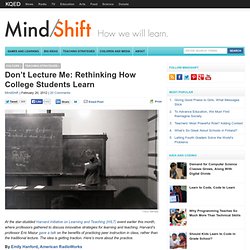
"We assume that telling people things without asking them to actively process them results in learning," Mr. Dont Lecture Me: Rethinking How College Students Learn. Flickr:AllHails At the star-studded Harvard Initiative on Learning and Teaching (HILT) event earlier this month, where professors gathered to discuss innovative strategies for learning and teaching, Harvard’s professor Eric Mazur gave a talk on the benefits of practicing peer instruction in class, rather than the traditional lecture.
The idea is getting traction. Here’s more about the practice. By Emily Hanford, American RadioWorks It’s a typical scene: a few minutes before 11:00 on a Tuesday morning and about 200 sleepy-looking college students are taking their seats in a large lecture hall – chatting, laughing, calling out to each other across the aisles. This is an introductory chemistry class at a state university.
Students in this class say the instructor is one of the best lecturers in the department. Student Marly Dainton says she doesn’t think she’ll remember much from this class. “I’m going to put it to short-term memory,” she says. One of the Oldest Teaching Methods Emily Hanford. U.S. Schoolchildren Don’t Make Grade on Reading, Math Tests. (Adds Education Secretary’s comment in sixth paragraph) Nov. 1 (Bloomberg) -- Only three in 10 U.S. schoolchildren make the grade in reading, the U.S.

Education Department said today. Four in 10 passed muster in math. About half of fourth-graders knew that a right triangle and a rectangle each had at least one right angle, according to a federal test, known as the Nation’s Report Card. On the 2011 National Assessment of Educational Progress, which measures fourth- and eighth-grade knowledge, scores rose from 2009 except in reading at the lower level. President Barack Obama and Congress are seeking to change No Child Left Behind, the nation’s main education law, which requires that all students pass state tests in math and reading by 2014 or risk losing federal money. David P. Almost all states give reading and math tests that are easier to pass than the federal exams, the Education Department said in an August study.
Achievement Gap In both cases, students performed at the “basic” level.