
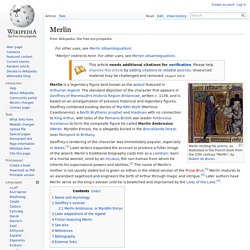
Merlin. Merlin reciting his poems, as illustrated in the French book from the 13th century "Merlin", by Robert de Boron.
Geoffrey's rendering of the character was immediately popular, especially in Wales.[1] Later writers expanded the account to produce a fuller image of the wizard. Merlin's traditional biography casts him as a cambion: born of a mortal woman, sired by an incubus, the non-human from whom he inherits his supernatural powers and abilities.[2] The name of Merlin's mother is not usually stated but is given as Adhan in the oldest version of the Prose Brut.[3] Merlin matures to an ascendant sagehood and engineers the birth of Arthur through magic and intrigue.[4] Later authors have Merlin serve as the king's advisor until he is bewitched and imprisoned by the Lady of the Lake.[4] Name and etymology[edit] The Enchanter Merlin, by Howard Pyle from The Story of King Arthur and His Knights. (1903) Geoffrey's sources[edit] Geoffrey's Prophetiae do not reveal much about Merlin's background.
List of Arthurian characters. King Arthur's family. King Arthur's family grew throughout the centuries with King Arthur's legend.

Several of the legendary members of this mythical king's family became leading characters of mythical tales in their own right. Welsh literature[edit] In Welsh Arthurian literature from before the time of Geoffrey of Monmouth's Historia Regum Britanniae (History of the Kings of Britain), Arthur was granted numerous relations and family members. Several early Welsh sources are usually taken as indicative of Uther Pendragon being known as Arthur's father before Geoffrey wrote, with Arthur also being granted a brother (Madog) and a nephew (Eliwlod) in these texts.[1] Arthur also appears to have been assigned a sister in this material – Gwalchmei is named as his sister-son (nephew) in Culhwch, his mother being one Gwyar.[2] Rachel Bromwich and D.
Simon Evans have observed that Culhwch and Olwen, the Vita Iltuti and the Brut Dingestow combine to suggest that Arthur had a mother too, named Eigyr.[3] off the face of ? King Arthur. Historical basis for King Arthur. The historical basis of King Arthur is a source of considerable debate among historians.

Due to the poverty of British records in the period 450-550 CE, historian Thomas Charles-Edwards noted that "at this stage of the enquiry, one can only say that there may well have been an historical Arthur [but …] the historian can as yet say nothing of value about him".[1] Historian David Dumville summed up his position by saying, "I think we can dispose of him [Arthur] quite briefly. He owes his place in our history books to a 'no smoke without fire' school of thought ...
The fact of the matter is that there is no historical evidence about Arthur; we must reject him from our histories and, above all, from the titles of our books. "[2] The name "Arthur"[edit] The name Artúr is frequently attested in southern Scotland and northern England in the 7th and 8th centuries.[5] For example, Artúr mac Conaing,[6] who may have been named after his uncle Artúr mac Áedáin. Early sources[edit]