
Edward Bulwer-Lytton, 1st Baron Lytton. Edward George Earle Lytton Bulwer-Lytton, 1st Baron Lytton PC (25 May 1803 – 18 January 1873), was an English novelist, poet, playwright, and politician.

He was immensely popular with the reading public and wrote a stream of bestselling novels which earned him a considerable fortune. He coined the phrases "the great unwashed",[1] "pursuit of the almighty dollar", "the pen is mightier than the sword", "dweller on the threshold", as well as the infamous opening line "It was a dark and stormy night".[2] Life[edit] Bulwer-Lytton was born on 25 May 1803 to General William Earle Bulwer of Heydon Hall and Wood Dalling, Norfolk and Elizabeth Barbara Lytton, daughter of Richard Warburton Lytton of Knebworth, Hertfordshire.
He had two elder brothers, William Earle Lytton Bulwer (1799–1877) and Henry (1801–1872), later Lord Dalling and Bulwer. When Edward was four his father died and his mother moved to London. He purchased a commission in the army, but sold it without serving. The pen is mightier than the sword. Richelieu; Or the Conspiracy (generally shortened to Richelieu) is an 1839 historical play by the British writer Edward Bulwer-Lytton.

It portrays the life of the Seventeenth Century French statesmen Cardinal Richelieu. The play has become best known for its line "The pen is mightier than the sword", spoken by the Cardinal in Act II, Scene II. The play formed the basis of a 1935 American film directed by Rowland V. Lee and starring George Arliss as Richelieu. It was produced by 20th Century Pictures. Alexandre Dumas. Prolific in several genres, Dumas began his career by writing plays, which were successfully produced from the first.

He also wrote numerous magazine articles and travel books; his published works totaled 100,000 pages.[2] In the 1840s, Dumas founded the Théâtre Historique in Paris. Dumas' father (general Thomas-Alexandre Davy de la Pailleterie) was born in Saint-Domingue (present-day Haiti) to a French nobleman and an enslaved African woman. His father's aristocratic rank helped young Alexandre acquire work with Louis-Philippe, Duke of Orléans.
In the election of Louis-Napoléon Bonaparte in 1851, Dumas fell from favor, and left France for Belgium, where he stayed for several years. Upon leaving Belgium, Dumas moved to Russia for a few years, before going to Italy. Divine Comedy. Walter Scott. Sir Walter Scott, 1st Baronet, FRSE (15 August 1771 – 21 September 1832) was a Scottish historical novelist, playwright, and poet.
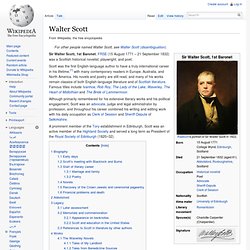
Although primarily remembered for his extensive literary works and his political engagement, Scott was an advocate, judge and legal administrator by profession, and throughout his career combined his writing and editing work with his daily occupation as Clerk of Session and Sheriff-Depute of Selkirkshire. Biography[edit] Early days[edit] Scott's meeting with Blacklock and Burns[edit] After completing his studies in law, he became a lawyer in Edinburgh. Emily Brontë. Emily Jane Brontë (/ˈbrɒnti/;[1][2] 30 July 1818 – 19 December 1848)[3] was an English novelist and poet, best remembered for her only novel, Wuthering Heights, now considered a classic of English literature.

Emily was the third eldest of the four surviving Brontë siblings, between the youngest Anne and her brother Branwell. She wrote under the pen name Ellis Bell. Early life and education[edit] The three Brontë sisters, in an 1834 painting by their brother Patrick Branwell. From left to right: Anne, Emily and Charlotte. After the death of their mother in September 1821 from cancer, when Emily was three years old,[9][10] the older sisters Maria, Elizabeth and Charlotte were sent to the Clergy Daughters' School at Cowan Bridge, where they encountered abuse and privations later described by Charlotte in Jane Eyre. The three remaining sisters and their brother Patrick Branwell were thereafter educated at home by their father and aunt Elizabeth Branwell, their mother's sister.
Jane Austen. Jane Austen (16 December 1775 – 18 July 1817) was an English novelist whose works of romantic fiction, set among the landed gentry, earned her a place as one of the most widely read writers in English literature.
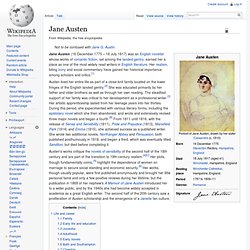
Her realism, biting irony and social commentary have gained her historical importance among scholars and critics.[1] Austen's works critique the novels of sensibility of the second half of the 18th century and are part of the transition to 19th-century realism.[4][C] Her plots, though fundamentally comic,[5] highlight the dependence of women on marriage to secure social standing and economic security.[6] Her works, though usually popular, were first published anonymously and brought her little personal fame and only a few positive reviews during her lifetime, but the publication in 1869 of her nephew's A Memoir of Jane Austen introduced her to a wider public, and by the 1940s she had become widely accepted in academia as a great English writer.