
Spirulina (dietary supplement) Spirulina tablets Spirulina is a cyanobacterium that can be consumed by humans and other animals and is made primarily from two species of cyanobacteria: Arthrospira platensis and Arthrospira maxima.
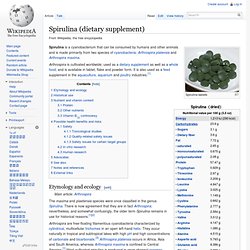
Arthrospira is cultivated worldwide; used as a dietary supplement as well as a whole food; and is available in tablet, flake and powder form. It is also used as a feed supplement in the aquaculture, aquarium and poultry industries.[1] Spirulina thives at a pH around 8.5 + , which will get more alkaline, and a temperature around 86 deg. F. Spirulina was a food source for the Aztecs and other Mesoamericans until the 16th century; the harvest from Lake Texcoco and subsequent sale as cakes were described by one of Cortés' soldiers.[6][7] The Aztecs called it "tecuitlatl".[3] Spirulina has also been traditionally harvested in Chad. Dried spirulina contains about 60% (51–71%) protein. The U.S. Spirulina is not considered to be a reliable source of Vitamin B12. Niacin. Niacin (also known as vitamin B3 and nicotinic acid) is an organic compound with the formula C 6H 5NO 2 and, depending on the definition used, one of the 20 to 80 essential human nutrients.
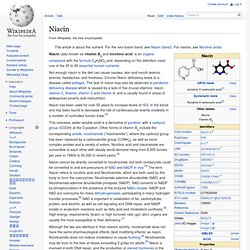
Not enough niacin in the diet can cause nausea, skin and mouth lesions, anemia, headaches, and tiredness. Chronic Niacin deficiency leads to a disease called pellagra. The lack of niacin may also be observed in pandemic deficiency disease which is caused by a lack of five crucial vitamins: niacin, vitamin C, thiamin, vitamin D and vitamin A, and is usually found in areas of widespread poverty and malnutrition. Niacin has been used for over 50 years to increase levels of HDL in the blood and has been found to decrease the risk of cardiovascular events modestly in a number of controlled human trials.[3] This colorless, water-soluble solid is a derivative of pyridine, with a carboxyl group (COOH) at the 3-position. Dietary needs[edit] Deficiency[edit] Therapeutic effects[edit] Niacin prescriptions[edit]
Riboflavin. A solution of riboflavin. Riboflavin is best known visually as the vitamin which imparts the orange color to solid B-vitamin preparations, the yellow color to vitamin supplement solutions, and the unusual fluorescent-yellow color to the urine of persons who supplement with high-dose B-complex preparations. Riboflavin can be used as a deliberate orange-red food color additive, and as such is designated in Europe as the E number E101.[3] Discovery[edit] Vitamin B was originally considered to have two components, a heat-labile vitamin B1 and a heat-stable vitamin B2. In the 1920s, vitamin B2 was thought to be the factor necessary for preventing pellagra. Further, the researchers noted that a yellow-green fluorescence in each extract promoted rat growth, and that the intensity of fluorescence was proportional to the effect on growth. Biochemical function[edit] Mechanism of action as cofactors and flavoproteins[edit] Riboflavin in food: occurrence, sources and stability[edit] Clinical uses[edit]
Thiamine. Thiamine or thiamin or vitamin B1 (/ˈθaɪ.əmɨn/ THY-ə-min), named as the "thio-vitamine" ("sulfur-containing vitamin") is a water-soluble vitamin of the B complex.
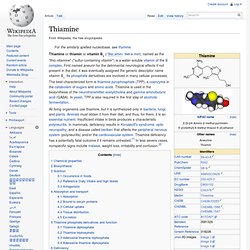
First named aneurin for the detrimental neurological effects if not present in the diet, it was eventually assigned the generic descriptor name vitamin B1. Its phosphate derivatives are involved in many cellular processes. The best-characterized form is thiamine pyrophosphate (TPP), a coenzyme in the catabolism of sugars and amino acids. Thiamine is used in the biosynthesis of the neurotransmitter acetylcholine and gamma-aminobutyric acid (GABA).
In yeast, TPP is also required in the first step of alcoholic fermentation. All living organisms use thiamine, but it is synthesized only in bacteria, fungi, and plants. Chemical properties[edit] Thiamine is a colorless organosulfur compound with a chemical formula C12H17N4OS. Biosynthesis[edit] Nutrition[edit] Occurrence in foods[edit] Reference Daily Intake and high doses[edit]