
Madonna of Chancellor Rolin. Detail of the Virgin's mantle.

The Madonna of Chancellor Rolin is an oil painting by the Early Netherlandish master Jan van Eyck, dating from around 1435. It is on display in the Musée du Louvre, Paris. The work was commissioned by the energetic Nicolas Rolin, chancellor of the Duchy of Burgundy, whose votive portrait takes up the left side of the picture, for his parish church, Notre-Dame-du-Chastel in Autun, where it remained until the church burnt down in 1793.
After a period in Autun Cathedral, it was moved to the Louvre in 1805. Description[edit] Detail of the angel. The interior has complex light sources, typical of van Eyck, with light coming both from the central portico and the side windows. As in other van Eycks, the depiction of the space is not as straightforward as it first appears. Alterations[edit] Infrared reflectograms have disclosed a number of changes from the underdrawing. The carvings above Rolin. Iconography[edit] See also[edit] Annunciation (van Eyck, Washington) The Annunciation is an oil painting by the Early Netherlandish master Jan van Eyck, from around 1434-1436.

It is in the National Gallery of Art, in Washington D.C. It was originally on panel but has been transferred to canvas. It is thought that it was the left (inner) wing of a triptych; there has been no sighting of the other wings since before 1817. It is a highly complex work, whose iconography is still debated by art historians. The picture depicts the Annunciation by the Archangel Gabriel to the Virgin Mary that she will bear the son of God (Luke 1:26-38). The setting develops this theme. The architecture moves from older, round Romanesque forms above, to (slightly) pointed Gothic arches below, with the higher levels largely in darkness, and the floor level well-lit.[7] The gloom of the Old Covenant is about to be succeeded by the light of the New Covenant.
Detail - Mary and Gabriel. Portrait of a Man (Self Portrait?) Portrait of a Man (Self Portrait?)

,[1] also often known as Portrait of a Man in a Turban, or in a red turban, etc., is an oil painting by the Early Netherlandish master Jan van Eyck, from 1433. It has been in the National Gallery, London since 1851, having been in England since Thomas Howard, 21st Earl of Arundel acquired it, probably during his exile in Antwerp from 1642-44.[2] The original frame survives (the vertical sides are in fact a single piece of wood with the central panel), and has the painted inscription JOHES DE EYCK ME FECIT ANO MCCCC.33. 21. OCTOBRIS ("Jan van Eyck Made Me on October 21, 1433") at the bottom and at the top the motto AlC IXH XAN ("I Do as I Can"), which appears on other van Eyck paintings, always written in Greek letters, and includes a pun on his name.
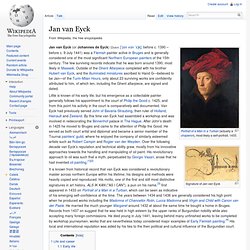
As on other van Eyck frames, the letters are painted to appear carved. Like all van Eyck's portraits, it shows a sharp and detailed analysis of the physical lines. Jan van Eyck. Signature of Jan van Eyck Jan van Eyck (or Johannes de Eyck) (Dutch: [ˈjɑn vɑn ˈɛjk]; before c. 1390 – before c. 9 July 1441) was a Flemish painter active in Bruges and is generally considered one of the most significant Northern European painters of the 15th century.
The few surviving records indicate that he was born around 1390, most likely in Maaseik. Outside of the Ghent Altarpiece completed with his brother Hubert van Eyck, and the illuminated miniatures ascribed to Hand G—believed to be Jan—of the Turin-Milan Hours, only about 23 surviving works are confidently attributed to him, of which ten, including the Ghent altarpiece, are signed and dated. Little is known of his early life, but his emergence as a collectable painter generally follows his appointment to the court of Philip the Good c. 1425, and from this point his activity in the court is comparatively well documented. Van Eyck had previously served John of Bavaria-Straubing, then ruler of Holland, Hainault and Zeeland.